• Product
  • Suppliers
  • Manufacturers
  • Solutions
  • Free tools
  • Knowledges
  • Experts
  • Communities
Search


The world's first 550 kV perfluoroisobutyronitrile (C4F7N) eco-friendly gas-insulated transmission line has been successfully commissioned.

Baker
Field: News
Engineer
4-6Year
Canada

Recently, the world’s first 550 kV perfluoroisobutyronitrile (C4F7N)-based eco-friendly gas-insulated transmission line, developed by a Chinese manufacturer specializing in environmentally friendly gas-insulated power transmission equipment, was officially commissioned at the 500 kV Rongsheng Substation in Anqing, Anhui Province. This milestone marks another major breakthrough for China in the field of eco-friendly power equipment.

For decades, sulfur hexafluoride (SF₆) has been widely used in the power industry due to its excellent insulation and arc-quenching properties. However, SF₆ has a global warming potential (GWP) 24,300 times greater than that of carbon dioxide, posing significant environmental concerns. As a result, policies restricting or phasing out SF₆ emissions have been introduced both domestically and internationally. 

Against this backdrop, finding an environmentally sustainable alternative to SF₆ has become a critical task in building a green, low-carbon next-generation power system. Perfluoroisobutyronitrile (C4F7N) has emerged as the leading SF₆ replacement gas globally, demonstrating outstanding performance in terms of low global warming potential, low-temperature operability, high dielectric strength, chemical stability, and non-flammability.
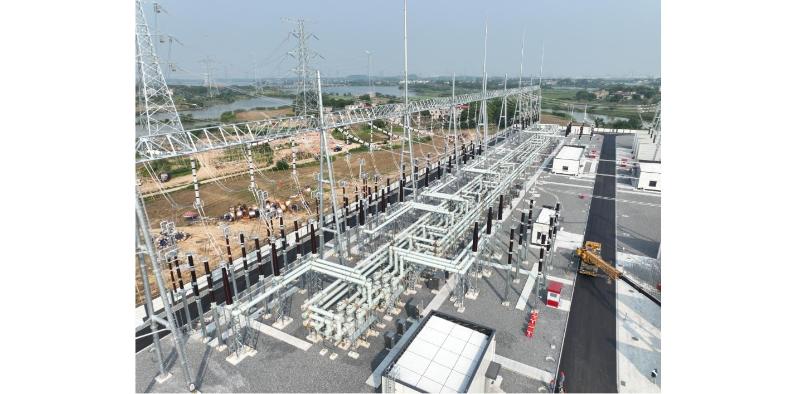
550 kV Perfluoroisobutyronitrile Environmentally Friendly Gas-Insulated Transmission Line.jpg

In active response to China’s national “Dual Carbon” goals (carbon peak and carbon neutrality) and to accelerate the green transformation of power equipment, the Chinese manufacturer launched the scientific and technological project “Key Technologies and Application of Ultra-High-Voltage Eco-Friendly Gas-Insulated Transmission Lines.” The project successfully overcame core technical challenges related to insulation design and temperature rise in transmission line equipment using C4F7N-based eco-friendly gas, resulting in the successful development of the 550 kV C4F7N gas-insulated transmission line. 

Compared to conventional SF₆-based systems, this new solution reduces greenhouse gas impact by 97%. Moreover, it achieves “identical dimensions, identical structure, and identical parameters” compared to standard 550 kV SF₆ gas-insulated transmission lines and remains compatible with both pure SF₆ and SF₆/N₂ gas mixtures. This provides a practical green upgrade path for both retrofitting existing substations and constructing new ones, significantly advancing the eco-friendly transformation of China’s power transmission and transformation infrastructure.

The world-first commissioning of this 550 kV C4F7N eco-friendly gas-insulated transmission line holds profound significance. It offers the power industry a replicable and scalable green alternative, delivers strong technical support for building a new-type power system, and makes a meaningful contribution toward achieving China’s “Dual Carbon” targets.
Give a tip and encourage the author!

Recommended

Faults and Handling of Single-phase Grounding in 10kV Distribution Lines
Characteristics and Detection Devices for Single-Phase Ground Faults1. Characteristics of Single-Phase Ground FaultsCentral Alarm Signals:The warning bell rings, and the indicator lamp labeled “Ground Fault on [X] kV Bus Section [Y]” illuminates. In systems with a Petersen coil (arc suppression coil) grounding the neutral point, the “Petersen Coil Operated” indicator also lights up.Insulation Monitoring Voltmeter Indications:The voltage of the faulted phase decreases (in
01/30/2026
Neutral point grounding operation mode for 110kV~220kV power grid transformers
The arrangement of neutral point grounding operation modes for 110kV~220kV power grid transformers shall meet the insulation withstand requirements of transformer neutral points, and shall also strive to keep the zero-sequence impedance of substations basically unchanged, while ensuring that the zero-sequence comprehensive impedance at any short-circuit point in the system does not exceed three times the positive-sequence comprehensive impedance.For 220kV and 110kV transformers in new constructi
01/29/2026
Why Do Substations Use Stones, Gravel, Pebbles, and Crushed Rock?
Why Do Substations Use Stones, Gravel, Pebbles, and Crushed Rock?In substations, equipment such as power and distribution transformers, transmission lines, voltage transformers, current transformers, and disconnect switches all require grounding. Beyond grounding, we will now explore in depth why gravel and crushed stone are commonly used in substations. Though they appear ordinary, these stones play a critical safety and functional role.In substation grounding design—especially when multiple gr
01/29/2026
Why Must a Transformer Core Be Grounded at Only One Point? Isn't Multi-Point Grounding More Reliable?
Why Does the Transformer Core Need to Be Grounded?During operation, the transformer core, along with the metal structures, parts, and components that fix the core and windings, are all situated in a strong electric field. Under the influence of this electric field, they acquire a relatively high potential with respect to ground. If the core is not grounded, a potential difference will exist between the core and the grounded clamping structures and tank, which may lead to intermittent discharge.I
01/29/2026
Send inquiry
+86
Click to upload file
Download
Get the IEE Business Application
Use the IEE-Business app to find equipment, obtain solutions, connect with experts, and participate in industry collaboration anytime, anywhere—fully supporting the development of your power projects and business.