• Product
  • Suppliers
  • Manufacturers
  • Solutions
  • Free tools
  • Knowledges
  • Experts
  • Communities
Search


Discharging a Capacitor (Formula And Graphs)

Electrical4u
Field: Basic Electrical
0
China

What is Discharging a Capacitor?

Discharging a capacitor means releasing the charge stored within the capacitor. Let’s go over an example where a capacitor is discharged.

We connect a charged capacitor of capacitance C farad in series with a resistor of resistance R ohms.

We then short circuit this series combination by switching on the push switch as shown.
discharging a capacitor
As soon as the capacitor is short-circuited, it starts discharging.

Let us assume, the voltage of the capacitor at fully charged condition is V volt. As soon as the capacitor is short-circuited, the discharging current of the circuit would be – V / R ampere.

But after the instant of switching on that is at t = +0, the current through the circuit is

As per Kirchhoff’s Voltage Law, we get,
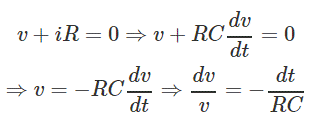
Integrating both sides, we get,

Where, A is the constant of integration and, at t = 0, v = V,
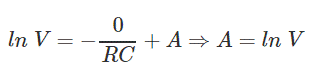
After calculating the value of A, we get,
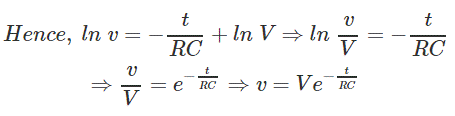
We know the form, KVL of the circuit,
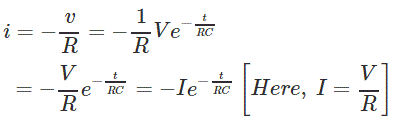
If we plot these discharging current and voltage in the graph, we get,
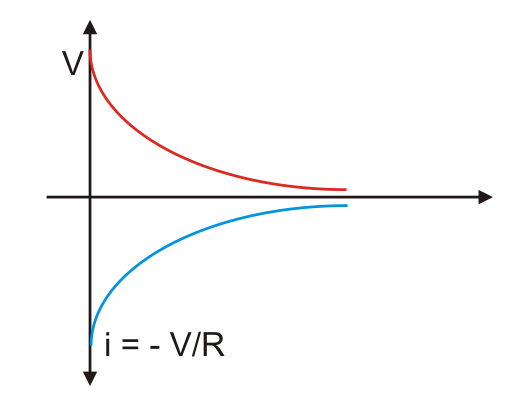
discharging a capacitor
Hence the capacitor current exponentially reaches zero from its initial value, and the capacitor voltage reaches exponentially to zero from its initial value during discharging.

Source: Electrical4u.

Statement: Respect the original, good articles worth sharing, if there is infringement please contact delete.
Give a tip and encourage the author!

Recommended

Revolutionary 550 kV Capacitor-Free Arc-Quenching Circuit Breaker Debuts in China
Recently, a Chinese high-voltage circuit breaker manufacturer, in collaboration with numerous renowned enterprises, successfully developed a 550 kV capacitor-free arc-quenching chamber circuit breaker, which has passed the full suite of type tests on its first attempt. This achievement marks a revolutionary breakthrough in the interrupting performance of circuit breakers at the 550 kV voltage level, effectively resolving the long-standing “bottleneck” issue caused by reliance on imported capacit
11/17/2025
Why Capacitor Bank Isolators Overheat & How to Fix
Causes of High Temperature in Isolating Switches of Capacitor Banks and Corresponding SolutionsI. Causes: OverloadThe capacitor bank is operating beyond its designed rated capacity. Poor ContactOxidation, loosening, or wear at contact points increases contact resistance. High Ambient TemperatureElevated external environmental temperatures impair the switch’s ability to dissipate heat. Inadequate Heat DissipationPoor ventilation or dust accumulation on heat sinks hinders effective cooling. Harmon
11/08/2025
Voltage Imbalance: Ground Fault, Open Line, or Resonance?
Single-phase grounding, line break (open-phase), and resonance can all cause three-phase voltage unbalance. Correctly distinguishing among them is essential for rapid troubleshooting.Single-Phase GroundingAlthough single-phase grounding causes three-phase voltage unbalance, the line-to-line voltage magnitude remains unchanged. It can be classified into two types: metallic grounding and non-metallic grounding. Inmetallic grounding, the faulted phase voltage drops to zero, while the other two phas
11/08/2025
Vacuum Circuit Breakers for Capacitor Bank Switching
Reactive Power Compensation and Capacitor Switching in Power SystemsReactive power compensation is an effective means to increase system operating voltage, reduce network losses, and improve system stability.Conventional Loads in Power Systems (Impedance Types): Resistance Inductive reactance Capacitive reactanceInrush Current During Capacitor EnergizationIn power system operation, capacitors are switched in to improve power factor. At the moment of closing, a large inrush current is generated.
10/18/2025
Related Products
Send inquiry
+86
Click to upload file
Download
Get the IEE Business Application
Use the IEE-Business app to find equipment, obtain solutions, connect with experts, and participate in industry collaboration anytime, anywhere—fully supporting the development of your power projects and business.