
• Product
  • Suppliers
  • Manufacturers
  • Solutions
  • Free tools
  • Knowledges
  • Experts
  • Communities
Search


What is the difference between a star connected motor and a delta connected motor?

Encyclopedia
Field: Encyclopedia
0
China

Differences Between Star (Y) Connection and Delta (Δ) Connection in Motors

Star connection (Y-connection) and delta connection (Δ-connection) are two common wiring methods used in three-phase motors. Each connection method has its unique characteristics and applications. Here are the main differences between star and delta connections:

1. Connection Method

Star Connection (Y-Connection)

Definition: In a star connection, the ends of the three windings are connected together to form a common point (neutral point), while the starting points are connected to the three phase lines of the power supply.

Diagram:

4b8d9fae94a1e9a5623db2057c72ebe1.jpeg

Delta Connection (Δ-Connection)

Definition: In a delta connection, one end of each winding is connected to one end of another winding, forming a closed triangular loop.

Diagram:

54e59e6b01ae99c5e8471612701ed44e.jpeg

2. Voltage and Current

Star Connection

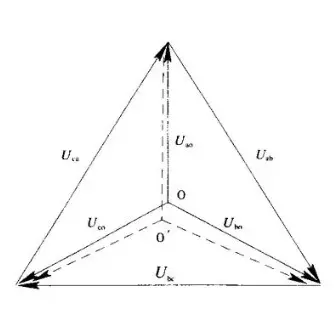
Line Voltage (VL) and Phase Voltage (Vph):

bfe9451bf8385e918395e8ce1151aa40.jpeg

Delta Connection

6ed97f57a27942f344006e69c9f2c71a.jpeg

3. Power and Efficiency

Star Connection

Power: Power in a star connection

cba3c30d944102c764f0679504a2fdd7.jpeg

Efficiency: Star connection is typically used in low-power and low-voltage applications because the phase voltage is lower, and the current is lower, reducing copper and iron losses.

Delta Connection

Power: Power in a delta connection

aa12951284b8074adec4196fadb9ac7d.jpeg

Efficiency: Delta connection is suitable for high-power and high-voltage applications because the phase voltage equals the line voltage, and the current is higher, providing higher output power.

4. Starting Characteristics

Star Connection

Starting Current: The starting current in a star connection is lower because the phase voltage is lower, resulting in less current surge during startup.

Starting Torque: Starting torque is relatively low but sufficient for light or medium loads.

Delta Connection

Starting Current: The starting current in a delta connection is higher because the phase voltage equals the line voltage, resulting in a larger current surge during startup.

Starting Torque: Starting torque is higher, suitable for heavy loads.

5. Applications

Star Connection

Applicable Occasions: Suitable for low-power and low-voltage applications, such as small motors and household appliances.

Advantages: Lower starting current, moderate starting torque, suitable for light or medium loads.

Delta Connection

Applicable Occasions: Suitable for high-power and high-voltage applications, such as large industrial motors, pumps, and fans.

Advantages: Higher starting torque, suitable for heavy loads, higher output power.

Summary

Both star connection and delta connection have their own advantages and disadvantages, and the choice of which to use depends on the specific application requirements. Star connection is suitable for low-power and light-load applications, while delta connection is suitable for high-power and heavy-load applications. Understanding the characteristics and differences of these two connection methods helps in selecting the appropriate motor wiring method to optimize system performance.
Give a tip and encourage the author!

Recommended

Why Must a Transformer Core Be Grounded at Only One Point? Isn't Multi-Point Grounding More Reliable?
Why Does the Transformer Core Need to Be Grounded?During operation, the transformer core, along with the metal structures, parts, and components that fix the core and windings, are all situated in a strong electric field. Under the influence of this electric field, they acquire a relatively high potential with respect to ground. If the core is not grounded, a potential difference will exist between the core and the grounded clamping structures and tank, which may lead to intermittent discharge.I
01/29/2026
Understanding Transformer Neutral Grounding
I. What is a Neutral Point?In transformers and generators, the neutral point is a specific point in the winding where the absolute voltage between this point and each external terminal is equal. In the diagram below, pointOrepresents the neutral point.II. Why Does the Neutral Point Need Grounding?The electrical connection method between the neutral point and earth in a three-phase AC power system is called theneutral grounding method. This grounding method directly affects:The safety, reliabilit
01/29/2026
Voltage Imbalance: Ground Fault, Open Line, or Resonance?
Single-phase grounding, line break (open-phase), and resonance can all cause three-phase voltage unbalance. Correctly distinguishing among them is essential for rapid troubleshooting.Single-Phase GroundingAlthough single-phase grounding causes three-phase voltage unbalance, the line-to-line voltage magnitude remains unchanged. It can be classified into two types: metallic grounding and non-metallic grounding. Inmetallic grounding, the faulted phase voltage drops to zero, while the other two phas
11/08/2025
Composition and Working Principle of Photovoltaic Power Generation Systems
Composition and Working Principle of Photovoltaic (PV) Power Generation SystemsA photovoltaic (PV) power generation system is primarily composed of PV modules, a controller, an inverter, batteries, and other accessories (batteries are not required for grid-connected systems). Based on whether it relies on the public power grid, PV systems are divided into off-grid and grid-connected types. Off-grid systems operate independently without relying on the utility grid. They are equipped with energy-s
10/09/2025
Send inquiry
+86
Click to upload file
Download
Get the IEE Business Application
Use the IEE-Business app to find equipment, obtain solutions, connect with experts, and participate in industry collaboration anytime, anywhere—fully supporting the development of your power projects and business.