• Product
  • Suppliers
  • Manufacturers
  • Solutions
  • Free tools
  • Knowledges
  • Experts
  • Communities
Search


Analysis of Common Faults and Causes in Routine Inspection of Distribution Transformers

Felix Spark
Field: Failure and maintenance
China

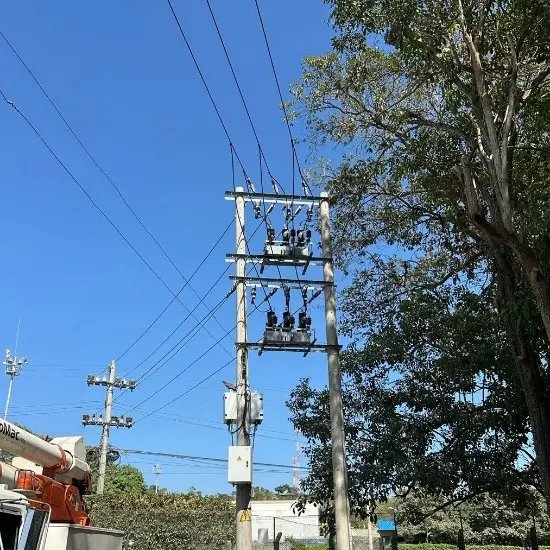
Common Faults and Causes in Routine Inspection of Distribution Transformers

As the terminal component of power transmission and distribution systems, distribution transformers play a critical role in supplying reliable electricity to end users. However, many users have limited knowledge of power equipment, and routine maintenance is often carried out without professional support. If any of the following conditions are observed during transformer operation, immediate action should be taken:

  • Excessively high temperature or abnormal noise:This may result from prolonged overload operation, high ambient temperature, cooling system failure, or—in the case of oil-immersed transformers—oil leakage leading to insufficient oil level.

  • Vibration, unusual sounds, or discharge noises:Possible causes include overvoltage, significant frequency fluctuations, loose fasteners, insecure core clamping, poor grounding (causing discharges), or surface contamination on bushings/insulators leading to partial spark discharges.

  • Abnormal odors:These may stem from overheated and poorly connected terminals on bushings, burnt-out fans or oil pumps emitting a burning smell, or ozone generated by corona discharge or flashover.

  • Oil level significantly below normal:This could be due to oil leakage from poor tank welds or a malfunctioning oil-level gauge that fails to display the correct level.

  • Gas present in the gas chamber of the Buchholz relay or relay tripping:This is typically caused by partial discharges, abnormal core conditions, or overheating of conductive components inside the transformer.

  • Ruptured explosion-proof diaphragm or signs of discharge on the pressure relief device:Usually triggered by Buchholz or differential relay operations, indicating serious internal faults.

  • Cracks or discharge marks on bushings or porcelain insulators:Likely caused by overvoltage leading to insulation breakdown or mechanical damage from external forces.

Prompt identification and resolution of these issues during routine inspections are essential to ensure safe, stable, and efficient operation of distribution transformers.
Give a tip and encourage the author!
Recommended
HECI GCB for Generators – Fast SF6 Circuit Breaker
1.Definition and Function1.1 Role of the Generator Circuit BreakerThe Generator Circuit Breaker (GCB) is a controllable disconnect point located between the generator and the step-up transformer, serving as an interface between the generator and the power grid. Its primary functions include isolating generator-side faults and enabling operational control during generator synchronization and grid connection. The operating principle of a GCB is not significantly different from that of a standard c
01/06/2026
How to Test Insulation Resistance of Distribution Transformers
In practical work, insulation resistance of distribution transformers is generally measured twice: the insulation resistance between thehigh-voltage (HV) windingand thelow-voltage (LV) winding plus the transformer tank, and the insulation resistance between theLV windingand theHV winding plus the transformer tank.If both measurements yield acceptable values, it indicates that the insulation among the HV winding, LV winding, and transformer tank is qualified. If either measurement fails, pairwise
12/25/2025
Design Principles for Pole-Mounted Distribution Transformers
Design Principles for Pole-Mounted Distribution Transformers(1) Location and Layout PrinciplesPole-mounted transformer platforms should be located near the load center or close to critical loads, following the principle of “small capacity, multiple locations” to facilitate equipment replacement and maintenance. For residential power supply, three-phase transformers may be installed nearby based on current demand and future growth projections.(2) Capacity Selection for Three-Phase Pole-Mounted Tr
12/25/2025
Transformer Noise Control Solutions for Different Installations
1.Noise Mitigation for Ground-Level Independent Transformer RoomsMitigation Strategy:First, conduct a power-off inspection and maintenance of the transformer, including replacing aged insulating oil, checking and tightening all fasteners, and cleaning dust from the unit.Second, reinforce the transformer foundation or install vibration isolation devices—such as rubber pads or spring isolators—selected based on the severity of vibration.Finally, strengthen sound insulation at weak points of the ro
12/25/2025
Related Products
Send inquiry
Download
Get the IEE Business Application
Use the IEE-Business app to find equipment, obtain solutions, connect with experts, and participate in industry collaboration anytime, anywhere—fully supporting the development of your power projects and business.