• Product
  • Suppliers
  • Manufacturers
  • Solutions
  • Free tools
  • Knowledges
  • Experts
  • Communities
Search


What Are Combined Transformer Standards? Key Specs & Tests

Edwiin
Field: Power switch
China

Combined Instrument Transformers: Technical Requirements and Testing Standards Explained with Data

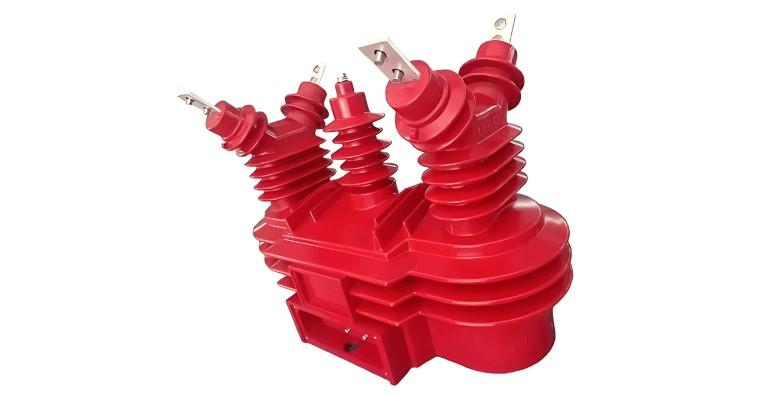
A combined instrument transformer integrates a voltage transformer (VT) and a current transformer (CT) into a single unit. Its design and performance are governed by comprehensive standards covering technical specifications, testing procedures, and operational reliability.

1. Technical Requirements

Rated Voltage:
The primary rated voltages include 3kV, 6kV, 10kV, and 35kV, among others. The secondary voltage is typically standardized at 100V or 100/√3 V. For example, in a 10kV system, the primary rated voltage of the combined transformer is 10kV, while the secondary output is 100V—meeting both measurement and protection requirements.

Rated Current Ratio:
The CT section offers various rated current ratios such as 50/5, 100/5, and 200/5. These ratios can be selected based on actual system current levels to accurately transform primary current to the secondary side (typically 5A), ensuring precise monitoring and relay protection operation.

2. Testing Standards

Insulation Tests:
These verify the dielectric strength of the transformer under normal and transient overvoltage conditions.

  • Power Frequency Withstand Test:
    For a 10kV combined transformer, the test voltage is typically 42kV RMS, applied for 1 minute. This ensures the insulation can withstand sustained power-frequency overvoltages during service.

  • Impulse Withstand Test:
    The peak impulse voltage is generally 75kV, simulating lightning surge conditions. This test evaluates the transformer’s ability to endure transient overvoltages without breakdown.

Accuracy (Error) Tests:
Strict error limits are defined based on accuracy classes.
CT VT.jpg

  • Voltage Transformer (0.2 Class):
    At rated voltage, the ratio error must not exceed ±0.2%, and the phase angle error must be within ±10 minutes (′).

  • Current Transformer (0.2S Class):
    Over a wide range from 1% to 120% of rated current, the ratio error remains within approximately ±0.2%, with tightly controlled phase angle error. This high accuracy is essential for metering applications, especially under low-load conditions.

Temperature Rise Test:
This test ensures safe long-term operation under full load.

  • Conducted at rated load and specified ambient temperature (usually 40°C), the average winding temperature rise must not exceed 65K. This limit prevents insulation degradation and ensures reliable performance over the transformer’s service life.

Summary

Combined instrument transformers are engineered to meet rigorous international standards (such as IEC 61869 series and GB/T 20840). Their technical parameters—like 10kV primary voltage, 100V secondary output, and 100/5 current ratio—are selected based on system requirements. Compliance with tests including 42kV power frequency, 75kV impulse withstand, ±0.2% accuracy, and 65K temperature rise guarantees safety, precision, and durability in power systems.
Give a tip and encourage the author!

Recommended

Faults and Handling of Single-phase Grounding in 10kV Distribution Lines
Characteristics and Detection Devices for Single-Phase Ground Faults1. Characteristics of Single-Phase Ground FaultsCentral Alarm Signals:The warning bell rings, and the indicator lamp labeled “Ground Fault on [X] kV Bus Section [Y]” illuminates. In systems with a Petersen coil (arc suppression coil) grounding the neutral point, the “Petersen Coil Operated” indicator also lights up.Insulation Monitoring Voltmeter Indications:The voltage of the faulted phase decreases (in
01/30/2026
Neutral point grounding operation mode for 110kV~220kV power grid transformers
The arrangement of neutral point grounding operation modes for 110kV~220kV power grid transformers shall meet the insulation withstand requirements of transformer neutral points, and shall also strive to keep the zero-sequence impedance of substations basically unchanged, while ensuring that the zero-sequence comprehensive impedance at any short-circuit point in the system does not exceed three times the positive-sequence comprehensive impedance.For 220kV and 110kV transformers in new constructi
01/29/2026
Why Do Substations Use Stones, Gravel, Pebbles, and Crushed Rock?
Why Do Substations Use Stones, Gravel, Pebbles, and Crushed Rock?In substations, equipment such as power and distribution transformers, transmission lines, voltage transformers, current transformers, and disconnect switches all require grounding. Beyond grounding, we will now explore in depth why gravel and crushed stone are commonly used in substations. Though they appear ordinary, these stones play a critical safety and functional role.In substation grounding design—especially when multiple gr
01/29/2026
Why Must a Transformer Core Be Grounded at Only One Point? Isn't Multi-Point Grounding More Reliable?
Why Does the Transformer Core Need to Be Grounded?During operation, the transformer core, along with the metal structures, parts, and components that fix the core and windings, are all situated in a strong electric field. Under the influence of this electric field, they acquire a relatively high potential with respect to ground. If the core is not grounded, a potential difference will exist between the core and the grounded clamping structures and tank, which may lead to intermittent discharge.I
01/29/2026
Send inquiry
+86
Click to upload file
Download
Get the IEE Business Application
Use the IEE-Business app to find equipment, obtain solutions, connect with experts, and participate in industry collaboration anytime, anywhere—fully supporting the development of your power projects and business.