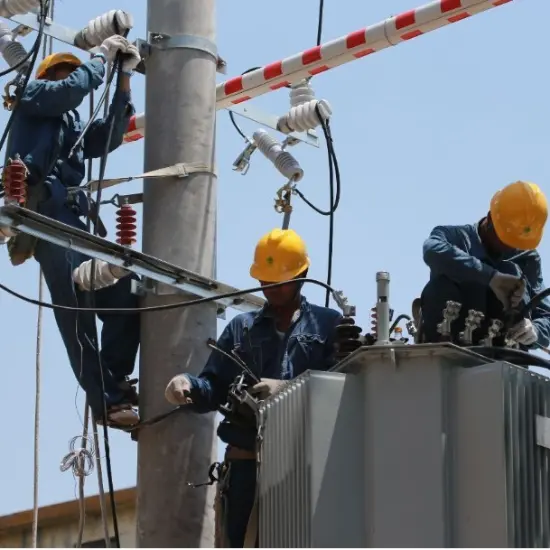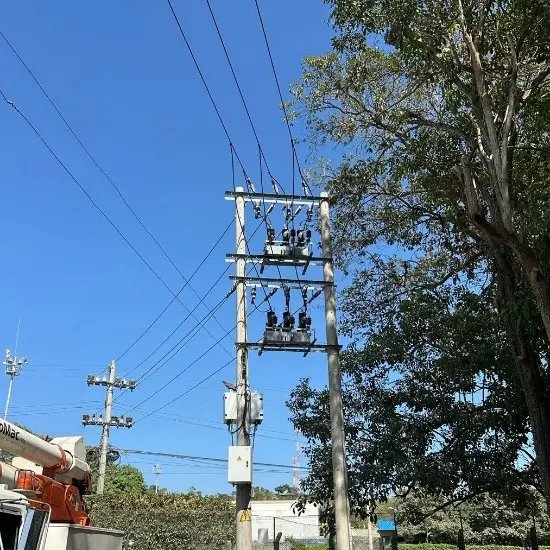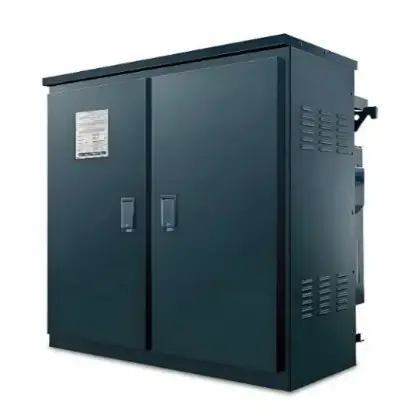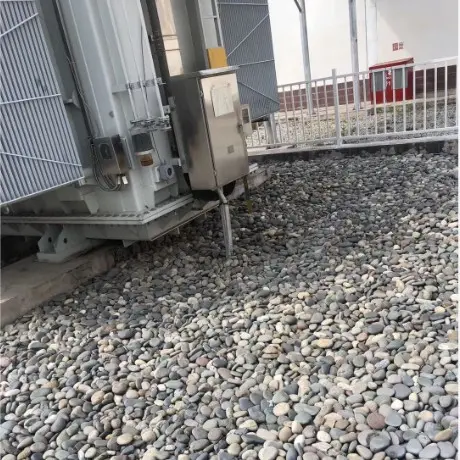
Substations designed for voltage levels ranging from 55 kV to 765 kV are known as outdoor substations. This type of substation requires less construction time but occupies more space. Outdoor substations are mainly divided into pole-mounted substations and foundation-mounted substations.
Pole-Mounted Substations
This type of substation is used to support distribution transformers with capacities up to 250 kVA. Such transformers represent the cheapest, simplest, and smallest form of distribution. All equipment is of outdoor type and installed on the supporting structures of high-voltage distribution lines. A three-pole mechanically operated switch is used to open and close the high-voltage transmission line.
High-tension (HT) fuses are used to protect the high-voltage transmission line. For controlling the low-voltage circuit, low-voltage switches and fuses are provided. Surge arresters are installed on the high-voltage lines to protect the transformer from voltage surges. Pole-mounted substations are grounded at two or more locations.
Transformers with capacities up to 125 kVA are mounted on a two-pole structure, while transformers rated between 125 kVA and 250 kVA are installed on a four-pole structure with an appropriate platform. This type of substation is typically placed in densely populated areas.
They have low maintenance costs, and by deploying a large number of such substations in towns, it is expected that distribution networks can be established at lower cost. However, as the number of transformers increases, the total kVA increases, but load losses do not rise proportionally, leading to an increase in cost per kVA.
Foundation-Mounted Substations
In foundation-mounted substations, all equipment areas are assembled for safety purposes, and the entire substation is enclosed within a fence. The equipment used in such substations is heavy; therefore, the selected site must have good access for heavy transportation.
Advantages of Outdoor Substations
Outdoor substations offer the following main advantages:
All equipment in an outdoor substation is visible, making fault location easier.
Expansion of outdoor substations is simpler.
Construction time required for this type of substation is shorter.
Less construction material—such as steel and concrete—is needed.
Relatively less construction work is required, and the cost of installing switchgear is low.
Maintenance is easy, and adequate spacing between equipment ensures that a fault at one point does not propagate to another.
Disadvantages of Outdoor Substations
Outdoor substations require more space.
Protective devices must be installed to guard against lightning surge effects.
The length of control cables increases, raising the overall cost of the substation.
Equipment designed for outdoor substations is more expensive because it requires additional dust and weather protection.
Despite these disadvantages, outdoor substations are widely used in power systems.