• Product
  • Suppliers
  • Manufacturers
  • Solutions
  • Free tools
  • Knowledges
  • Experts
  • Communities
Search


Boiler Economizer: What is it? (Function & Construction)

Electrical4u
Field: Basic Electrical
0
China

WechatIMG1836.jpeg

What Does an Economizer Do in a Boiler

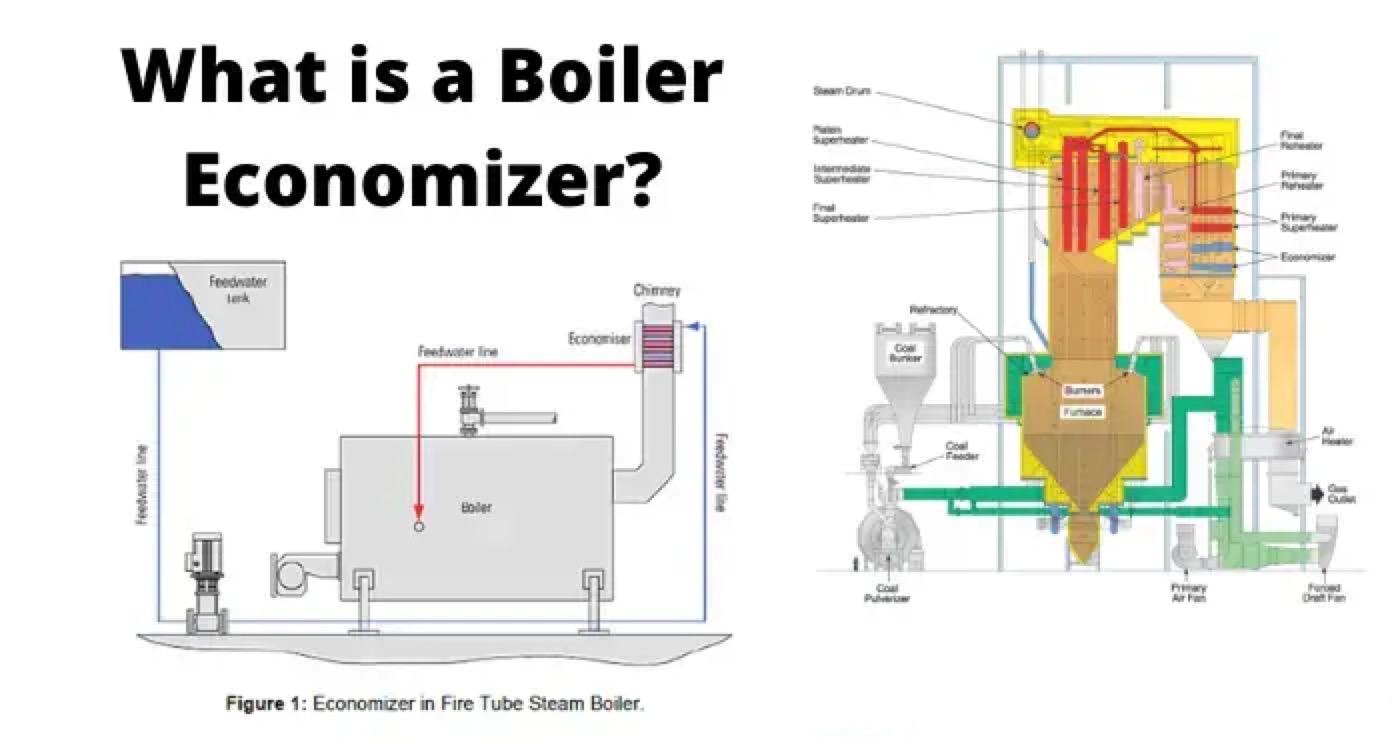
A boiler economizer (also known as an economizer) are mechanical devices intended to reduce energy consumption or perform a useful function such as preheating a fluid. A boiler economizer is essentially a heat exchanger that makes a system more energy efficient by taking enthalpy in fluid streams that are hot, but not hot enough to be used in a boiler – hence recovering more useful enthalpy and improving the steam boiler’s efficiency.

After producing steam, flue gas comes out from the system (flue gas is the gas exiting to the atmosphere via a flue). Some heat energy remains in the flue gas when it goes out. If we cannot utilize this heat energy, it gets lost. Boiler economizer is a device that uses a portion this remained energy of the flue gas to heat up inlet water (feed water) to the boiler. Since the heat energy is given to the water before it gets fed to the boiler, the requirement of fuel for producing steam is optimized. Because of that, we call this device as an economizer.

Construction and Working Principle of Boiler Economizer

The construction and working principle of the boiler economizer is simple. At the bottom part, it has a horizontal inlet pipe through which we feed water with normal temperature to the economizer. There is another horizontal pipe fitted at the top of the economizer.

These two horizontal pipes, which are bottom and top pipes connected through a group of vertical pipes. There is an outlet valve fitted on the top horizontal pipe to supply hot water to the boiler. The flue gases from the boiler furnace flow through the vertical pipes of the economizer.


Boiler Economiser


Here, the flue gases transfer remain heat to the water through the surface of the vertical pipe when the water goes up through the vertical pipes to top horizontal pipe. In this way heat of the flue gases gets utilized through the economizer for heating up the water before entering into the boiler for producing steam.

The flue gas will have ash particles mixed with it which will get deposited on vertical pipe surfaces. If special care is not taken there will be a thick layer of soot on the surfaces which insulate the heat to enter the water.

To remove this soot, the scraper is attached to each vertical pipe which continuously moves up and down by means of a chain pulley system. By scraping the soot fall down to the soot chamber placed at the bottom of the economizer. Then we collect the soot from the soot chamber. This is how a boiler economizer works. This is a very simple form of boiler economizer.

Statement: Respect the original, good articles worth sharing, if there is infringement please contact delete.
Give a tip and encourage the author!

Recommended

Faults and Handling of Single-phase Grounding in 10kV Distribution Lines
Characteristics and Detection Devices for Single-Phase Ground Faults1. Characteristics of Single-Phase Ground FaultsCentral Alarm Signals:The warning bell rings, and the indicator lamp labeled “Ground Fault on [X] kV Bus Section [Y]” illuminates. In systems with a Petersen coil (arc suppression coil) grounding the neutral point, the “Petersen Coil Operated” indicator also lights up.Insulation Monitoring Voltmeter Indications:The voltage of the faulted phase decreases (in
01/30/2026
Neutral point grounding operation mode for 110kV~220kV power grid transformers
The arrangement of neutral point grounding operation modes for 110kV~220kV power grid transformers shall meet the insulation withstand requirements of transformer neutral points, and shall also strive to keep the zero-sequence impedance of substations basically unchanged, while ensuring that the zero-sequence comprehensive impedance at any short-circuit point in the system does not exceed three times the positive-sequence comprehensive impedance.For 220kV and 110kV transformers in new constructi
01/29/2026
Why Do Substations Use Stones, Gravel, Pebbles, and Crushed Rock?
Why Do Substations Use Stones, Gravel, Pebbles, and Crushed Rock?In substations, equipment such as power and distribution transformers, transmission lines, voltage transformers, current transformers, and disconnect switches all require grounding. Beyond grounding, we will now explore in depth why gravel and crushed stone are commonly used in substations. Though they appear ordinary, these stones play a critical safety and functional role.In substation grounding design—especially when multiple gr
01/29/2026
HECI GCB for Generators – Fast SF6 Circuit Breaker
1.Definition and Function1.1 Role of the Generator Circuit BreakerThe Generator Circuit Breaker (GCB) is a controllable disconnect point located between the generator and the step-up transformer, serving as an interface between the generator and the power grid. Its primary functions include isolating generator-side faults and enabling operational control during generator synchronization and grid connection. The operating principle of a GCB is not significantly different from that of a standard c
01/06/2026
Send inquiry
+86
Click to upload file
Download
Get the IEE Business Application
Use the IEE-Business app to find equipment, obtain solutions, connect with experts, and participate in industry collaboration anytime, anywhere—fully supporting the development of your power projects and business.