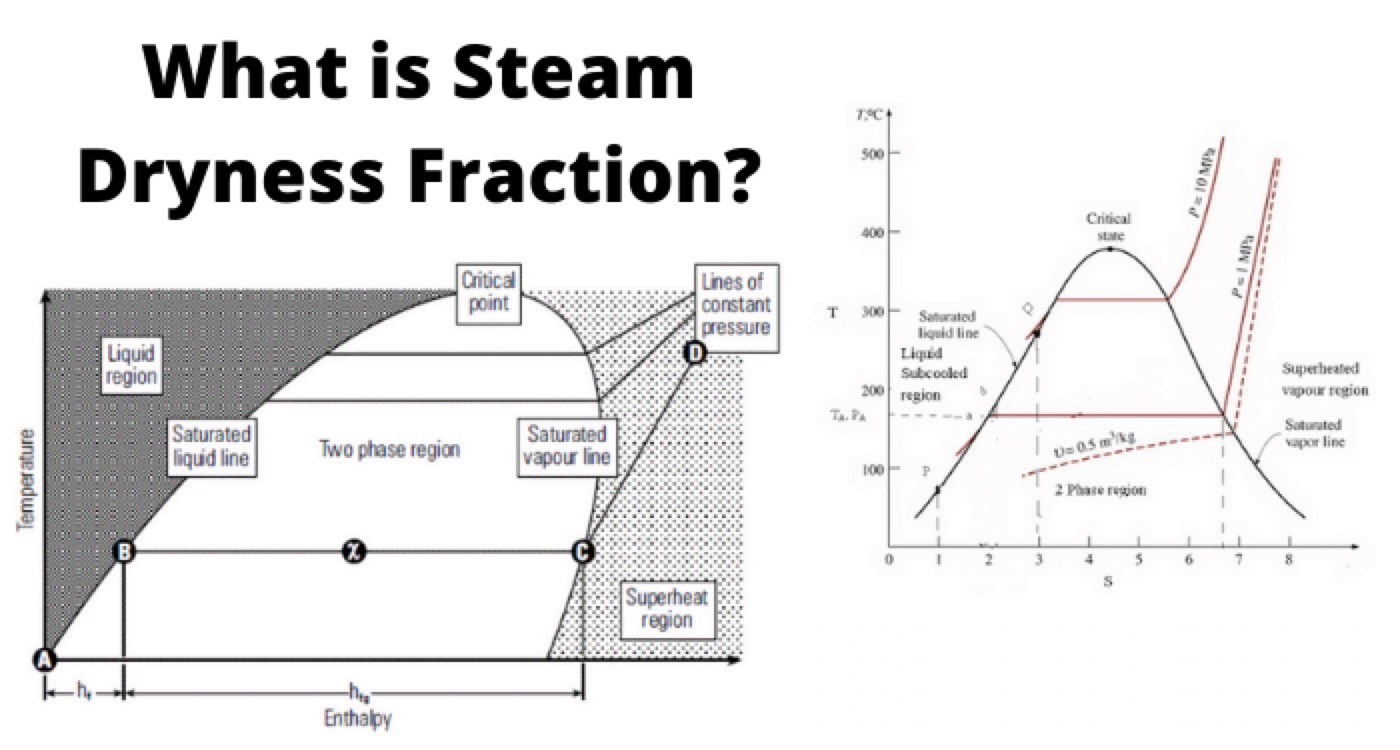
Steam is said to be dry saturated when at that particular pressure its temperature is equal to the boiling point. It is difficult to produce dry saturated steam in practice and steam will often contains water droplets. So steam generated in the drum of the boiler is often wet and contains some moisture. If the moisture content of the steam is 7% by mass, then the dryness fraction of the steam is said to be 0.93 and that means the steam is only 93% dry.
Evaporation Enthalpy of wet steam is expressed as a product of specific enthalpy (hfg) and dryness fraction (x). Heat content of the wet steam and dry saturated steam are different. Dry saturated steam is having higher heat content (useable energy) than the wet steam.
Actual Enthalpy of Evaporation
Actual total Enthalpy of wet steam
Where, hf is Liquid Enthalpy.
Density of water is higher than that of the steam, so the specific volume of the water is far lesser than that of the specific volume of the steam.
Thus the droplets of water in the wet steam will occupy negligible-space and the specific volume of the wet-steam is less than that of the dry steam and given by the formula:
Actual specific volume = x vg
Where, vg is the specific volume of dry saturated steam
Relation of enthalpy and temperature corresponding to different pressure range is graphically represented in Phase Diagram.
When water is heated from 0oC to its saturation temperature at atmospheric pressure it follows the saturated liquid line until it has received all its liquid enthalpy hf and is represented by (A-B) on Phase diagram.
Any further heat addition results in change in phase to saturated steam and is represented by (hfg) on phase diagram i.e B-C
When heat is applied then the liquid start changing its phase from liquid to vapour and then the dryness fraction of the mixture starts increasing i.e moving towards unity. In the phase diagram dryness fraction of the mixture is 0.5 at exactly mid of the line B-C. Similarly at point C on the phase diagram dryness fraction value is 1.
Point C is in the saturated vapour line, any further heat addition results in increasing the steam temperature i.e beginning of steam super-heating represented by line C – D.
Region towards left side of the saturated liquid line.
Region towards right side of the saturated vapour line.
Area between the saturated liquid and saturated vapour line is mixture liquid and vapour. Mixture with varied dryness fractions.
It is the Apex point where saturated liquid and saturated vapour lines meet. Enthalpy of evaporation diminishes to zero at critical point, it means that water changes directly to steam at critical point and thereafter.
Maximum temperature which liquid can attain or exist is equivalent to critical point.
Temperature 374.15oC, Pressure 221.2 bar, values above this are super-critical values and are useful in increasing the efficiency of the Rankine Cycle.
Flash steam is produced when water pressure is reduced from high to a low pressure, then the water is at higher temperature than that of saturation temperature at low pressure. Thus this excess heat energy is released at low pressure in the foam of flashing and the steam thus produced is “Flash Steam”.
It is the excess energy or enthalpy available (due to fall in pressure) will flashes/evaporate some portion of the water/condensate when pressure falls.
Amount of Flash steam produced is given by the formula:
hf at 6 bar = 697.22 kJ/Kg
hf at 0 bar = 417.5 kJ/Kg
hfg at 0 bar = 2258 kJ/Kg
Flash steam generation for the condensate for values as given in Figure:1 = 0.124 Kg of steam/per Kg of water
OR
= 12.4 %
Following are the areas where Flash steam effect should be given due consideration other it may lead to water hammer:
Condensate-receiver tank vent sizing
Steam-traps discharge piping.
Condensate return line sizing.
Statement: Respect the original, good articles worth sharing, if there is infringement please contact delete.