A natural draft cooling tower is a type of heat exchanger that cools water by direct contact with air. It is used in power plants, oil refineries, petrochemical plants, and natural gas plants to remove excess heat from the circulating water system. A natural draft cooling tower relies on the principle of convective flow to provide air circulation, without the need for fans or other mechanical devices. The airflow is driven by the density difference between the warm and moist air inside the tower and the cooler and drier ambient air outside the tower.
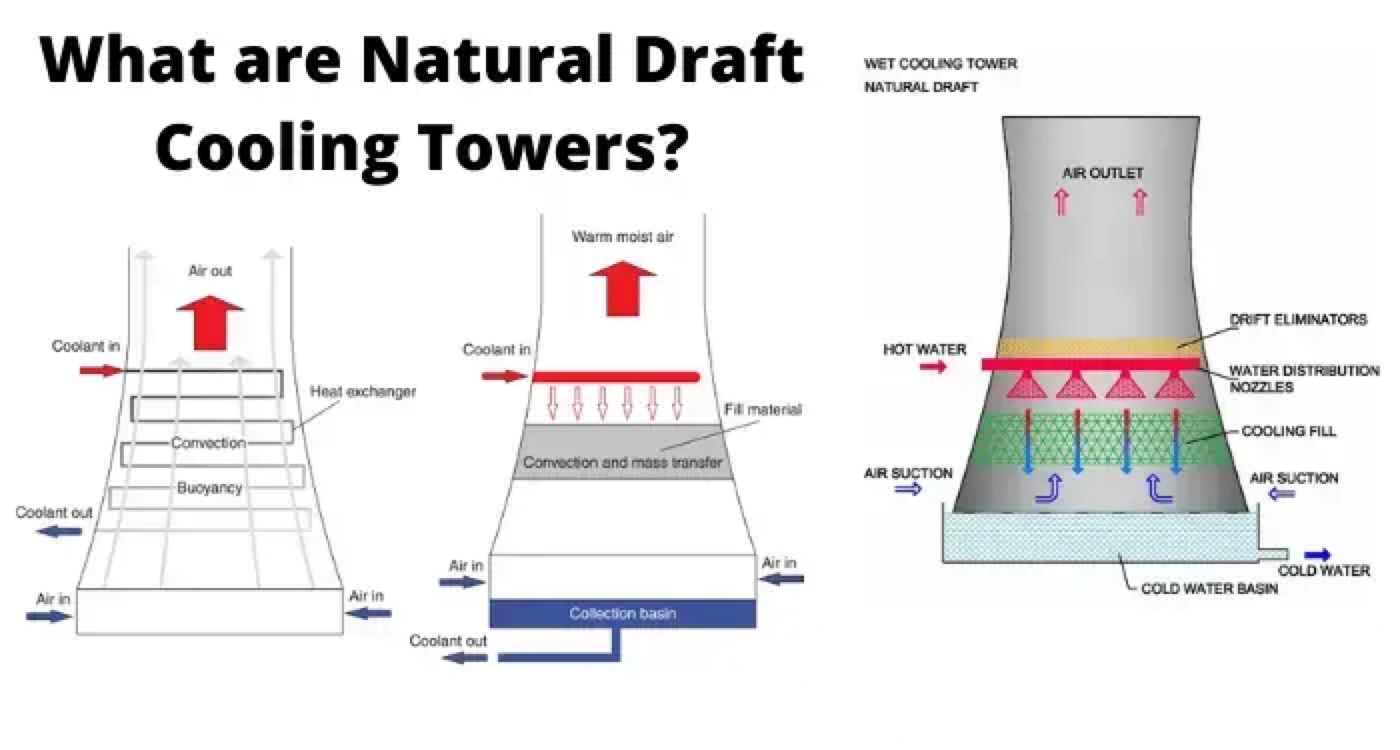
The basic working principle of a natural draft cooling tower is illustrated in the following diagram:
The main components of a natural draft cooling tower are:
Hot water inlet: This is where the hot water from the system or condenser enters the tower at the top. The hot water inlet is connected to a series of nozzles that spray the water over the fill material.
Fill material: This is a porous material that provides a large surface area for heat transfer between the water and the air. The fill material can be made of wood, plastic, metal, or ceramic. The fill material can be arranged in different ways, such as splash bars, grids, or film packs.
Cold water basin: This is where the cooled water collects at the bottom of the tower. The cold water basin has a drain valve and a pump that recirculates the water back to the system or condenser.
Air inlet: This is where the fresh air enters the tower at the base. The air inlet can be opened or closed, depending on the design of the tower.
Air outlet: This is where the warm and moist air exits the tower at the top. The air outlet can have a diffuser or a stack to enhance the airflow.
The process of cooling water in a natural draft cooling tower involves two main mechanisms: sensible heat transfer and latent heat transfer.
Sensible heat transfer: This is when heat is transferred from the hot water to the cold air by direct contact. As a result, the temperature of both fluids changes, but not their phase. The sensible heat transfer depends on factors such as the temperature difference, the flow rate, and the surface area of contact.
Latent heat transfer: This is when heat is transferred from the hot water to the cold air by evaporation. As a result, some of the water changes its phase from liquid to vapor, while absorbing heat from its surroundings. The latent heat transfer depends on factors such as the humidity ratio, the vapor pressure, and the mass transfer coefficient.
The combination of sensible and latent heat transfer cools down the water and heats up the air. The cooled water falls down to the cold water basin, while the heated air rises up to the air outlet due to buoyancy. The buoyancy effect creates a natural draft that draws in more fresh air at the air inlet, creating a continuous cycle of cooling.
Natural draft cooling towers can be classified into two types based on their configuration:
Counterflow natural draft cooling towers: In these towers, the water flows downward, and the air flows upward in opposite directions. This allows for a higher temperature difference and a higher cooling efficiency. However, these towers require more height and more spray nozzles than crossflow towers.
Crossflow natural draft cooling towers: In these towers, the water flows downward, and the air flows horizontally in perpendicular directions. This allows for a lower height and fewer spray nozzles than counterflow towers. However, these towers have a lower temperature difference and a lower cooling efficiency than counterflow towers.
The following table summarizes some of the advantages and disadvantages of each type:
Type |
Advantages |
Disadvantages |
Counterflow |
Higher temperature difference Higher cooling efficiency Better distribution of water Less prone to freezing |
Higher height Higher cost More spray nozzles More prone to scaling |
| Crossflow | Lower height Lower cost Fewer spray nozzles Less prone to scaling | Lower temperature difference Lower cooling efficiency Poorer distribution of water More prone to freezing |
The following figure shows the difference between counterflow and crossflow natural draft cooling towers:
Natural draft cooling towers are generally preferred for applications that require:
Large and constant cooling capacity over many years
Low operational and maintenance costs
Low noise level and power consumption
High resistance to wind loadings and corrosion
Some examples of applications that use natural draft cooling towers are:
Thermal power plants that use coal, oil, gas, or nuclear fuel to generate electricity
Oil refineries process crude oil into various products such as gasoline, diesel, jet fuel, etc.
Petrochemical plants that produce chemicals from petroleum or natural gas feedstocks
Natural gas plants that process natural gas into liquefied natural gas (LNG), compressed natural gas (CNG), or other products
Some of the advantages of natural draft cooling towers are:
They do not require fans or other mechanical devices to induce airflow, which saves power and reduces noise
They have low operational and maintenance costs, as they have fewer moving parts and less wear and tear
They have low system losses, as they lose less than 1% of the total water flow due to evaporation
They have a large cooling capacity, as they can handle huge amounts of water flow
They have no recirculation of air, as they have a high stack outlet that prevents the warm air from re-entering the tower
Some of the disadvantages of natural draft cooling towers are:
They require a large initial capital investment, as they are expensive to construct and install
They require a large area, as they have a wide base and a tall height
They are difficult to get planning permission, as they have a negative aesthetic impact on the local area
Their performance depends on the wind velocity and direction, as they can affect the airflow and heat transfer
They are susceptible to freezing problems in cold climates, as they can cause ice formation on the fill material and the cold water basin.
Natural draft cooling towers are a type of heat exchanger that cools water by direct contact with air. They are used in various industrial applications that require a large and constant cooling capacity. They have two main types: counterflow and crossflow, which differ in how the water and air interact. They have some advantages, such as low operational and maintenance costs, low noise levels, and high cooling efficiency. They also have some disadvantages, such as high initial capital investment, large area requirements, and dependence on wind conditions. Natural draft cooling towers are an important component of many thermal systems that need to reject excess heat from the environment.
Statement: Respect the original, good articles worth sharing, if there is infringement please contact delete.