• Product
  • Suppliers
  • Manufacturers
  • Solutions
  • Free tools
  • Knowledges
  • Experts
  • Communities
Search


What is a Suspension Insulator?

Edwiin
Field: Power switch
China

What is a Suspension Insulator?

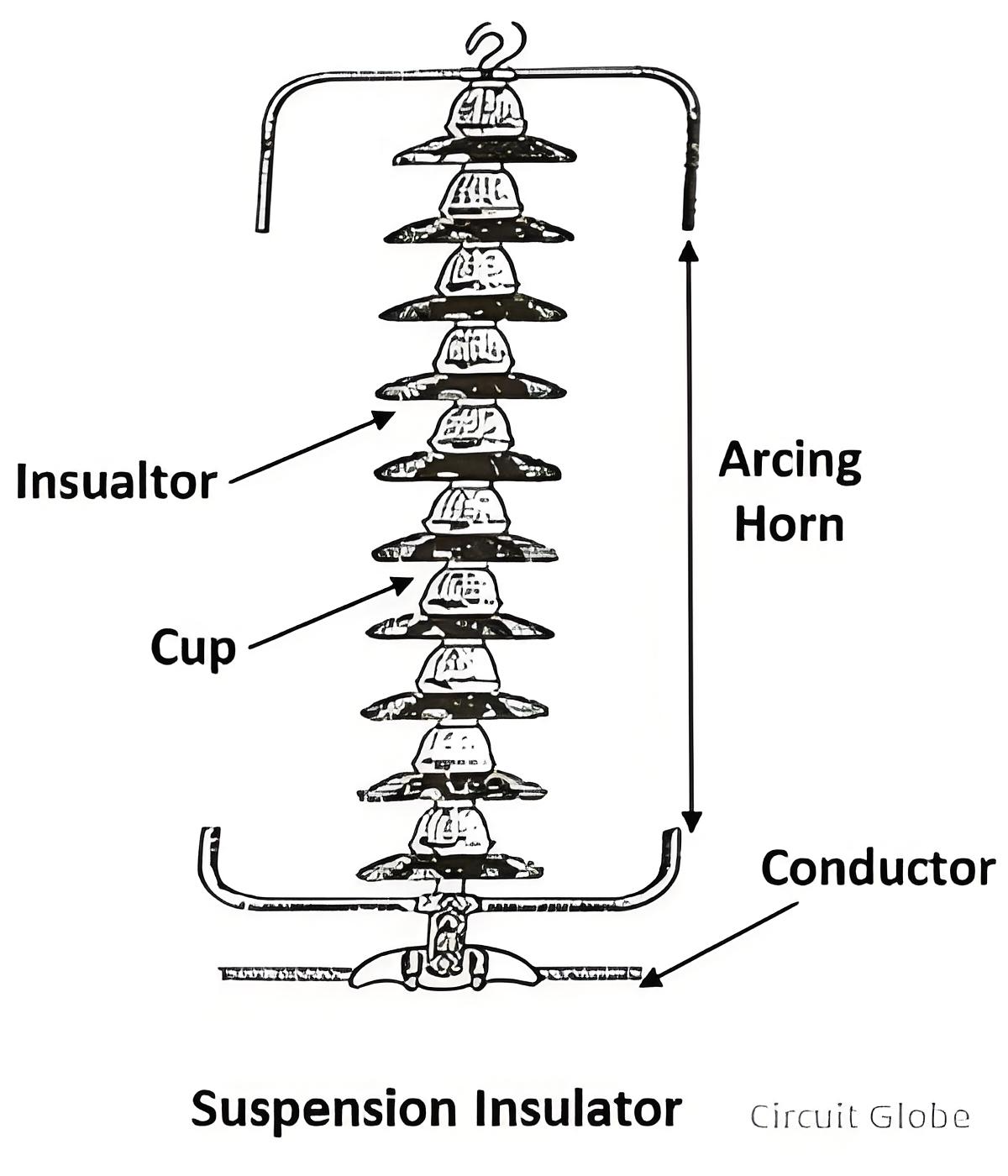
Suspension insulators serve to isolate line conductors and provide electrical support for them. They are composed of multiple porcelain insulator units that are interconnected by metal links, forming a flexible string. The conductor is attached to the bottom of this string. A diagram of the suspension insulator is presented as follows.
Advantages of Suspension Type Insulator

Suspension type insulators offer several benefits, as detailed below:

  • Voltage Adaptability: Each unit can withstand approximately 11 kV of voltage. Thus, based on the overall line voltage, the appropriate number of insulator discs can be connected in series within the string. This modular approach allows for easy customization to different voltage requirements.

  • Maintenance Ease: In the event that one unit within the string gets damaged, it can be replaced individually with a new one. There is no need to replace the entire string, which significantly reduces maintenance costs and downtime.

  • Mechanical Flexibility: The insulator string is designed to be able to swing freely in any direction. This provides a high degree of flexibility to the transmission line, allowing it to better adapt to environmental factors such as wind and mechanical vibrations.

  • Lightning Protection: Since the conductors are positioned beneath the suspension insulators, they receive partial protection from lightning strikes. This helps in reducing the risk of damage to the conductors and maintaining the integrity of the power transmission system.

Types of Suspension Insulator

Suspension insulators are primarily categorized into two main types:

  • Cap and Pin Type

  • Hewlett or Interlink Type

The following sections provide a detailed explanation of the cap - and - pin type and Hewlett (Interlink) type insulators.

1. Cap - and - Pin Type Insulator

In a cap - and - pin type insulator, a galvanized cast iron or forged steel cap is connected to a galvanized forged - steel pin, with porcelain serving as the insulating material. The individual units are joined together using either ball - and - socket or clevis - pin connections. These connection methods ensure a secure yet flexible link between the units, enabling the insulator string to function effectively under various mechanical stresses.

2. Interlink Type Insulator

The interlink type insulator unit features porcelain with two curved channels that are oriented at right angles to each other. U - shaped, leveled, and covered steel links are passed through these channels, and they are used to connect the units.

One of the significant advantages of the Interlink type insulators is their superior mechanical strength compared to the cap - and - pin type units. In the event that the porcelain between the links breaks, the metallic link remains in place and continues to support the power line. As a result, the electrical supply is not interrupted, enhancing the reliability of the power transmission system.

However, the Hewlett (Interlink) type insulator has a drawback. The porcelain between the links is highly stressed electrically. Consequently, its puncture stress is lower compared to other insulator types. This means that it is more vulnerable to electrical breakdown under certain high - voltage conditions, which needs to be carefully considered during its installation and use in power transmission systems.
Give a tip and encourage the author!

Recommended

Main Transformer Accidents and Light Gas Operation Issues
1. Accident Record (March 19, 2019)At 16:13 on March 19, 2019, the monitoring background reported a light gas action of No. 3 main transformer. In accordance with the Code for Operation of Power Transformers (DL/T572-2010), operation and maintenance (O&M) personnel inspected the on-site condition of No. 3 main transformer.On-site confirmation: The WBH non-electrical protection panel of No. 3 main transformer reported a Phase B light gas action of the transformer body, and the reset was ineff
02/05/2026
Faults and Handling of Single-phase Grounding in 10kV Distribution Lines
Characteristics and Detection Devices for Single-Phase Ground Faults1. Characteristics of Single-Phase Ground FaultsCentral Alarm Signals:The warning bell rings, and the indicator lamp labeled “Ground Fault on [X] kV Bus Section [Y]” illuminates. In systems with a Petersen coil (arc suppression coil) grounding the neutral point, the “Petersen Coil Operated” indicator also lights up.Insulation Monitoring Voltmeter Indications:The voltage of the faulted phase decreases (in
01/30/2026
Neutral point grounding operation mode for 110kV~220kV power grid transformers
The arrangement of neutral point grounding operation modes for 110kV~220kV power grid transformers shall meet the insulation withstand requirements of transformer neutral points, and shall also strive to keep the zero-sequence impedance of substations basically unchanged, while ensuring that the zero-sequence comprehensive impedance at any short-circuit point in the system does not exceed three times the positive-sequence comprehensive impedance.For 220kV and 110kV transformers in new constructi
01/29/2026
Why Do Substations Use Stones, Gravel, Pebbles, and Crushed Rock?
Why Do Substations Use Stones, Gravel, Pebbles, and Crushed Rock?In substations, equipment such as power and distribution transformers, transmission lines, voltage transformers, current transformers, and disconnect switches all require grounding. Beyond grounding, we will now explore in depth why gravel and crushed stone are commonly used in substations. Though they appear ordinary, these stones play a critical safety and functional role.In substation grounding design—especially when multiple gr
01/29/2026
Related Products
Send inquiry
+86
Click to upload file
Download
Get the IEE Business Application
Use the IEE-Business app to find equipment, obtain solutions, connect with experts, and participate in industry collaboration anytime, anywhere—fully supporting the development of your power projects and business.