• Product
  • Suppliers
  • Manufacturers
  • Solutions
  • Free tools
  • Knowledges
  • Experts
  • Communities
Search


General Rules for GIS Grounding and bonding
Edwiin
Field: Power switch
China

General Rules for GIS Grounding and bonding

In most Gas - Insulated Switchgears (GIS), there are two grounding grids:

  • The station grounding grid, which is analogous to that in a typical Air - Insulated Switchgear (AIS) installation.

  • The GIS grounding mesh, a closely - spaced grounding grid embedded in the concrete slab where the GIS is installed.

Typical rules for GIS grounding and bonding are as follows:

  • All grounding conductors should be kept as short as feasible.

  • The grounding mesh and its interconnections must be able to carry the system's fault currents.

  • All exposed grounding conductors should be safeguarded against mechanical damage.

  • At all discontinuities within the GIS, appropriate grounding and bonding techniques, such as using multiple conductors or voltage limiters, must be employed.

  • Ensure that all metallic building components, GIS support structures, and GIS maintenance platforms are properly grounded.

  • Reinforcement steel in the building floor should be linked to the GIS grounding mesh to further balance ground potentials.

  • All secondary cables should be shielded, with both ends of each cable shield grounded to reduce potential electromagnetic interference.

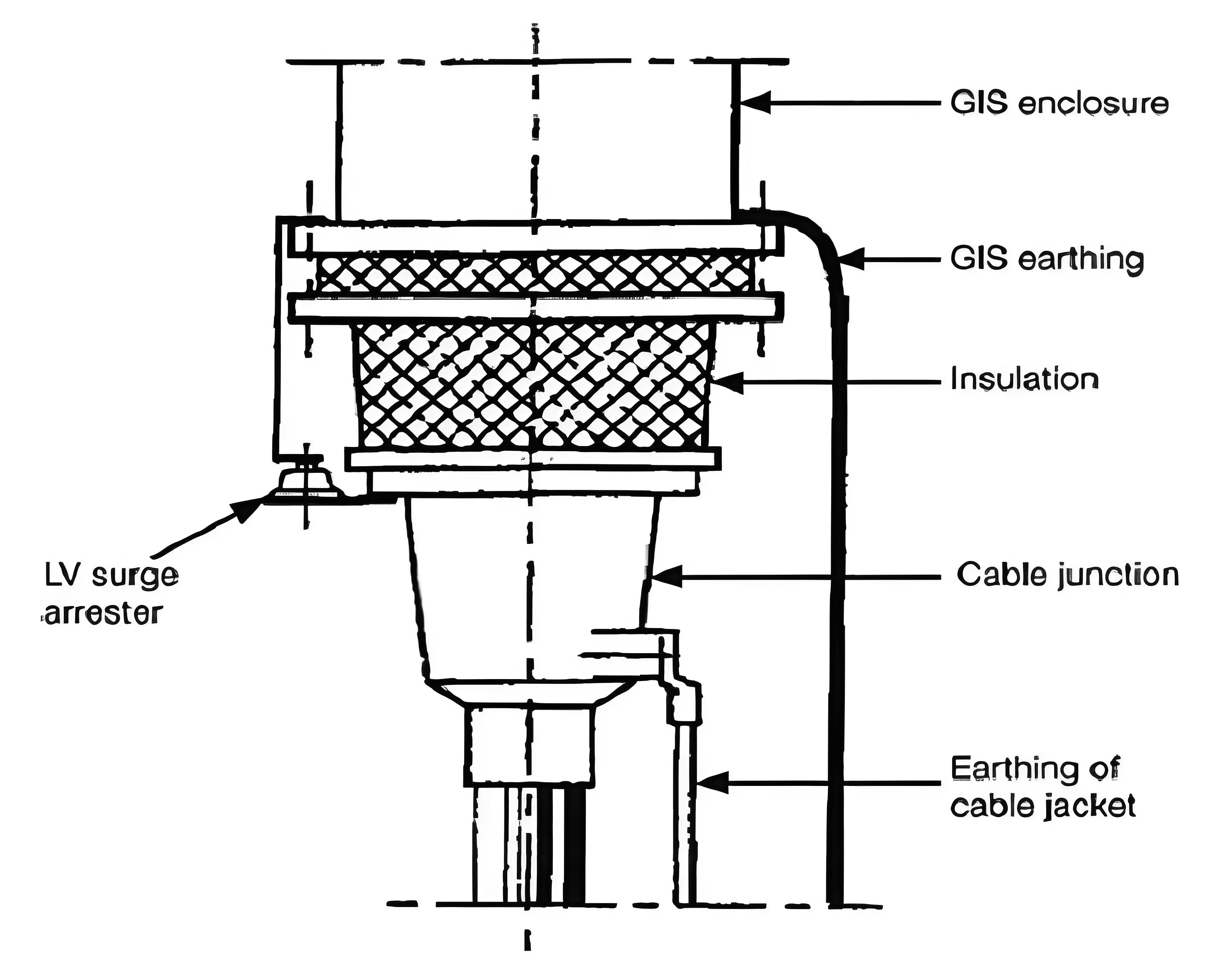
The picture depicts the insulation connection between the metal enclosure of a GIS and the metal part of the cable via nonlinear resistors.
Give a tip and encourage the author!

Recommended

Main Transformer Accidents and Light Gas Operation Issues
1. Accident Record (March 19, 2019)At 16:13 on March 19, 2019, the monitoring background reported a light gas action of No. 3 main transformer. In accordance with the Code for Operation of Power Transformers (DL/T572-2010), operation and maintenance (O&M) personnel inspected the on-site condition of No. 3 main transformer.On-site confirmation: The WBH non-electrical protection panel of No. 3 main transformer reported a Phase B light gas action of the transformer body, and the reset was ineff
02/05/2026
Faults and Handling of Single-phase Grounding in 10kV Distribution Lines
Characteristics and Detection Devices for Single-Phase Ground Faults1. Characteristics of Single-Phase Ground FaultsCentral Alarm Signals:The warning bell rings, and the indicator lamp labeled “Ground Fault on [X] kV Bus Section [Y]” illuminates. In systems with a Petersen coil (arc suppression coil) grounding the neutral point, the “Petersen Coil Operated” indicator also lights up.Insulation Monitoring Voltmeter Indications:The voltage of the faulted phase decreases (in
01/30/2026
Neutral point grounding operation mode for 110kV~220kV power grid transformers
The arrangement of neutral point grounding operation modes for 110kV~220kV power grid transformers shall meet the insulation withstand requirements of transformer neutral points, and shall also strive to keep the zero-sequence impedance of substations basically unchanged, while ensuring that the zero-sequence comprehensive impedance at any short-circuit point in the system does not exceed three times the positive-sequence comprehensive impedance.For 220kV and 110kV transformers in new constructi
01/29/2026
Why Do Substations Use Stones, Gravel, Pebbles, and Crushed Rock?
Why Do Substations Use Stones, Gravel, Pebbles, and Crushed Rock?In substations, equipment such as power and distribution transformers, transmission lines, voltage transformers, current transformers, and disconnect switches all require grounding. Beyond grounding, we will now explore in depth why gravel and crushed stone are commonly used in substations. Though they appear ordinary, these stones play a critical safety and functional role.In substation grounding design—especially when multiple gr
01/29/2026
Related Products
Send inquiry
+86
Click to upload file
Download
Get the IEE Business Application
Use the IEE-Business app to find equipment, obtain solutions, connect with experts, and participate in industry collaboration anytime, anywhere—fully supporting the development of your power projects and business.