Why Cables are Insulated?
In modern electrical systems, with the exception of overhead power transmission cables mounted on electric poles, nearly all cables in use today are insulated. The degree of insulation resistance in a cable is intricately tied to its intended application. Insulation serves multiple critical functions. Beyond minimizing energy losses to the surroundings, its most crucial role is safeguarding human lives by preventing electrocution.
Electricity poses a significant danger. A single accidental contact with a live cable can have fatal consequences, leaving no room for second chances. Our bodies are partial conductors of electricity. When we come into contact with a current - carrying conductor, electric current will flow from the conductor into our body. Given our body's limited conductivity, it cannot effectively dissipate the incoming current. When the amount of current exceeds our body's tolerance, it can result in a fatal outcome.
To prevent such tragic accidents in domestic and industrial settings, cable insulation has become an essential requirement. Insulation acts as a barrier, preventing current leakage and ensuring that live electrical components are not accessible, thereby eliminating the risk of electrocution.
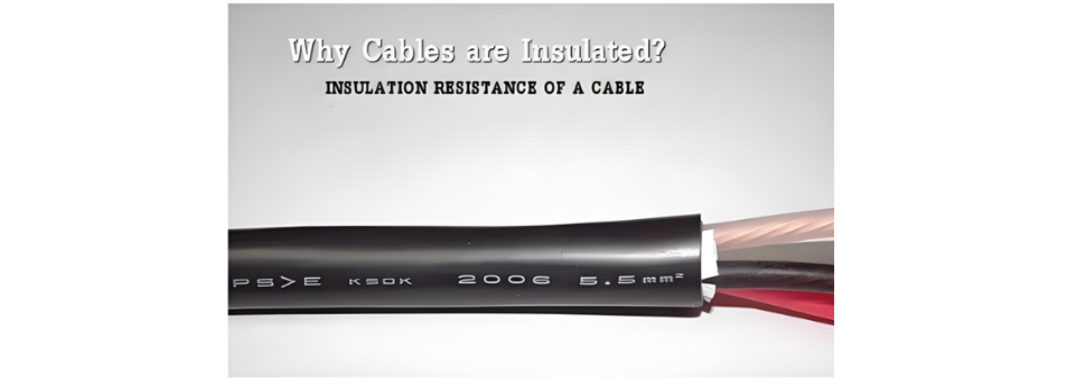
An insulator is a material or substance that resists the flow of heat and electricity. This resistance stems from the absence of free - moving electrons within the material. When conductors are covered with insulating materials, such as polyvinyl chloride (PVC), they are said to be insulated. This process, known as insulation, serves to prevent electrical energy and signals from dissipating into the surrounding environment.
Effect of Temperature on Insulated Materials
Temperature has a profound impact on the electrical properties of different materials. In conductors, an increase in temperature leads to an increase in resistance. In contrast, semiconductors and insulators exhibit a decrease in resistance as the temperature rises. Under extreme temperature conditions, a semiconductor can transform into a better conductor, and an insulator may even exhibit semiconductor - like behavior.
Insulation Resistance of a Cable
Cable conductors are encased in insulation of an appropriate thickness to prevent current leakage. The thickness of the insulation is determined by the cable's intended use. In a cable, the path of current leakage is radial, and the insulation offers radial resistance to the flow of current along its entire length.
Rins = ρdr/2πrl
For a single - core cable with a conductor of radius r1, an internal sheath of radius r2, length l, and an insulation material with resistivity ρ, the perimeter of the conductor is 2πr1. The differential thickness of the insulation is denoted as dr. The insulation resistance Rins can be expressed as:
Rins = ρ/2πl[loge r2 /r2 ]
Notably, Rins is inversely proportional to the length l of the cable, which contrasts with the relationship R=ρl for conductor resistance, where ρ represents resistivity, a material - specific constant.
Some cables, such as coaxial cables, feature multiple insulating layers and multiple cores. In coaxial cables, the central wire serves as the primary conductor. The additional cores are designed for grounding purposes and to shield against the escape of electromagnetic waves and radiation. A coaxial cable consists of an inner conductor, typically made of copper due to its low resistivity (and sometimes plated for enhanced performance), encased within a series of insulating layers. These layers often include a dielectric material, an aluminum foil or copper strand shield, and an outer PVC sheath. The outer sheath protects the cable from external environmental factors. When a voltage is applied to the inner conductor, the shield remains at a negligible voltage.
The coaxial design offers significant advantages. It confines electric and magnetic fields within the dielectric, minimizing leakage outside the shield. The multiple layers of insulation effectively block external electromagnetic fields and radiation, preventing interference. Since conductors with larger diameters have lower resistance and emit less electromagnetic leakage, and additional insulation further reduces such leakage, coaxial cables with multiple insulation layers are ideal for transmitting weak signals that are vulnerable to interference.
Features of an Insulated Cable
Given that the insulation resistance of a cable is determined by its design purpose, engineers must consider several factors when designing cables. Coaxial cables, for example, require extensive insulation to prevent both power leakage and electromagnetic radiation escape, often featuring two, three, or even four layers of insulation. Different cables are engineered for diverse applications, but they generally share the following key features:
Heat Resistance: Capable of withstanding high temperatures without degrading.
High Insulation Resistance: Minimizes current leakage and ensures electrical safety.
Mechanical Durability: Resistant to cuts, tears, and abrasion, ensuring long - term reliability.
Superior Properties: Exhibits excellent mechanical and electrical characteristics.
Chemical Resistance: Resistant to oils, solvents, and various chemicals.
Environmental Resilience: Impervious to ozone and weather conditions, suitable for both indoor and outdoor use.