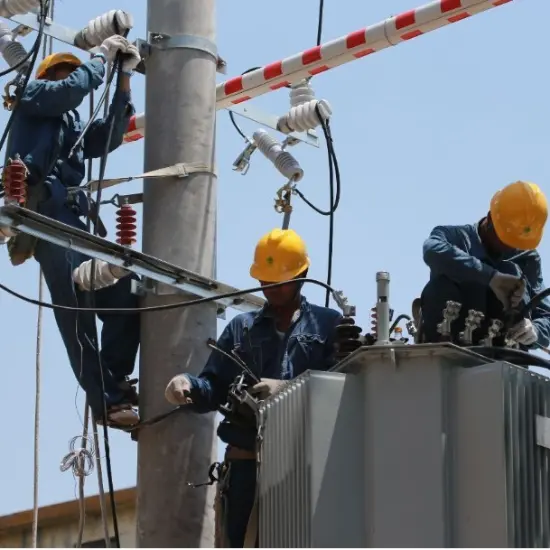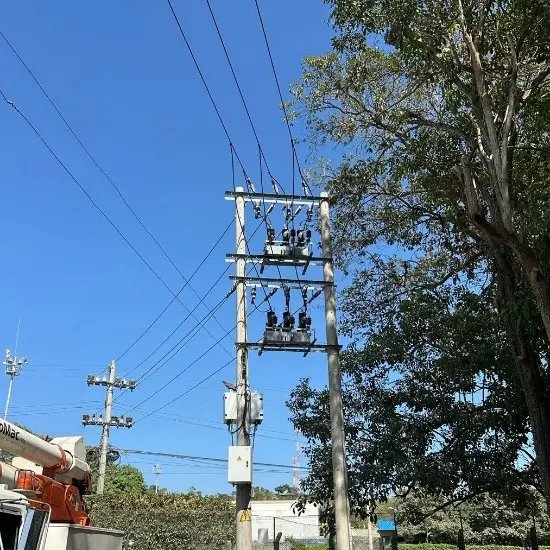

Electric power can be transmitted or distributed either by overhead transmission systems or by underground cables. Cables are mainly designed for a specific requirement. Power cables are mainly used for power transmission and distribution purposes. It is an assembly of one or more individually insulated electrical conductors, usually held together with an overall sheath. The assembly is used for transmission and distribution of electrical power.
Electrical power cables may be installed as permanent wiring within buildings, buried in the ground, and run overhead or exposed. Flexible power cables are used for portable devices, mobile tools, and machinery.
These are designed and manufactured as per voltage, current to be carried, operating maximum temperature and purpose of applications desired by the customer.
For mining, we give extra mechanical strength to cable with double armoring. For wind power plant customers generally, require flexible and UV protected cable with the mechanical tough sheath so we design as per their requirement. The underground cables have several advantages such as less liable to damage through storms, lightning, low maintenance cost, a lower chance of faults, a smaller voltage drop, and a better general appearance.
It happens frequently that the conductor size necessary for installation is dictated by its ability to carry short-circuit current rather than sustained current. During a short-circuit, there is a sudden inrush of current for a few cycles followed by a steadier flow of current for a short period until the protection switchgear operators, normally between 0.1 – 0.3 seconds.
Conductor Size and Material |
Insulation Material |
Operating Maximum Temperature |
Short Circuit Rating |
120 sq-mm Copper conductor |
PVC Insulation |
70oC |
13.80 KA/SEC |
120 sq-mm Aluminium conductor |
PVC Insulation |
70oC |
9.12 KA/SEC |
120 sq-mm Copper conductor |
PVC Insulation |
85oC |
12.48 KA/SEC |
120 sq-mm Aluminium conductor |
PVC Insulation |
85oC |
8.28 KA/ |
The current carrying capacity is an important aspect is the selection of the optimum size of the conductor. Voltage drop and short rating is also a very important aspect to select the economical and optimum size of conductor. The safe current carrying capacity of an underground cable is determined by the maximum permissible temperature rise. The cause of temperature rise is the losses that occur in a cable which appear as heat.
Continuous Current Rating of (Cables laid singly) |
2 Core × 16 mm2 |
2 Core × 25 mm2 |
(i) In Ground (Ground Temp 30oC) |
103 A |
131 A |
(ii) In Duct (Ground Temp 30oC) |
86 A |
111 A |
(iii) In Air (Ambient AirTemp 40oC) |
94 A |
125 A |
The allowable maximum voltage drops from source to load is another aspect of power cable conductor design.
As per Ohm’s law, V = IR. The first is the choice of material used for the wire. Copper is a better conductor than The first is the choice of material used for the wire. Copper is a better conductor than and will have less voltage drop than aluminum for a given length and wire size.
Wire size is another important factor in determining voltage drop. Larger wire sizes (those with a greater diameter) will have less voltage drop than smaller wire sizes of the same length. In American wire gauge, every 6 gauge decrease gives a doubling of the wire diameter, and every 3 gauge decrease doubles the wire cross-sectional area. In the Metric Gauge scale, the gauge is 10 times the diameter in millimeters, so a 50 gauge metric wire would be 5 mm in diameter.
There are various parts of a cable to be taken care of during construction. The power cable mainly consists of
Conductor
Insulation
LAY for Multicore cables only
Bedding
Beading/Armouring (if required)
Outer Sheath

Conductor
Conductors are the only power carrying path in a power cable. Conductors are of different materials. Mainly in the cable industry, we use copper (ATC, ABC) and aluminum conductors for power cables. There are different types of a conductor as Class 1: solid, Class 2 stranded, Class 5 flexible, Class 6 Extra flexible (Mostly used for cords and welding), etc. Conductor sizes are identified with conductor resistance.
The insulation provided on each conductor of a cable by mainly PVC (Poly Vinyl Chloride), XLPE (Crosslinked Polyethylene), RUBBER (Various Types of Rubber). The insulating material is based on operating temperature.
Insulation Material |
Maximum Operating Temperature |
PVC TYPE A |
75oC |
PVC TYPE B |
85oC |
PVC TYPE C |
85oC |
XLPE |
90oC |
RUBBER – EPR IE-1 |
90oC |
RUBBER – EPR IE-2, EPR IE-3, EPR IE-4, SILICON IE-5 |
150oC |
Cores are identified by color-coding by using different colors on insulation or by number printing on cores
This portion of the cable is also known as the inner sheath. Mostly it is used in Multi-core cables. It works as a binder for insulated conductors together in multi-core power cables and provides bedding to armor/braid. This portion of the cable is mainly made of PVC( PVC ST-1, PVC ST-2 ), RUBBER (CSP SE-3, CSP SE-4, and PCP SE-3, PCP SE-4, HOFR SE-3 HOFR SE-4, HD HOFR SE-3 ETC).
There are mainly G.I. WIRE ARMOURING, G.I. STEEL STRIP armoring. It is done by placing G.I. WIREs, GI, or STEEL STRIPs one by one on inner sheath. Armoring is a process that is done mainly for providing an earthing shield to the current-carrying conductors as well as it is also used for earthing purposes of the cable for safety.
When there is any insulation failure in the conductor, the fault current gets enough paths to flow through the armor if it is properly earthed. Providing extra mechanical protection and strength to cable is an important added advantage of armoring. In mining cables this is done for conductance.
ANNEALED TINNED COPPER WIRE, NYLON BRAID, COTTON BRAID are mainly used for this purpose. Braiding is the process which gives high mechanical protection to cable and also used for earthing purpose. The significance of braiding is it is more flexible in comparison to armoring.
This is the outermost cover of the cable normally made of PVC (Poly Vinyl Chloride), RUBBER (Various Types of Rubber), and often the same material as the bedding. It is provided over the armor for overall mechanical, weather, chemical, and electrical protection. The outer sheath is the protection offered to the cable not much electrically but more mechanically.
Material |
Advantages |
Disadvantages |
Max Operating Temperature |
PVC |
Cheap, Durable, Widely available |
Highest dielectric losses, Melts at high temperatures, Contains halogens |
70oC for general-purpose 85oC for heat-resisting purpose |
PE |
Lowest dielectric losses, High initial dielectric strength |
Highly sensitive to water treeing, Material breaks down at high temperatures |
|
XLPE |
Low dielectric losses, Improved material properties at high temperatures |
Does not melt but thermal expansion occurs, Medium sensitivity to water treeing (although some XLPE polymers are water-tree resistant) |
90oC |
EPR |
Increased flexibility, Reduced thermal expansion (relative to XLPE), Low sensitivity to water treeing |
Medium-High dielectric losses, Requires inorganic filler/additive |
90oC |
Paper / Oil |
Low-Medium dielectric losses, Not harmed by DC testing, Known history of reliability |
High weight, High cost, Requires hydraulic pressure/pumps for insulating fluid, Difficult to repair, Degrades with moisture |
70oC |
Mainly above 6 square mm cables are called power cables but it depends upon the use of a cable. For PVC power cables we use IS:1554 and for XLPE power cables we use IS:7098 and for Rubber-based power cables, we use IS:9968 and other relevant specifications. Power cables are defined by voltage grade and nominal cross-sectional area.
Statement: Respect the original, good articles worth sharing, if there is infringement please contact delete.