How Silicon Steel Minimizes Transformer Core Loss
Why Transformers Use Silicon Steel Laminations to Reduce Eddy Current Loss
Transformers rely on efficient magnetic cores to transfer energy between windings with minimal loss. One of the most critical design choices is the use of laminated silicon steel sheets—not solid iron or plain steel—for the core. This decision directly addresses a major source of inefficiency: eddy current loss.
What Is Eddy Current Loss?
When a transformer operates under alternating current (AC), the primary winding generates a time-varying magnetic flux. This changing flux passes through the iron core and induces circulating currents within the core material itself. These currents—called eddy currents—flow in closed loops perpendicular to the magnetic field and dissipate energy as heat, reducing efficiency and raising operating temperatures.
Eddy current loss is one component of core (or iron) loss, the other being hysteresis loss.
Why Silicon Steel?
Silicon steel—an alloy of iron with 0.8% to 4.8% silicon—is the industry standard for power transformer cores due to two key properties:
High magnetic permeability: Enables strong magnetic flux density with less excitation current, allowing for more compact transformer designs.
Increased electrical resistivity: Silicon raises the resistivity of the steel, which inherently suppresses eddy current magnitude.
Additionally, silicon steel exhibits a narrow hysteresis loop, meaning less energy is lost during each magnetization cycle—reducing hysteresis loss and associated heating.
Why Laminated Sheets—Not a Solid Block?
If the core were made from a solid block of silicon steel, eddy currents would flow freely through its large cross-section, causing significant power loss and overheating.
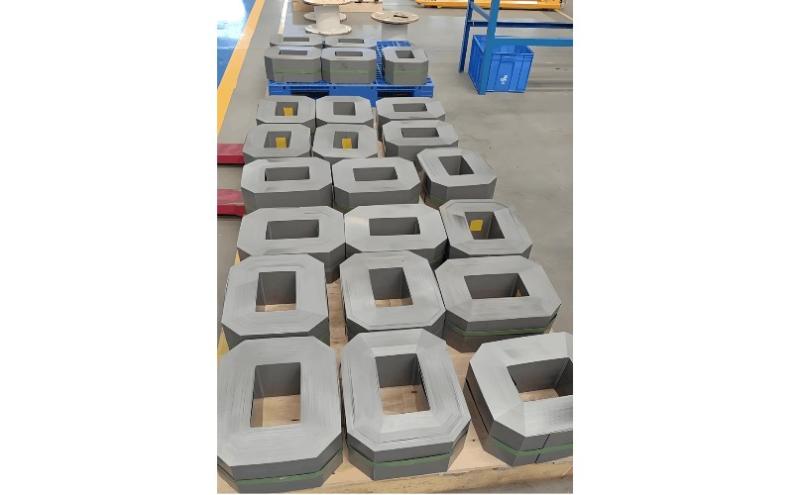
To combat this, transformer cores are built from thin, insulated laminations—typically 0.35 mm thick cold-rolled silicon steel sheets—stacked together. This design:
Restricts eddy currents to narrow paths within each lamination,
Increases effective electrical resistance along current loops,
Dramatically reduces eddy current magnitude and associated heating.
The laminations are coated with an insulating oxide or varnish layer to prevent electrical contact between sheets, ensuring currents cannot bridge across layers.
Practical Design Trade-offs
In theory, thinner laminations = lower eddy current loss. However, manufacturing extremely thin sheets increases:
Material cost,
Production complexity,
Labor time,
Risk of reduced core cross-sectional area (lowering magnetic performance).
Therefore, engineers balance efficiency, cost, and manufacturability when selecting lamination thickness—0.35 mm remains the optimal standard for most distribution and power transformers.
Common core shapes include:
Single-phase “core-type” (single-window),
Three-phase “shell-type” or double-window (“日”-shaped) configurations.