Ⅰ. Working Principle of 32-Step Voltage Regulator
(I) Basic Concepts and Control Principles
Core Function: Based on discrete control principles, it achieves output voltage regulation through precise voltage gradations.
Control Strategy Difference: Unlike traditional continuous-feedback regulators, it uses 32 fixed voltage levels for accurate adjustments, enabling rapid switching to preset levels.
(II) Structural Implementation and Case Studies
Mechanical Solution
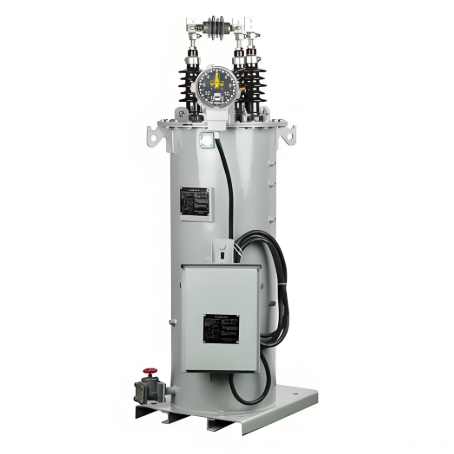
Principle: Utilizes an autotransformer with 32 tap switches to change winding ratios, enabling stepwise voltage adjustment.
Application Case: In 10kV distribution networks, each tap step adjusts voltage by 10% of the line voltage.
Digital Solution
Principle: Employs switching circuits and microcontrollers (e.g., STM32) to control resistor networks or inductors for discrete voltage steps.
Application Case: A converter-based design uses 9 resistors + 8 switches to achieve 0.2V/step adjustment (output range: 0.1–32V).
(III) Technical Advantages and Performance
Voltage Resolution:
Autotransformer: Broad adjustment range per step but finer control with 32 levels.
Digital Control: Achieves steps as low as 0.1V using precise resistor-switch combinations.
Dynamic Response: Discrete control enables faster response (1–10 ms), meeting rapid voltage stabilization needs.
II. Technical Features of 32-Step Voltage Regulator
High-Precision Control
Core Advantage: 32-step gradation enables minimal step values (e.g., 0.2V/step), surpassing traditional linear regulators.
Implementation: Digital potentiometers, MOSFET arrays, and microcontrollers ensure accuracy.
Applications: Medical devices, semiconductor manufacturing, and precision instruments.
Rapid Dynamic Response
Response Time: 1–10 ms for level switching, outperforming traditional regulators limited by loop bandwidth.
Value: Quickly stabilizes voltage during load/input fluctuations, ensuring system stability.
Wide-Range Regulation
Range: Supports 0–520V in three-phase systems, with customizable input voltage.
Scenarios: Renewable energy integration, industrial automation, and power grid management.
Comprehensive Protection
Mechanisms: Integrated overcurrent/voltage/temperature protection and short-circuit safeguards.
Case: Synchronous rectification circuits reduce losses while enhancing safety.
Cost Efficiency
Mechanical: Low-cost structure with minimal maintenance.
Digital: Microcontrollers (e.g., TMC-series chips) reduce system complexity.
III. Performance Comparison: 32-Step vs. Traditional Regulators
Performance Metric |
32-Step Regulator |
Traditional Regulator |
Regulation Accuracy |
32 steps; ≤0.2V/step |
Limited by noise/loop delay |
Dynamic Response |
1–10 ms |
µs-range but bandwidth-constrained |
Efficiency |
Mechanical: ~70%; Digital: 85–90% |
Linear: Low (e.g., 38%); Switching: 90%+ |
Cost |
Mechanical: Low; Digital: Moderate |
Linear: Low; Switching: High |
IV. Application Scenarios
Medical Equipment
Use: Powers MRI/CT scanners, ensuring imaging precision and safety.
Value: Matches demands for stable output and fast response.
Semiconductor Manufacturing
Core Role: Controls lithography laser sources (e.g., 0.625% voltage/step), critical for chip yield.
Renewable Energy Integration
Solution: Combines with SVC/SVG devices for grid voltage stabilization, handling renewable output fluctuations.
Industrial Automation
Implementation: Drives servo systems in CNC machines/robots, enhancing machining accuracy.
Communication Equipment
Benefit: Reduces power noise in base stations via precise voltage control.
V. Technical Implementation Schemes
Mechanical Autotransformer
Principle: 32 physical taps adjust winding ratios.
Pros/Cons: Simple/low-cost but prone to contact wear.
Use Case: Cost-sensitive, wide-range scenarios (e.g., power grids).
Digital Switching Circuit
Design: MOSFET arrays + microcontroller (e.g., STM32) for 0.1V/step resolution.
Advantage: High precision, fast response, low maintenance.
Applications: Precision instruments and test equipment.
Hybrid Solution
Structure: Autotransformer + electronic relays + digital control (e.g., 0.5V/step).
Balance: Cost-effectiveness with enhanced flexibility.
Microcontroller Functions
Roles: Generates step signals, manages switches, and enables protection logic (e.g., overcurrent/temperature).
Protection Mechanisms
Features: Real-time monitoring for overcurrent/voltage/temperature, with shutdown triggers.
Value: Ensures reliability in critical systems like industrial automation.