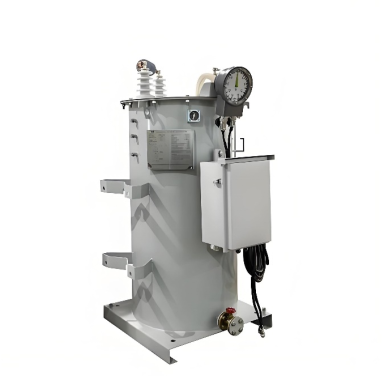
Ⅰ. Technical Principle and Core Advantages
1. Working Principle
The 32-step voltage regulator is a tap-switching type voltage regulation device that adjusts voltage by automatically switching the tap positions of series windings:
• Boost/Buck Mode: A Reversing Switch selects the relative polarity of the series and parallel windings, achieving a ±10% voltage regulation range.
• 32-Step Fine Regulation: Each step adjusts the voltage by 0.625% (32 steps total), preventing abrupt voltage changes and ensuring continuous power supply.
• Make-Before-Break Switching: Utilizes a "twin contacts + bridging reactor" design. During tap switching, the load current is temporarily diverted through the reactor, ensuring uninterrupted power to the load.
2. Advantages for Rural Grid Adaptation
Feature |
Traditional Mechanical Regulator |
32-Step Voltage Regulator |
Response Speed |
Seconds to minutes |
Milliseconds |
Regulation Accuracy |
±2%–5% |
±0.625% |
Supportable Supply Radius |
Limited (Typically <10km) |
Extended (>20km) |
Maintenance Requirement |
High (Mechanical wear) |
Contactless, Maintenance-Free |
Table: Performance Comparison between Traditional Equipment and the 32-Step Regulator
II. Voltage Issues and Requirements in Rural Distribution Networks
Rural power grids are prone to voltage quality issues due to the following characteristics:
Excessively Long Supply Radii: Significant voltage drop occurs at line ends.
Severe Load Fluctuations: Agricultural loads (e.g., irrigation equipment) cause significant daytime-nighttime voltage deviation (high voltage during the day, low voltage at night).
Three-Phase Imbalance: Concentrated single-phase loads cause neutral point displacement, worsening voltage instability.
Aging Equipment: Small conductor diameters and insufficient transformer capacity exacerbate line losses.
III. Solution Design
1. System Architecture
Adopts a hierarchical deployment strategy:
• Substation Outlet: Install Type B regulators (constant excitation) to stabilize the main feeder voltage.
• Mid-point/End of Long Branches: Deploy Type A regulators (e.g., VR-32) to compensate for local voltage drops.
2. Key Implementation Steps
• Siting Principle: Base site selection on the voltage drop curve under maximum load; install at nodes where voltage drop exceeds 5%.
• Capacity Matching: Select regulator capacity based on peak line current (e.g., VR-32 in Zhangwu County supports a 7700kVA load).
• Intelligent Coordination:
Coordinate with Static Var Generators (SVG) to suppress fluctuations from inductive loads.
Combine with PV inverter reactive power regulation to mitigate daytime overvoltage.
3. Communication and Automation
• Local Control: Voltage sensors provide real-time feedback, triggering tap changes (no central command needed).
• Remote Monitoring: Upload operational data (voltage, tap position, load rate) to the central control system to support predictive maintenance.
IV. Application Cases and Results
Case Area |
Problem Description |
Solution |
Results |
Alberta, Canada |
Voltage drop >10% at feeder end during irrigation season; severe undervoltage |
Installed VR-32 voltage regulator at the mid-point of the line |
End voltage stabilized within 230V ±10% (qualified range) |
Bavaria, Germany |
Minimum night voltage dropping to 151V |
Installed a combination (Dynamic compensator + Voltage regulator) at the line end |
Voltage stabilized above 210V |
Farm Areas, Chile |
Peak-valley voltage deviation >15% |
Deployed a new flexible voltage regulation device at the transformer outlet |
All-day voltage fluctuation rate <3% |
V. Innovation Directions and Future Trends
Synergy with Distributed Energy Resources (DER):
Integrate with PV Energy Storage (DES), using regulators to suppress voltage violations caused by renewable energy fluctuations.
Artificial Intelligence Optimization:
Apply Deep Reinforcement Learning (DRL) to predict load changes and pre-adjust tap positions (e.g., pre-boost voltage in anticipation of irrigation peaks).
Hybrid Voltage Regulation Systems:
Combine with Soft Open Points (SOP) to form multi-level regulation networks: SOP regulates active/reactive power, while regulators handle steady-state voltage drop.
VI. Economics and Social Benefits
• Return on Investment: The cost of a single regulator is approximately 10k–10k–10k–15k USD, capable of reducing line losses by 3%–8%.
• Improved Power Supply Quality: Voltage qualification rate increases from <90% to >99%, supporting rural industrialization (e.g., stable operation of cold chain and processing equipment).