• Product
  • Suppliers
  • Manufacturers
  • Solutions
  • Free tools
  • Knowledges
  • Experts
  • Communities
Search


What Is the Current Status and Detection Methods of Single-Phase Grounding Faults?

Leon
Field: Fault Diagnosis
China

Current Status of Single-Phase Grounding Fault Detection

The low accuracy of single-phase grounding fault diagnosis in non-effectively grounded systems is attributed to several factors: the variable structure of distribution networks (such as looped and open-loop configurations), diverse system grounding modes (including ungrounded, arc-suppression coil grounded, and low-resistance grounded systems), the increasing annual ratio of cable-based or hybrid overhead-cable wiring, and complex fault types (like lightning strikes, tree flashovers, wire breakages, and personal electric shocks).

Classification of Grounding Faults

Faults in the power grid can involve metallic grounding, lightning discharge grounding, tree branch grounding, resistance grounding, and poor insulation grounding. They can also include various arc grounding scenarios, such as short-gap discharge arcs, long-gap discharge arcs, and intermittent arcs. The fault signal characteristics exhibited by different grounding conditions vary in form and magnitude.

Grounding Fault Handling Technologies

  • Arc-suppression compensation technology and personal electric shock protection

  • Overvoltage suppression

  • Fault line selection and phase selection, fault section location, and precise fault location

  • Relay protection: Fault removal

  • Feeder automation: Fault isolation and automatic power supply restoration

Difficulties in Grounding Faults

  • Different neutral point grounding methods

  • Different grounding attributes: Variable grounding forms

  • Different line types: Overhead lines, cable lines, and hybrid overhead-cable lines

  • Different fault locations and fault occurrence times

Complexity of Grounding Fault Characteristics

  • Small grounding current; residual current in resonant grounding is less than 10 A.

  • The compensation current of the arc-suppression coil causes the zero-sequence current of the fault line to have a smaller amplitude than that of non-fault lines, with the same direction.

  • Intermittent grounding with unstable arcs; approximately 10% of faults involve intermittent grounding.

  • A high proportion of high-resistance (resistance above 1,000 ohms) faults, accounting for about 5%. Even with low-resistance grounding, it is difficult to detect high-resistance faults.

  • Main causes of distribution network electric shock faults: ① The human body touches or approaches normally operating conductors; ② Conductors fall to the ground. Both human electric shocks and conductor-to-ground faults involve high grounding resistance. Thus, electric shock protection in distribution networks is also a high-resistance grounding fault protection issue.

Methods for Locating Single-Phase Grounding Faults

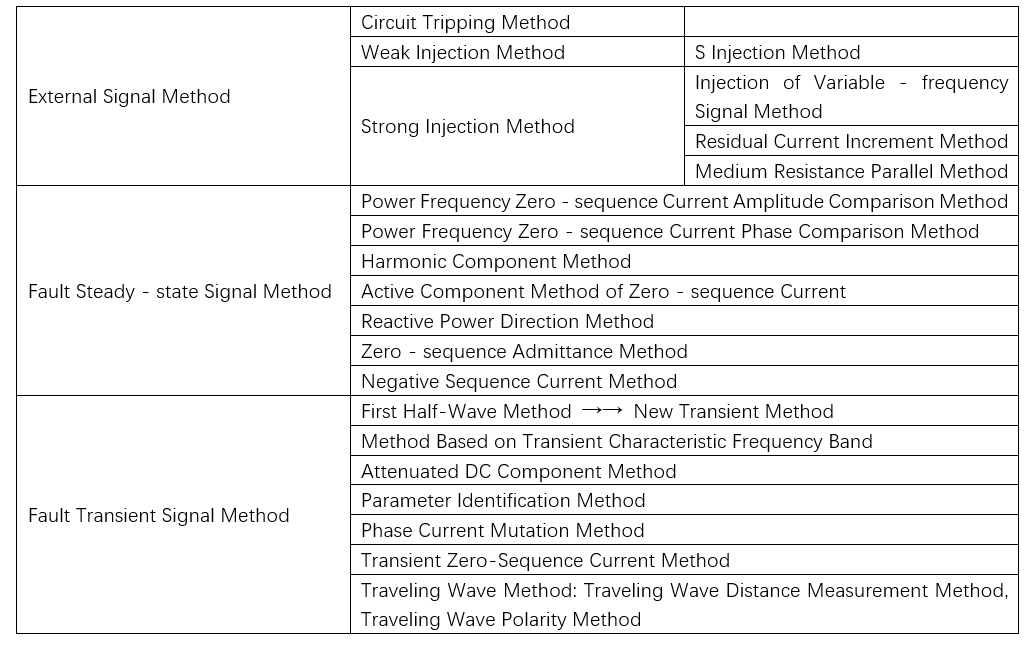
There are currently three categories, totaling 20 basic methods, for locating single-phase grounding faults:
Artificial intelligence (AI) is a cutting-edge technology in the development of modern technology. It establishes corresponding theoretical models by simulating the characteristics of humans, animals, or plants, and solves problems using "human-like" thinking. Especially for power grids, which are inherently highly nonlinear systems, they fall within the scope of AI applications. Additionally, the use of computer computing enhances operational speed, enabling the solution of complex systems like power grids.

  • Expert Database: Establish a database that integrates relevant knowledge and experience.

  • Artificial Neural Network: Simulates the operation of human neurons to solve problems, functioning as a highly nonlinear system.

  • Ant Colony Optimization: An algorithm that simulates the biological behavior of ants searching for food to solve the traveling salesman problem.

  • Genetic Algorithm: Simulates the biological evolution process to obtain global optimal or suboptimal solutions.

  • Petri Net: Models interrelated components in a system, describing phenomena where related components change in chronological order.

  • Rough Set Theory: Uses more information than the system requires as input to ensure a comprehensive description of the system's operational status.

Most intelligent algorithms remain in the theoretical stage, with only a few having been practically applied. However, AI algorithms have demonstrated their superiority in the new era.
Give a tip and encourage the author!

Recommended

Why Must a Transformer Core Be Grounded at Only One Point? Isn't Multi-Point Grounding More Reliable?
Why Does the Transformer Core Need to Be Grounded?During operation, the transformer core, along with the metal structures, parts, and components that fix the core and windings, are all situated in a strong electric field. Under the influence of this electric field, they acquire a relatively high potential with respect to ground. If the core is not grounded, a potential difference will exist between the core and the grounded clamping structures and tank, which may lead to intermittent discharge.I
01/29/2026
Understanding Transformer Neutral Grounding
I. What is a Neutral Point?In transformers and generators, the neutral point is a specific point in the winding where the absolute voltage between this point and each external terminal is equal. In the diagram below, pointOrepresents the neutral point.II. Why Does the Neutral Point Need Grounding?The electrical connection method between the neutral point and earth in a three-phase AC power system is called theneutral grounding method. This grounding method directly affects:The safety, reliabilit
01/29/2026
Voltage Imbalance: Ground Fault, Open Line, or Resonance?
Single-phase grounding, line break (open-phase), and resonance can all cause three-phase voltage unbalance. Correctly distinguishing among them is essential for rapid troubleshooting.Single-Phase GroundingAlthough single-phase grounding causes three-phase voltage unbalance, the line-to-line voltage magnitude remains unchanged. It can be classified into two types: metallic grounding and non-metallic grounding. Inmetallic grounding, the faulted phase voltage drops to zero, while the other two phas
11/08/2025
Composition and Working Principle of Photovoltaic Power Generation Systems
Composition and Working Principle of Photovoltaic (PV) Power Generation SystemsA photovoltaic (PV) power generation system is primarily composed of PV modules, a controller, an inverter, batteries, and other accessories (batteries are not required for grid-connected systems). Based on whether it relies on the public power grid, PV systems are divided into off-grid and grid-connected types. Off-grid systems operate independently without relying on the utility grid. They are equipped with energy-s
10/09/2025
Send inquiry
+86
Click to upload file
Download
Get the IEE Business Application
Use the IEE-Business app to find equipment, obtain solutions, connect with experts, and participate in industry collaboration anytime, anywhere—fully supporting the development of your power projects and business.