Auxiliary contact in switchgears

Auxiliary contacts are essential components in circuit breakers and switchgear, providing critical functionality for control and indication. Here's a breakdown of their purpose and operation:
Purpose of Auxiliary Contacts:
Breaker Trip & Closing Control:
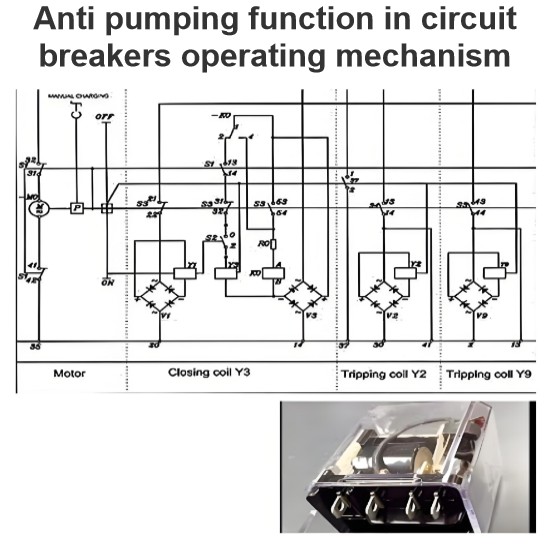
Auxiliary contacts are used in control circuits to manage the supply to the trip coil and closing coil, ensuring proper operation of the circuit breaker.
Breaker ON/OFF Indication:
These contacts provide signals to indicate whether the breaker is in the ON (closed) or OFF (open) position.
Integration with Relays and SCADA:
Auxiliary contacts are connected to devices like the Trip Circuit Supervision (TCS) relay, busbar relay, and SCADA systems for monitoring and control purposes.
Customer Use:
Contacts not used in control circuits are typically made available to customers for custom applications.
Types of Contacts:
NO (Normally Open) Contact:
Open when the device is not energized or in its default state.
Closes when the device is energized or activated.
NC (Normally Closed) Contact:
Closed when the device is not energized or in its default state.
Opens when the device is energized or activated.
NOC (Normally Open-Closed) Contact (Change-Over Contact):
A combination of NO and NC contacts with a common backside.
When the device changes position, the NO contact closes, and the NC contact opens simultaneously.
Operation of Auxiliary Switch:
When the auxiliary switch operates, its contacts change their status:
Open contacts become closed.
Closed contacts become open.
This change in status is used for various control and indication functions in the circuit breaker.
Typical Quantities of Auxiliary Contacts:
Auxiliary switches are often provided in standard configurations, such as:
12 NO + 12 NC
18 NO + 18 NC
20 NO + 20 NC
Circuit Diagram Representation:
In the circuit diagram, the auxiliary switch is typically shown with its NO, NC, and NOC contacts, illustrating how they interact with the breaker's operating mechanism.