Typical transient recovery voltage waveshapes under fault conditions


Transient Recovery Voltages (TRVs) caused by fault current interruptions are typically categorized into three types of waveshapes: exponential, oscillatory, and sawtoothed. Additionally, significant TRV conditions can be classified under two main scenarios:
Short Circuit Current Interruption: This is the simplest scenario involving the interruption of a symmetrical, rated-frequency short-circuit current. Since this current naturally reduces to zero at least once every half cycle, it represents the minimum natural rate of current decay (di/dt). For conventional power systems, which are inherently inductive, the voltage induced following current interruption is kept at a minimum due to this natural decay.
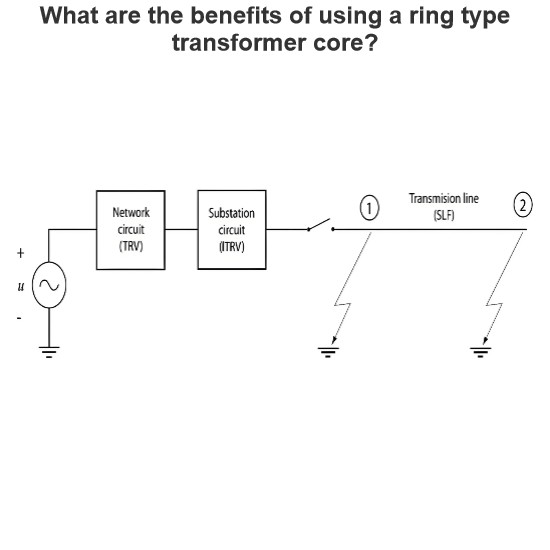
Short-Line Fault Current Interruption: A fault occurring on a transmission line close to the terminals of a high-voltage circuit breaker is referred to as a short-line fault. Clearing such a fault imposes significant thermal stress on the arc channel within the first few microseconds after current interruption. This is due to the reflection of electromagnetic waves from the short circuit back to the circuit breaker terminals, potentially resulting in a TRV with a rise rate ranging from 5 to 10 kV/μs.
These classifications highlight the complexity and variability of TRVs encountered during fault current interruptions, emphasizing the importance of understanding these phenomena for effective system design and protective measures.