• Product
  • Suppliers
  • Manufacturers
  • Solutions
  • Free tools
  • Knowledges
  • Experts
  • Communities
Search


Revolutionary 550 kV Capacitor-Free Arc-Quenching Circuit Breaker Debuts in China

Baker
Baker
Field: News
Engineer
4-6Year
Canada

Recently, a Chinese high-voltage circuit breaker manufacturer, in collaboration with numerous renowned enterprises, successfully developed a 550 kV capacitor-free arc-quenching chamber circuit breaker, which has passed the full suite of type tests on its first attempt. This achievement marks a revolutionary breakthrough in the interrupting performance of circuit breakers at the 550 kV voltage level, effectively resolving the long-standing “bottleneck” issue caused by reliance on imported capacitors. It provides strong technical support for building next-generation power systems and significantly contributes to clean energy transmission and China’s “Dual Carbon” goals (carbon peak and carbon neutrality).

As a critical component of power systems—often hailed as the “guardian of grid safety”—the arc-quenching capability of circuit breakers directly impacts grid stability. Traditional extra-high-voltage (EHV) circuit breakers rely on external capacitor banks to assist in arc interruption, resulting in complex structures, large physical footprints, and high operation and maintenance costs. Moreover, these capacitors have been entirely dependent on imports, leading to prolonged procurement cycles.
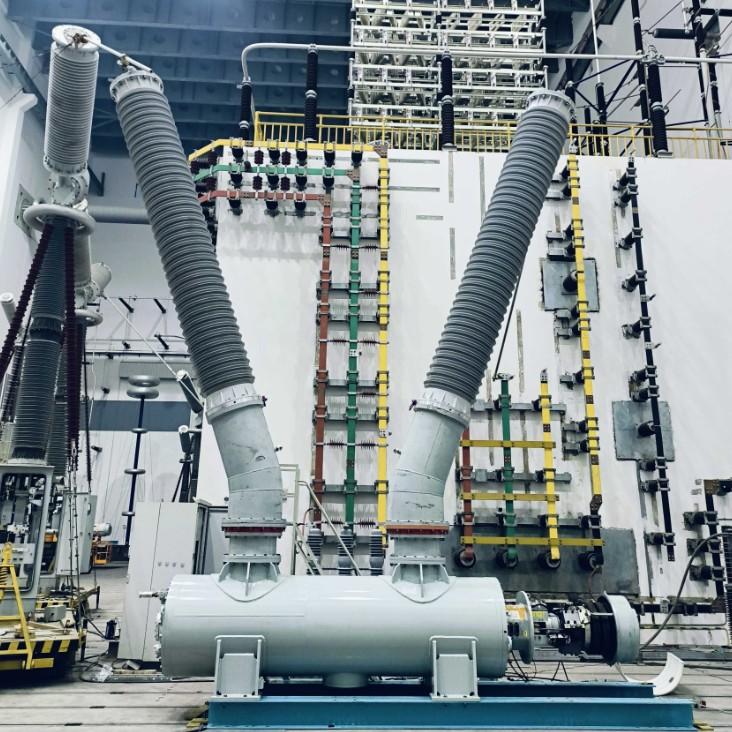
550 kV capacitor-free arc-quenching chamber circuit breaker.jpg

To address these challenges, the R&D team at the Chinese manufacturer leveraged internationally advanced arc simulation and measurement systems to conduct in-depth studies on how parameters such as puffer cylinder pressure, fluid temperature, flow velocity, and mass flow rate affect interrupting performance. Through multi-stage gas flow field optimization, they significantly enhanced breaking capability. Crucially, the team pioneered a capacitor-free arc-quenching chamber design, completely eliminating dependence on traditional capacitor banks.

The new 550 kV circuit breaker features a capacitor-free arc-quenching structure, substantially increasing the insulation distance to ground. Its coaxial design ensures mechanical simplicity and compactness. The unit supports cover-opening inspections, effectively avoiding risks associated with capacitor oil leakage or damage, thereby greatly improving equipment reliability. By removing integrated capacitors per phase, eliminating capacitor supports, and optimizing both moving and stationary end brackets, the design enhances assembly efficiency and quality while reducing reliance on imported core components. This innovation shortens manufacturing lead times and achieves full domestic control over the production process.

Looking ahead, the Chinese high-voltage circuit breaker manufacturer will continue to prioritize market demand, drive innovation-led development, and leverage synergies across industry–academia–research partnerships. The company remains committed to advancing landmark core technologies and building a world-class high-end equipment industrial cluster, contributing Chinese ingenuity to the global energy transition.
Give a tip and encourage the author!
Recommended
Why does a 2-in 4-out 10 kV solid-insulated ring main unit have two incoming feeder cabinets?
A "2-in 4-out 10 kVsolid-insulated ring main unit" refers to a specific type of ring main unit (RMU). The term "2-in 4-out" indicates that this RMU has two incoming feeders and four outgoing feeders.10 kVsolid-insulated ring main unit are equipment used in medium-voltage power distribution systems, primarily installed in substations, distribution stations, and transformer stations to distribute high-voltage power to low-voltage distribution networks. They generally consist of high-voltage incomi
Garca
12/10/2025
Research and Development Status of 12 kV SF6 Gas-Free Ring Main Unit
Gas insulation is primarily based on SF₆ gas. SF₆ has extremely stable chemical properties and exhibits excellent dielectric strength and arc-quenching performance, making it widely used in electrical power equipment. SF₆-insulated switchgear features a compact structure and small size, is unaffected by external environmental factors, and demonstrates exceptional adaptability.However, SF₆ is internationally recognized as one of the six major greenhouse gases. Leakage from SF₆-insulated switchgea
Echo
12/10/2025
Research on Arcing and Interruption Characteristics of Eco-Friendly Gas-Insulated Ring Main Units
Eco-friendly gas-insulated ring main units (RMUs) are important power distribution equipment in electrical systems, featuring green, environmentally friendly, and high-reliability characteristics. During operation, arc formation and interruption characteristics significantly affect the safety of eco-friendly gas-insulated RMUs. Therefore, in-depth research on these aspects is of great significance for ensuring the safe and stable operation of power systems. This article aims to investigate the a
Dyson
12/10/2025
SF6 vs SF6 gas Free Ring Main Units: Key Differences
From the perspective of insulation performance, sulfur hexafluoride SF6 exhibits excellent insulating properties. Its dielectric strength is approximately 2.5 times that of air, effectively ensuring the insulation performance of electrical equipment under standard atmospheric pressure and ambient temperature. The new SF6 gas free gases used in SF6 gas-free switchgear—such as certain gas mixtures—can also meet insulation requirements, though their specific values vary depending on the formulation
Echo
12/10/2025
Send inquiry
Download
Get the IEE Business Application
Use the IEE-Business app to find equipment, obtain solutions, connect with experts, and participate in industry collaboration anytime, anywhere—fully supporting the development of your power projects and business.