• Product
  • Suppliers
  • Manufacturers
  • Solutions
  • Free tools
  • Knowledges
  • Experts
  • Communities
Search


Buchholz Relay Function | Oil Level & Gas Fault Detection for Transformer Protection

Rockwell
Field: Manufacturing
China

Revised and Polished Version:

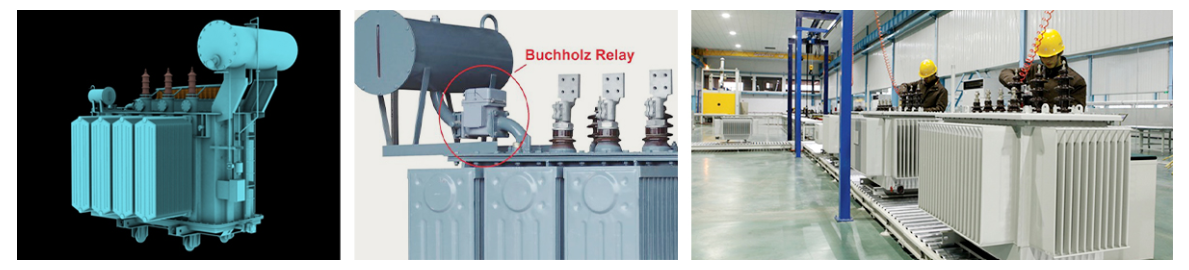
The Buchholz relay is a critical protective device used in oil-immersed transformers, serving multiple key functions to ensure safe and reliable operation:

1. Monitoring Oil Level Changes:

The relay continuously monitors the oil level within the transformer tank. A drop in oil level—often caused by leaks or oil loss—can compromise the transformer’s insulation and cooling capabilities, potentially leading to overheating or insulation failure. The Buchholz relay detects such changes and initiates appropriate alarm or shutdown actions.

2. Detecting Gas Accumulation:

Under abnormal operating conditions, such as insulation aging, localized overheating, or partial discharges, insulating materials and transformer oil may decompose and generate gases like hydrogen, methane, ethylene, and acetylene. The Buchholz relay detects the accumulation of these fault-generated gases in the oil, providing an early indication of developing internal problems.
3. Identifying Internal Faults:

In the event of serious internal faults—such as winding insulation breakdown, arcing, or severe short circuits—rapid gas generation occurs, often accompanied by a surge of oil flow. The Buchholz relay is designed to sense both the slow accumulation of gases (for minor faults) and sudden oil displacement (for major faults), triggering alarm signals for minor issues and initiating immediate tripping of the transformer for severe faults.

4. Providing Protective Actions:

Upon detecting abnormal conditions, the Buchholz relay activates protective measures. It typically has two sets of contacts: one for alarm (activated by gas accumulation) and another for tripping (activated by sudden oil flow due to major faults). This dual-stage response helps prevent catastrophic damage and enhances system safety.

Conclusion:

In summary, the Buchholz relay plays a vital role in the early detection of incipient faults within oil-immersed transformers. By monitoring oil levels and gas formation, it enables timely intervention, minimizes damage, and significantly improves the reliability and longevity of the transformer. As such, it is an indispensable safety component in power transformer protection systems.
Give a tip and encourage the author!

Recommended

Faults and Handling of Single-phase Grounding in 10kV Distribution Lines
Characteristics and Detection Devices for Single-Phase Ground Faults1. Characteristics of Single-Phase Ground FaultsCentral Alarm Signals:The warning bell rings, and the indicator lamp labeled “Ground Fault on [X] kV Bus Section [Y]” illuminates. In systems with a Petersen coil (arc suppression coil) grounding the neutral point, the “Petersen Coil Operated” indicator also lights up.Insulation Monitoring Voltmeter Indications:The voltage of the faulted phase decreases (in
01/30/2026
Neutral point grounding operation mode for 110kV~220kV power grid transformers
The arrangement of neutral point grounding operation modes for 110kV~220kV power grid transformers shall meet the insulation withstand requirements of transformer neutral points, and shall also strive to keep the zero-sequence impedance of substations basically unchanged, while ensuring that the zero-sequence comprehensive impedance at any short-circuit point in the system does not exceed three times the positive-sequence comprehensive impedance.For 220kV and 110kV transformers in new constructi
01/29/2026
Why Do Substations Use Stones, Gravel, Pebbles, and Crushed Rock?
Why Do Substations Use Stones, Gravel, Pebbles, and Crushed Rock?In substations, equipment such as power and distribution transformers, transmission lines, voltage transformers, current transformers, and disconnect switches all require grounding. Beyond grounding, we will now explore in depth why gravel and crushed stone are commonly used in substations. Though they appear ordinary, these stones play a critical safety and functional role.In substation grounding design—especially when multiple gr
01/29/2026
Why Must a Transformer Core Be Grounded at Only One Point? Isn't Multi-Point Grounding More Reliable?
Why Does the Transformer Core Need to Be Grounded?During operation, the transformer core, along with the metal structures, parts, and components that fix the core and windings, are all situated in a strong electric field. Under the influence of this electric field, they acquire a relatively high potential with respect to ground. If the core is not grounded, a potential difference will exist between the core and the grounded clamping structures and tank, which may lead to intermittent discharge.I
01/29/2026
Related Products
Send inquiry
+86
Click to upload file
Download
Get the IEE Business Application
Use the IEE-Business app to find equipment, obtain solutions, connect with experts, and participate in industry collaboration anytime, anywhere—fully supporting the development of your power projects and business.