• Product
  • Suppliers
  • Manufacturers
  • Solutions
  • Free tools
  • Knowledges
  • Experts
  • Communities
Search


What is Capacitive Voltage Transformer?

Edwiin
Field: Power switch
China

What is Capacitive Voltage Transformer?

Definition: A capacitive voltage transformer (CVT), also known as a capacitive potential transformer, steps down high - voltage input signals to provide low - voltage signals that can be easily measured by measuring instruments.

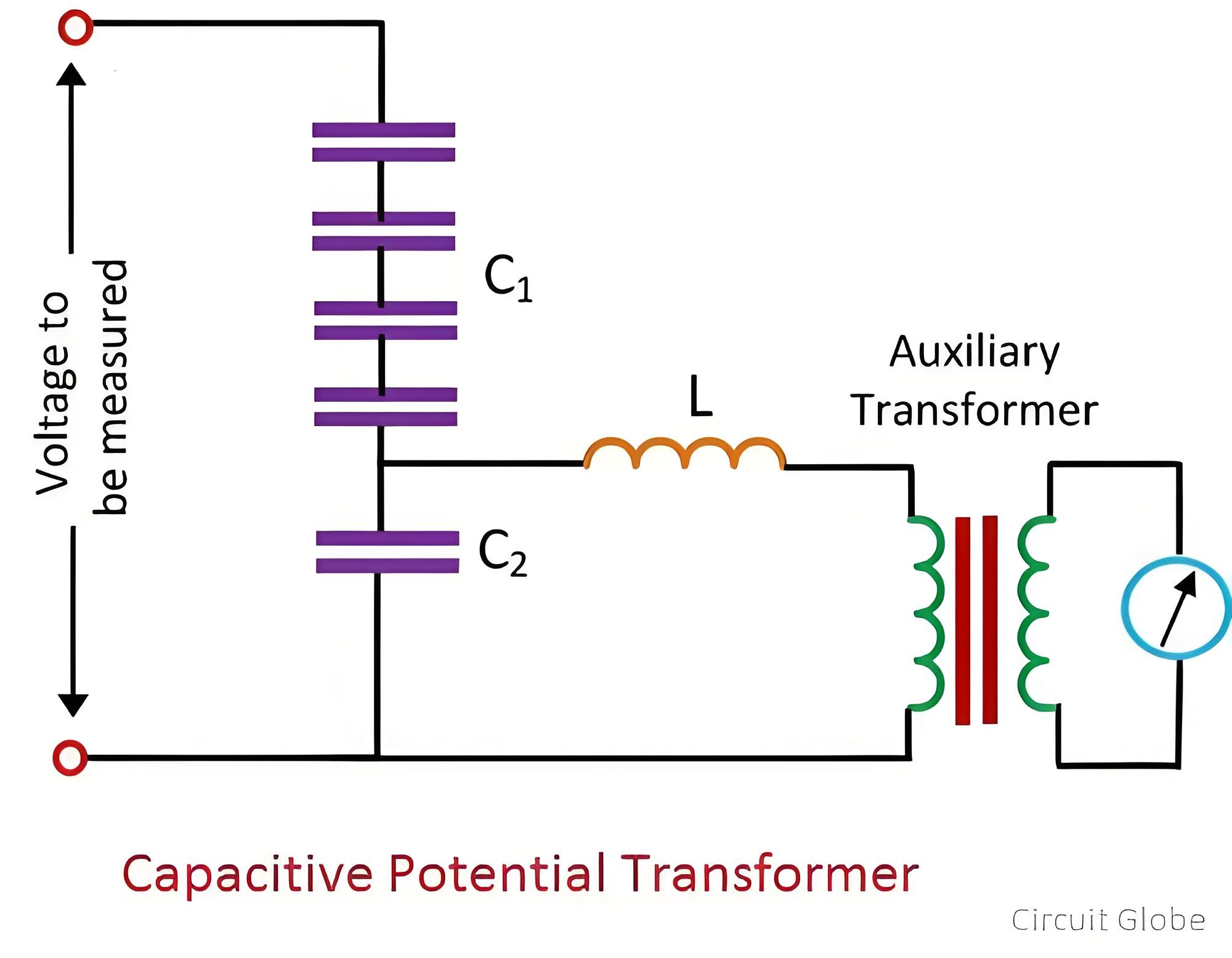
The capacitive potential divider, inductive element, and auxiliary transformer are the three main components of a capacitive potential transformer.
CVT.jpg

Why is a Capacitive Voltage Transformer (CVT) Needed?

When measuring high voltages above 100 kV, a highly - insulated transformer is required. Compared with ordinary transformers, highly - insulated transformers are quite costly. To cut costs, capacitive voltage transformers are employed in the system. CVTs are inexpensive, and their performance is not significantly inferior to that of highly - insulated transformers.

Working Principle of Capacitive Voltage Transformer

The capacitive potential divider is used in conjunction with the auxiliary transformer and the inductive element. The capacitive potential divider steps down extra - high - voltage signals to low - voltage signals. The output voltage of the capacitive voltage transformer is further stepped down with the aid of the auxiliary transformer.

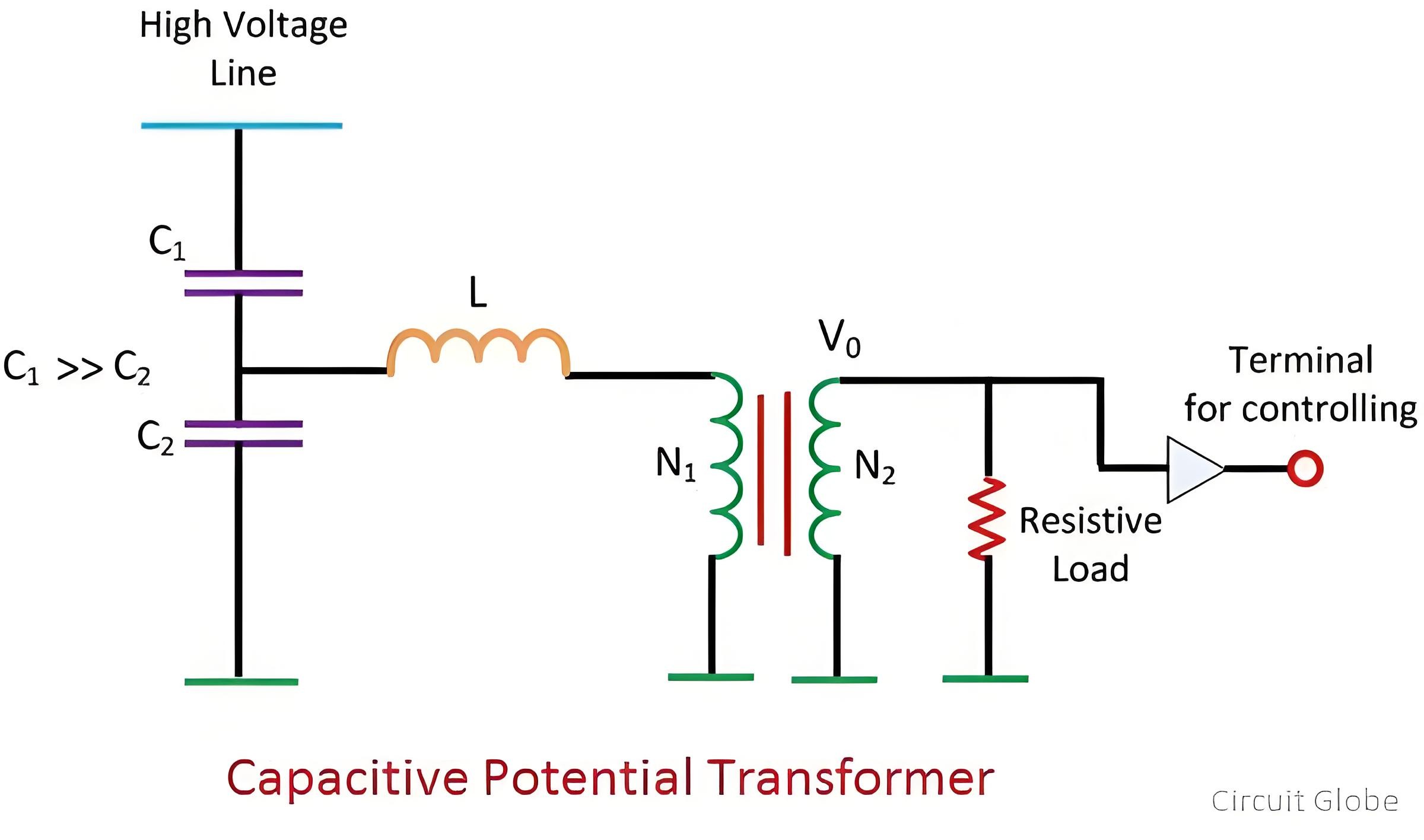
Refer to the circuit diagram of the capacitive voltage transformer.
CVT.jpg

Arrangement of Capacitor or Potential Divider

The capacitor or potential divider is connected across the line whose voltage is to be measured or controlled. Suppose C1 and C2 are the capacitors connected across the transmission line. The output of the potential divider serves as the input to the auxiliary transformer.

Compared with the capacitor placed near the transmission line, the capacitor placed near the ground has a higher capacitance value. A high capacitance value means that the impedance of that part of the potential divider becomes low. As a result, low voltages are transmitted to the auxiliary transformer. The auxiliary transformer further steps down the voltages.

N1 and N2 are the number of turns in the primary and secondary windings of the transformer respectively. The meter used to measure the low - voltage value is resistive, while the potential divider is capacitive. Therefore, a phase shift occurs, which affects the output. To solve this problem, an inductor is connected in series with the auxiliary transformer.This inductor L contains the leakage flux of the auxiliary winding of the auxiliary transformer. The value of the inductance is given by

image.png

The value of the inductance is adjustable. The inductance is utilized to compensate for the voltage drops that occur in the transformer due to the decrease in current from the potential divider. However, in practical operation, due to inductance losses, complete compensation cannot be achieved.The voltage transformation ratio of the transformer is expressed as

image.png

Since the value of C1 is larger than that of C2, the value of C1/(C1 + C2) is small, enabling the acquisition of a low voltage.The voltage transformation ratio of the capacitive potential transformer is independent of the burden. Here, the burden refers to the load carried by the secondary winding of the transformer
Give a tip and encourage the author!

Recommended

Classification of Equipment Defects for Relay Protection and Safety Automatic Devices in Substations
In daily operations, various equipment defects are inevitably encountered. Whether maintenance personnel, operation and maintenance staff, or specialized management personnel, all must understand the defect classification system and adopt appropriate measures according to different situations.According to Q/GDW 11024-2013 "Operation and Management Guide for Relay Protection and Safety Automatic Devices in Smart Substations," equipment defects are classified into three levels based on severity an
12/15/2025
Under What Conditions Will the Line Circuit Breaker Auto-Reclosing Signal Be Locked Out?
The line circuit breaker auto-reclosing signal will be locked out if any of the following conditions occur:(1) Low SF6 gas pressure in circuit breaker chamber at 0.5MPa(2) Insufficient energy storage in circuit breaker operating mechanism or low oil pressure at 30MPa(3) Busbar protection operation(4) Circuit breaker failure protection operation(5) Line distance protection zone II or zone III operation(6) Short lead protection operation of circuit breaker(7) Presence of remote tripping signal(8)
12/15/2025
Application of Auto-Reclosing Residual Current Protective Devices in Lightning Protection for Communication Power Supplies
1. Power Interruption Problems Caused by RCD False Tripping During Lightning StrikesA typical communication power supply circuit is shown in Figure 1. A residual current device (RCD) is installed at the power supply input terminal. The RCD primarily provides protection against electrical equipment leakage currents to ensure personal safety, while surge protective devices (SPDs) are installed on power supply branches to protect against lightning intrusions. When lightning strikes occur, the senso
12/15/2025
Reclosing Charge Time: Why Does Reclosing Require Charging? What Effects Does Charging Time Have?
1. Function and Significance of Reclosing ChargingReclosing is a protective measure in power systems. After faults such as short circuits or circuit overloads occur, the system isolates the faulty circuit and then restores normal operation through reclosing. The function of reclosing is to ensure continuous operation of the power system, improving its reliability and safety.Before performing reclosing, the circuit breaker must be charged. For high-voltage circuit breakers, the charging time is g
12/15/2025
Send inquiry
+86
Click to upload file
Download
Get the IEE Business Application
Use the IEE-Business app to find equipment, obtain solutions, connect with experts, and participate in industry collaboration anytime, anywhere—fully supporting the development of your power projects and business.