• Product
  • Suppliers
  • Manufacturers
  • Solutions
  • Free tools
  • Knowledges
  • Experts
  • Communities
Search


Air Break Circuit Breaker

Edwiin
Field: Power switch
China

In an air break circuit breaker, the arc is initiated and extinguished in substantially static air as the arc moves. These breakers are used for low voltages, generally up to 15 kV, with rupturing capacities of 500 MVA. As an arc-quenching medium, air circuit breakers offer several advantages over oil, including:

  • Elimination of risks and maintenance associated with oil use.

  • Absence of mechanical stress caused by gas pressure and oil movement.

  • Elimination of costs from regular oil replacement due to oil deterioration from successive breaking operations.

In air break circuit breakers, contact separation and arc extinction occur in air at atmospheric pressure, employing the high-resistance principle. The arc is expanded via arc runners and chutes, while arc resistance is increased through splitting, cooling, and lengthening.

Arc resistance is heightened until the voltage drop across the arc exceeds the system voltage, extinguishing the arc at the current zero point of the AC wave.

Air break circuit breakers are used in DC circuits and AC circuits up to 12,000 V. Typically indoor types, they are installed on vertical panels or indoor draw-out switchgear, widely applied in indoor medium- and low-voltage switchgear for AC systems.

Plain Break Type Air Break Circuit Breaker

The simplest variant features two horn-shaped contacts. Arcing initially occurs across the shortest distance between the horns and is steadily driven upward by convection currents from arc-heated air and the interaction of magnetic and electric fields. As the horns fully separate, the arc extends from tip to tip, achieving lengthening and cooling.

The process’s relative slowness and the risk of arc spreading to adjacent metal components limit its application to approximately 500 V and low-power circuits.

Magnetic Blow-Out Type Air Break Circuit Breaker

Used in circuits with voltages up to 11 kV, arc extinction in some air circuit breakers is achieved via a magnetic field from blowout coils connected in series with the interrupted circuit. These coils move the arc into chutes—they do not extinguish the arc themselves. In the chutes, the arc is lengthened, cooled, and extinguished. Arc shields prevent arc spreading to adjacent networks.

Polarity, Arc Chutes, and Operational Details of Air Break Circuit Breakers
Importance of Coil Polarity

Correct coil polarity is critical to direct the arc upward, leveraging electromagnetic forces to enhance arc movement. This principle becomes more effective with higher fault currents, enabling such breakers to achieve higher rupturing capacities.

Arc Chute Functionality

An arc chute is a key device for arc extinction in air, performing three interrelated roles:

  • Arc Confinement: Restricts the arc to a defined space, preventing uncontrolled spread.

  • Magnetic Control: Guides arc movement via magnetic fields to facilitate extinction within the chute.

  • Rapid Cooling: Deionizes arc gases through intense cooling, ensuring arc quenching.

Air Chute Air Break Circuit Breaker Design

For low- and medium-voltage circuits, this breaker features:

  • Dual Contact Sets:

    • Main Contacts: Copper-based, silver-plated for low resistance, conducting normal current in the closed position.

    • Arcing (Auxiliary) Contacts: Heat-resistant copper alloy, designed to withstand arcing during fault interruption. They close before and open after the main contacts to protect the main contacts from damage.

  • Blowout Mechanism: Steel inserts in the arcing chutes create magnetic fields that accelerate upward arc movement. These plates split the arc into series of short arcs, increasing total voltage drop (anode + cathode drops) across the arcs. If this sum exceeds the system voltage, the arc extinguishes rapidly.

  • Cooling Action: Arc contact with cool steel plates rapidly cools and deionizes the arc, aided by natural or magnetic blowout forces.

Working Principle

  • Fault Occurrence: Main contacts separate first, shifting current to the arcing contacts.

  • Arc Formation: As arcing contacts separate, an arc draws between them.

  • Arc Movement: Electromagnetic and thermal forces drive the arc upward along arc runners.

  • Arc Splitting & Extinction: The arc is split by splitter plates, lengthened, cooled, and deionized, leading to extinction.

Applications

  • Power Station Auxiliaries & Industrial Plants: Suitable for environments requiring fire/explosion hazard mitigation.

  • DC Systems: Employ arc lengthening, runners, and magnetic blowout for breakers up to 15 kV.

Limitation

  • Low-Current Inefficiency: Arc chutes are less effective at low currents due to weaker electromagnetic fields, causing slower arc movement into the chute and potentially delayed interruption.

This design balances simplicity and reliability for medium/low-voltage applications, though its performance varies with current magnitude.
Give a tip and encourage the author!

Recommended

Classification of Equipment Defects for Relay Protection and Safety Automatic Devices in Substations
In daily operations, various equipment defects are inevitably encountered. Whether maintenance personnel, operation and maintenance staff, or specialized management personnel, all must understand the defect classification system and adopt appropriate measures according to different situations.According to Q/GDW 11024-2013 "Operation and Management Guide for Relay Protection and Safety Automatic Devices in Smart Substations," equipment defects are classified into three levels based on severity an
12/15/2025
Under What Conditions Will the Line Circuit Breaker Auto-Reclosing Signal Be Locked Out?
The line circuit breaker auto-reclosing signal will be locked out if any of the following conditions occur:(1) Low SF6 gas pressure in circuit breaker chamber at 0.5MPa(2) Insufficient energy storage in circuit breaker operating mechanism or low oil pressure at 30MPa(3) Busbar protection operation(4) Circuit breaker failure protection operation(5) Line distance protection zone II or zone III operation(6) Short lead protection operation of circuit breaker(7) Presence of remote tripping signal(8)
12/15/2025
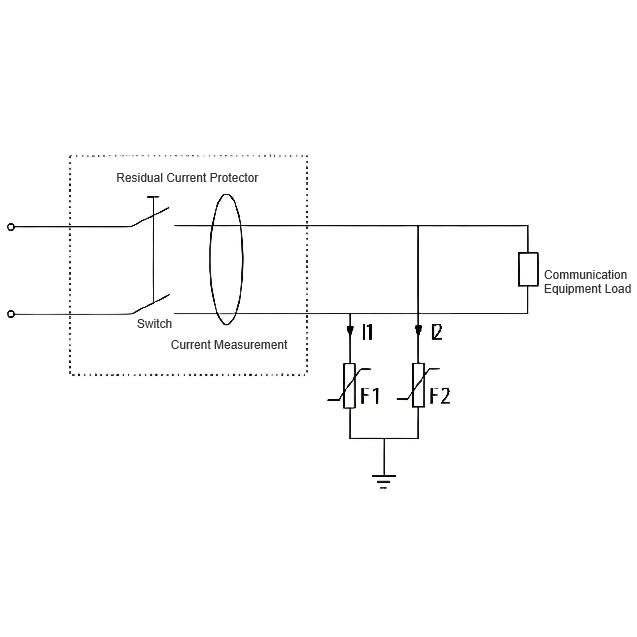
Application of Auto-Reclosing Residual Current Protective Devices in Lightning Protection for Communication Power Supplies
1. Power Interruption Problems Caused by RCD False Tripping During Lightning StrikesA typical communication power supply circuit is shown in Figure 1. A residual current device (RCD) is installed at the power supply input terminal. The RCD primarily provides protection against electrical equipment leakage currents to ensure personal safety, while surge protective devices (SPDs) are installed on power supply branches to protect against lightning intrusions. When lightning strikes occur, the senso
12/15/2025
Reclosing Charge Time: Why Does Reclosing Require Charging? What Effects Does Charging Time Have?
1. Function and Significance of Reclosing ChargingReclosing is a protective measure in power systems. After faults such as short circuits or circuit overloads occur, the system isolates the faulty circuit and then restores normal operation through reclosing. The function of reclosing is to ensure continuous operation of the power system, improving its reliability and safety.Before performing reclosing, the circuit breaker must be charged. For high-voltage circuit breakers, the charging time is g
12/15/2025
Related Products
Send inquiry
+86
Click to upload file
Download
Get the IEE Business Application
Use the IEE-Business app to find equipment, obtain solutions, connect with experts, and participate in industry collaboration anytime, anywhere—fully supporting the development of your power projects and business.