1. Core Advantages Overview: Redefining Substation Standards
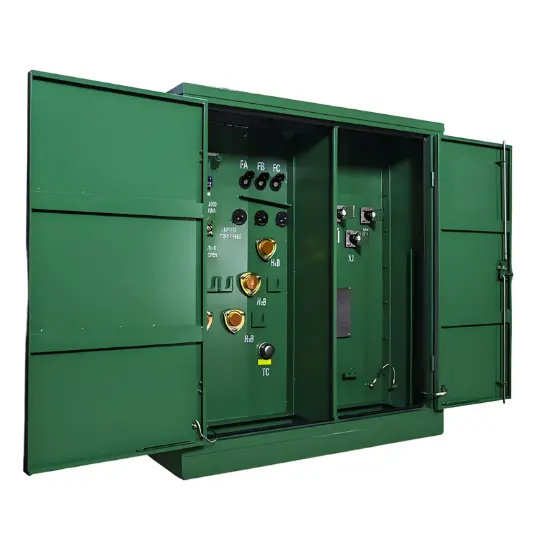
Driven by the dual demands of power system upgrades and urban space optimization, compact substations are revolutionizing traditional substation facilities globally with their innovative design and superior performance. As an integrated, modular power solution, compact substations combine core components—high-voltage switchgear, distribution transformers, and low-voltage distribution equipment—into a compact steel enclosure, achieving a fundamental breakthrough in substation functionality. Compared to conventional substations, they demonstrate significant advantages in space efficiency, construction speed, economic benefits, flexibility, and intelligence, perfectly aligning with modern power systems' needs for efficiency, adaptability, and sustainability.
1.1 Spatial Efficiency Revolution: Minimizing Footprint
Extreme Space Compression: Utilizing 3D layouts and compact equipment, compact substations maximize spatial efficiency. For a 4,000 kVA substation, traditional setups require ~3,000 m² (including civil works), while compact substations reduce this to 100–300 m²—just 1/10th the space. This is decisive for land-scarce urban cores and high-value development zones.
Flexible Deployment: With minimal foundations, compact substations can be installed in unconventional spaces like street greenbelts or building edges. Example: Two 800 kVA units embedded in a coastal city’s pedestrian zone used only 5% of the planned space, freeing land worth millions.
1.2 Construction Speed Breakthrough: From Months to Days
Factory Prefabrication: Core units are manufactured, assembled, and tested off-site. On-site installation, cable connections, and commissioning take 3–7 daysversus traditional substations’ 3–6 months—accelerating deployment by 20-fold.
All-Weather Resilience: During Typhoon Lekima (2019), two 1,600 kVA compact substations restored power in 48 hoursafter flooding, while traditional rebuilds required 4 months.
1.3 Economic Benefits: Lifecycle Cost Optimization
Compact substations reduce costs across initial investment and operations:
Economic Indicator |
Traditional Substation |
Compact Substation |
Advantage |
Initial Investment |
High (Baseline 100%) |
Civil works cost ↓60% |
Overall cost ↓40–50% |
Construction Time |
3–6 months |
3–7 days |
4-month earlier operation |
Energy Efficiency |
High no-load loss (e.g., S11: 570 W) |
Capacity-switching tech ↓70% loss |
Annual savings: 6,824 kWh (400 kVA) |
Maintenance Cost |
~¥80,000/year |
Predictive maintenance + remote monitoring |
**↓60% annual cost** |
Case Study: An industrial park used two 400 kVA capacity-switching units instead of an 800 kVA traditional setup, saving ¥906,000 over 20 years (initial cost + electricity fees).
1.4 Flexible Expansion: Dynamic Adaptation
Modular Design: "Lego-like" configuration supports adding high-voltage cabinets, transformers, or low-voltage modules. Example: A Shenzhen tech park upgraded from 800 kVA to 1,600 kVA in two weeksby adding transformer modules.
Smart Capacity Switching: Next-gen units (e.g., ZGS series) auto-switch capacities (e.g., 125 kVA/400 kVA). During low-load periods, no-load losses drop to 1/3 of large-capacity mode, solving "over-sizing" inefficiencies.
1.5 Environmental Integration: From Utility to Urban Asset
Eco-Performance: Sealed designs + dry-type transformers (<55 dB) reduce noise by 20 dBversus oil-filled units. Electromagnetic shielding lowers field strength to safe levels for residential areas.
2 Technical Architecture: Innovation-Driven Performance
Compact substations leverage integrated designs and cutting-edge technologies for transformative performance.
2.1 Intelligent Monitoring & Control
Real-Time Multi-Parameter Sensing: Temperature sensors (±1°C accuracy), partial discharge monitors (5 pC sensitivity), and 360° video surveillance create transparent operations.
AI Predictive Alerts: Deep learning systems forecast transformer overheating 72 hours in advancewith 92% accuracy, reducing downtime by 85% in automotive plants.
2.2 Triple-Layer Safety System
Structural Safety: IP54-rated enclosures and pressure-release channels (0.5 Bar response) withstand floods and pests.
Electrical Safety: Fully insulated busbars (42 kV/1 min withstand) and rapid ground-fault isolation (<0.1 s) prevent electrocution.
Fire Safety: Auto-extinguishing systems (temperature/smoke-linked) + flame-retardant materials (oxygen index >32) meet NFPA standards.
2.3 Efficient Thermal Management
Dynamic Cooling: Graded ventilation (>45°C triggers forced airflow) and directional cooling (dedicated transformer ducts) limit temperature rise to <65 Kin extreme heat.
Phase-Change Materials: Aerogel composites (thermal conductivity: 0.018 W/m·K) in wall layers boost insulation efficiency by 50%.
3 Application-Specific Solutions
Compact substations deliver tailored configurations for diverse scenarios.
3.1 High-Density Urban Areas
Challenges: Space constraints, high reliability demands, environmental sensitivity.
Solution:
COOPER-type compact substations + underground cabling + aesthetic integration.
SF6-insulated ring-main units (350mm width) for sidewalk installation.
Dual-circuit auto-transfer (ATS <100 ms) for N-1 security.
3.2 Rural Grid Upgrades
Challenges: Dispersed loads, long supply radii, limited maintenance.
Solution:
Capacity-switching units (125/400 kVA) + solar microgrids + 4G/5G remote monitoring.
Distributed siting (supply radius ≤500m) cuts line losses by 15%.
3.3 Renewable Energy Integration
Challenges: Intermittency, grid-compliance, harsh environments.
Solution:
Wind/PV-optimized substations (-40°C to +50°C operation) + harmonic suppression (THD<3%).
Power forecasting coordination reduces curtailment rates.
3.4 Emergency Power Assurance
Challenges: Rapid response, environmental adaptability, quick deployment.
Solution:
Mobile trailer-mounted substations + self-lifting systems (no cranes needed).
Multi-source compatibility (generators, storage, grid).
Case: 12 mobile units restored critical facilities in 24 hoursduring 2021 floods—5× faster than traditional methods.