1. Core Challenges of Renewable Energy Grid Integration
1.1 Volatility and Intermittency
Renewable sources like wind and solar exhibit output fluctuations due to natural conditions, leading to grid frequency/voltage instability.
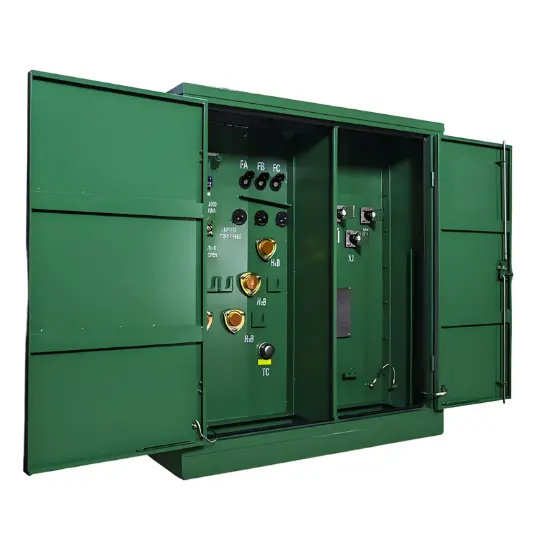
Mitigation requires energy storage systems and smart control technologies. Pad-mounted transformers (PMTs)must offer high compatibility as grid-connection nodes.
1.2 Grid Capacity and Absorption Limits
High renewable penetration risks local grid overload, necessitating optimization of transformer capacity and topology (e.g., loop-fed networks).
1.3 Power Quality Issues
Harmonic pollution and reactive power deficiency demand PMTs with high anti-interference capability and dynamic voltage regulation.
2. Technical Adaptation Solutions for Pad-Mounted Transformers
2.1 High-Compatibility Design
Wide Voltage Range: Supports multi-tap inputs (e.g., 13.8kV/34.5kV → 208V/480V) for diverse distributed energy access.
Dynamic Voltage Regulation: Integrated ±5% tap changers (5-position) enable real-time output adjustment against load fluctuations.
Eco-Friendly Insulation: Biodegradable ester fluid enhances fire safety and sustainability, aligning with renewable project goals.
2.2 Efficiency and Loss Control
Ultra-High Efficiency: Compliance with DOE 2016 standards (e.g., 300kVA PMT: no-load loss 280W, load loss 2.2kW, efficiency ≥99%).
Low-Loss Materials: Grain-oriented steel cores and copper windings reduce eddy-current losses, adapting to intermittent operation.
2.3 Structural Robustness and Reliability
Compact Enclosure: IP67-rated 304 stainless steel/corrosion-coated housing withstands -40°C to +40°C extremes (e.g., deserts/wind farms).
Loop-Feed Topology: Enables multi-transformer redundancy for fault tolerance in local grids.
3. Integrated System Solutions: Energy Storage + Smart Control
3.1 Transformer-Storage Synergy
Battery Energy Storage Systems (BESS) deployed at PMTs absorb surplus renewables via energy shifting, reducing net load volatility by 21%.
Example: 0.5MWh BESS integrated with 225kVA PMT smooths day-night PV output variance.
3.2 AI-Driven Smart Dispatch
Hybrid Dynamic Economic Emission Dispatch (HDEED) and algorithms (e.g., POA-CS) enable multi-objective control:
✓Minimizes operational costs and carbon emissions.
✓ Adjusts grid-connection strategies using generalized load fluctuation coefficients, boosting revenue by 22.4%.
3.3 Harmonic Suppression & Power Quality Optimization
K-factor transformers (K-1~K-4) mitigate high-order harmonics from renewable integration.
4. Case Study: Kaposvár Solar Farm, Hungary
Configuration: 100MW PV plant uses 5,000kVA PMTs to step down 34.5kV array output to 4,160V for grid feed-in.
Eco-Design: Helical pile foundations minimize ecological impact; smart grid strategies enable 130GWh/year generation and 120,000-tonne CO₂reduction.
Economics: Cuts coal consumption by 45,000 tonnes/year, validating PMT viability in high-renewable scenarios.
5. Technical Parameters Comparison (Typical Products)
Capacity |
HV Side (kV) |
LV Side (V) |
No-Load Loss (W) |
Load Loss (W) |
Efficiency |
300kVA |
13.8 |
208Y/120 |
280 |
2,200 |
99.00% |
225kVA |
4.16 |
208Y/120 |
395 |
2,290 |
99.10% |
5,000kVA |
13.8 |
4.16 |
8,889 |
34,996 |
98.20% |
6. Conclusion: Core Value of Pad-Mounted Transformers
PMTs serve as critical physical nodes for high-penetration renewables due to their scalable design, high compatibility, and smart-upgrade capability. Future directions include:
Digital Twin Integration: Real-time sensor data for predictive maintenance.
Grid-Forming Control: Enhanced weak-grid support.
Hybrid Energy Hubs: Deep integration with zero-carbon tech (e.g., storage, hydrogen).