• Product
  • Suppliers
  • Manufacturers
  • Solutions
  • Free tools
  • Knowledges
  • Experts
  • Communities
Search


Front-Panel Visible Wiring Standards for Electrical Control Panels
James
James
Field: Electrical Operations
China

Front-panel visible wiring: During manual wiring (not using templates or molds), wiring must be straight, neat, closely attached to the mounting surface, rationally routed, and with secure connections that facilitate maintenance.
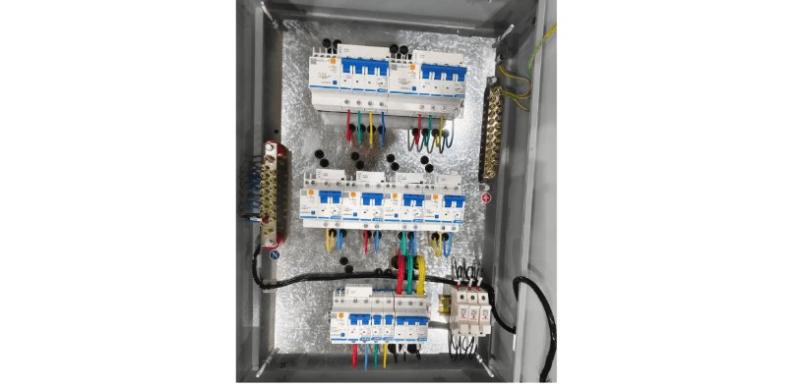
Visible Wiring Standards.jpg

  1. Wiring channels should be minimized as much as possible. Within the same channel, bottom-layer conductors shall be grouped by main and control circuits, arranged in a single-layer parallel dense layout or bundled, and kept closely attached to the mounting surface.

  2. Conductor length should be as short as possible. Horizontal aerial spans are permitted—for example, between two coil terminals or between main contact terminals—provided a certain amount of slack is left, and such conductors need not be tightly attached to the mounting surface.

  3. Conductors on the same plane shall be aligned at the same height or depth and must not cross. If crossing is unavoidable, a horizontal aerial span may be used, but only if it constitutes rational routing.

  4. Wiring must be horizontally level and vertically straight, with direction changes made at 90° angles.

  5. If upper and lower contact points are not vertically aligned, diagonal wiring shall not be used.

  6. When connecting conductors to terminal blocks or studs, the insulation layer must not be pinched, reverse loops are prohibited, and exposed copper shall not exceed 1 mm. Additionally, the spacing between conductors at different connection points of the same component or same circuit shall remain consistent.

  7. No more than two conductors shall be connected to a single terminal of an electrical component. Generally, only one conductor is allowed per terminal segment on a terminal block.

  8. During wiring, the conductor core and insulation must not be damaged.

  9. When conductors of different cross-sectional areas are used, those with larger cross-sections shall be placed in the lower layer, and those with smaller cross-sections in the upper layer.

  10. When routing multiple conductors (main power circuits), they shall be arranged so that the entire group lies on the same horizontal or vertical plane.

  11. Coding sleeves may be omitted if the wiring is simple.

Wire color coding:

  1. Protective earth (PE) conductors must be green-and-yellow.

  2. Neutral (N) and mid-point (M) conductors in power circuits must be light blue.

  3. AC or DC power circuits shall use black conductors.

  4. AC control circuits shall use red conductors.

  5. DC control circuits shall use blue conductors.

  6. Interlock conductors in control circuits that remain live when the external control circuit is disconnected shall be orange or yellow.

  7. Circuits connected to the protective conductor shall use white conductors.
Give a tip and encourage the author!
Recommended
Research on the Application of a Remote Online Defect Elimination System for High-Voltage Disconnector Contacts
High-voltage disconnectors, also known as isolator switches or knife switches, feature a simple working principle and convenient operation. As commonly used high-voltage switching equipment, they significantly impact the operational safety of substations, demanding stringent reliability in practical applications. The remote online defect-elimination system for high-voltage disconnector contacts offers advantages such as ease of operation, low operating costs, and high stability, making it well-s
Edwiin
11/11/2025
Application of High-Voltage Disconnectors in Traction Power Supply Systems
Traditional switches have become increasingly inadequate for the operational demands of modern traction power supply systems. The emergence of high-voltage disconnectors has effectively filled this gap. High-voltage disconnector systems optimize the structure of conventional switches, broaden their applicability, and place greater emphasis on fine details, thereby enhancing the safety and reliability of power systems during actual operation. Therefore, it is essential to analyze and study the ap
Echo
11/11/2025
Fault Handling of High-Voltage Disconnector Failure to Open at a 110 kV Substation
According to relevant regulations, high-voltage disconnectors are permitted to perform the following operations: Switching (opening/closing) normally operating potential transformers (PTs) and surge arresters; Switching the neutral grounding disconnector of a main transformer under normal operating conditions; Switching small-current loops to balance circulating currents.A high-voltage disconnector is an electrical component without arc-quenching capability. Therefore, it may only be operated wh
Felix Spark
11/11/2025
Monitoring Technology for Open/Close Position of High-Voltage Disconnectors
In the context of high-speed operation of power systems, the opening and closing mechanism of high-voltage disconnectors in substations faces challenges such as complex operational procedures, large workloads, and low operational efficiency. With the advancement of image recognition technologies and sensor innovations, modern intelligent substations now demand higher technical standards for monitoring the open/close positions of high-voltage disconnectors during infrastructure development.The in
Oliver Watts
11/11/2025
Send inquiry
Download
Get the IEE Business Application
Use the IEE-Business app to find equipment, obtain solutions, connect with experts, and participate in industry collaboration anytime, anywhere—fully supporting the development of your power projects and business.