Understanding the Difference and Applications of On-Delay and Off-Delay Time Relays

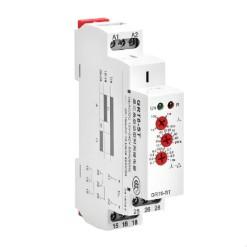
In electrical and electronic engineering, time relays are crucial control components. Operating on electromagnetic or mechanical principles, they delay the closing or opening of contacts within control circuits. This time-delayed action enables circuits to automatically perform specific operations after a set interval. Based on their timing characteristics, time relays are primarily classified into two types: on-delay and off-delay.
1. On-Delay Time Relay
An on-delay time relay does not respond immediately upon receiving an input signal. Instead, it initiates a preset delay period. During this interval, the internal timing mechanism begins counting, while the output section remains inactive. Only after the delay period ends does the output section activate, triggering the corresponding action in the control circuit. Once the input signal is removed, this type of relay immediately returns to its pre-actuated state.
2. Off-Delay Time Relay
Unlike the on-delay type, an off-delay time relay responds immediately when it receives an input signal—the output section activates instantly. However, when the input signal is removed, the relay does not deactivate immediately. Instead, it begins a preset delay period during which the output remains active before finally returning to its normal state.
During this delay period, even after the input signal has disappeared, the output section continues to maintain its active state. Only when the delay period ends does the time relay return to its pre-actuated state.
3. Electrical Symbols and Markings
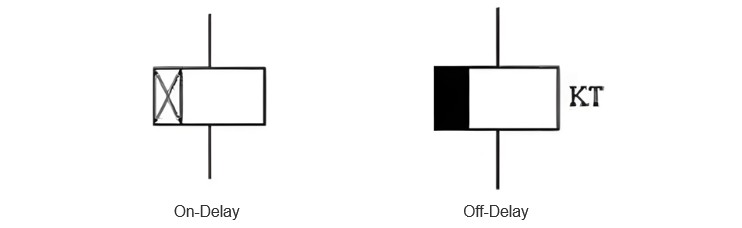
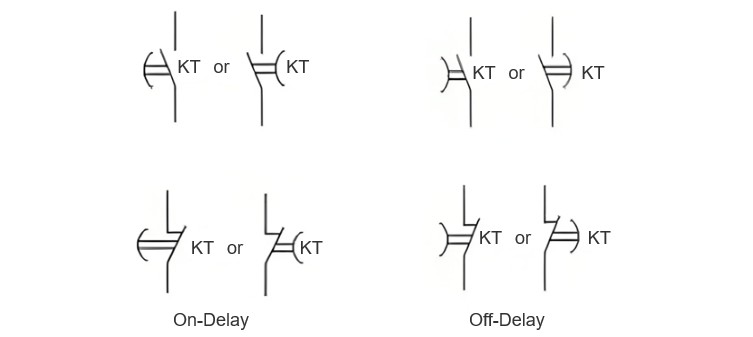
To help engineers identify and differentiate time relay types on circuit diagrams, specific electrical symbols are used. For on-delay time relays, the coil symbol typically features a hollow block to the left of a standard relay symbol, while the contact symbol includes an equal sign (=) on the left. For off-delay time relays, the coil symbol uses a solid block on the left, and the contact symbol is marked with a double equal sign (==).
4. Applications and Practice
In practical applications, correctly selecting and using time relays is critical for circuit stability. On-delay relays are typically used where an action must be delayed after the input signal appears, such as motor start delays or gradual lighting effects. Off-delay relays are ideal for scenarios requiring the output to remain active for a period after the input signal is removed, such as delayed closing of elevator doors or delayed reset of safety devices.
5. Summary
In summary, time relays play an irreplaceable role in control circuits, especially in automated systems requiring precise timing. By thoroughly understanding the operating principles and applications of on-delay and off-delay time relays, engineers can flexibly apply them to meet complex control requirements, thereby enhancing overall system performance and reliability.