High-Voltage DC Contactor Wiring Essentials: Polarity Requirements and Safety Guidelines

High-Voltage DC Contactors Usually Have Polarity Distinctions
This is especially true in application scenarios with high current and high voltage.
Why Polarity Distinctions Exist
Arc Characteristics
DC current has no zero-crossing point, making arc extinction more difficult than that of AC. Polarity (current direction) may affect the stretching and extinguishing effect of the arc.
Internal Structural Design
Some contactors optimize arc-extinguishing devices (such as magnetic blowout coils and permanent magnets) for current direction. Reverse current may lead to a decrease in arc-extinguishing capability.
Electronic Auxiliary Circuits
Certain contactors integrate electronic arc-extinguishing or surge suppression circuits (e.g., diodes, RC circuits). Incorrect polarity may damage these components.
Consequences of Reverse Connection
Arc Extinction Failure: The arc duration is prolonged, which ablates the contacts and shortens the service life.
Performance Degradation: The contact resistance increases, and heat generation intensifies.
Damage Risk: If electronic components (such as suppression diodes) are included, it may cause short circuits or failures.
Precautions for Using High-Voltage Relays
Inrush Current
Causes of Inrush Current
High-voltage DC relays are generally used in DC-side main circuits of inverters (energy storage), power modules (charging piles), electronic control units (electric vehicles) and other equipment. The DC side of such equipment usually has capacitors, which play roles in energy buffering and power balancing, filtering high-frequency harmonics and noise, maintaining stable DC bus voltage, protecting power devices, and improving the dynamic response of the system. However, this is similar to a capacitive load, which can cause excessive voltage difference across the high-voltage DC relay and thus induce inrush current.
Consequences of Inrush Current
Inrush current may cause the contacts of the high-voltage DC relay to stick. When the coil is de-energized, the contacts cannot open and will bounce open automatically after a period of time.
Inrush current may cause one-sided sticking of the high-voltage DC relay contacts. When the coil is energized, the relay does not pull in, but the auxiliary contacts remain closed.
Inrush current may cause uneven contacts of the high-voltage DC relay, reducing the effective contact area, increasing heat generation, and creating potential safety hazards.
Load-Bearing Interruption
High-voltage DC contactors face more severe challenges during load-bearing interruption (live breaking) than AC contactors. The main reason is that DC current has no natural zero-crossing point, making arc extinction difficult. The following are key points and countermeasures:
Difficulties in Load-Bearing Interruption
Sustained Arc: DC current has no zero-crossing point, so the arc may persist for a long time, leading to contact ablation or even welding.
High Energy Release: When inductive loads (such as motors and transformers) are de-energized, high induced voltage is generated, which may break down insulation or damage equipment.
Polarity Impact: If the contactor is designed for one-way arc extinction, reverse current may exacerbate arc problems.
Arc-extinguishing technology of high-voltage DC contactors
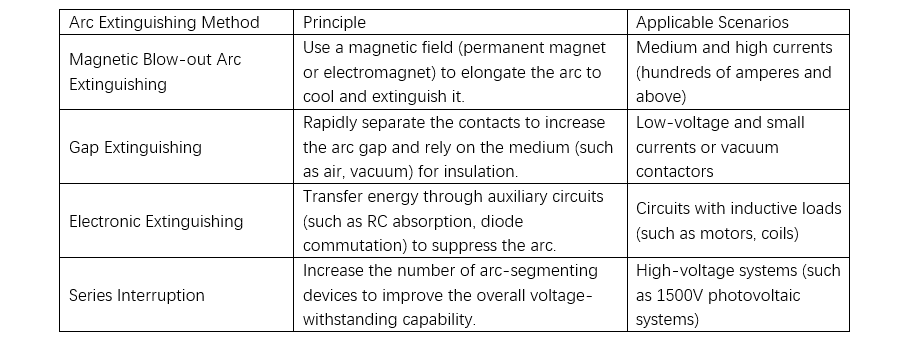
Solutions for Load-Bearing Interruption
Pre-charging Circuit (Common in Electric Vehicles)
Before the main contacts of the contactor close, a pre-charging resistor is used to limit the inrush current and reduce the energy during breaking.
Arc-Extinguishing Auxiliary Circuits
RC Snubber Circuit: Connected in parallel with the contacts to absorb inductive energy.
Freewheeling Diode: Provides a current loop for inductive loads (note polarity matching).
Metal Oxide Varistor (MOV): Limits overvoltage.
Step-by-Step Breaking
First break the small-current auxiliary contacts, then break the main contacts (such as in dual-contact design).
Precautions
Current/Voltage Limitation: Ensure the breaking current does not exceed the rated breaking capacity of the contactor (e.g., 1000V/500A); otherwise, it may fail.
Polarity Matching: If the contactor is of unidirectional design, it must be energized in the nominal direction; otherwise, the arc-extinguishing capability will decrease.
Load Types:
Resistive Loads: Easier to break (low arc energy).
Inductive Loads: Require additional protection circuits (such as diodes).
Capacitive Loads: Be wary of inrush current during closing (may cause contact adhesion).