• Product
  • Suppliers
  • Manufacturers
  • Solutions
  • Free tools
  • Knowledges
  • Experts
  • Communities
Search


Dry-Type vs Oil-Filled 35kV New Energy Transformers: Cost and Performance Comparison

Ron
Field: Modeling and Simulation
Cameroon

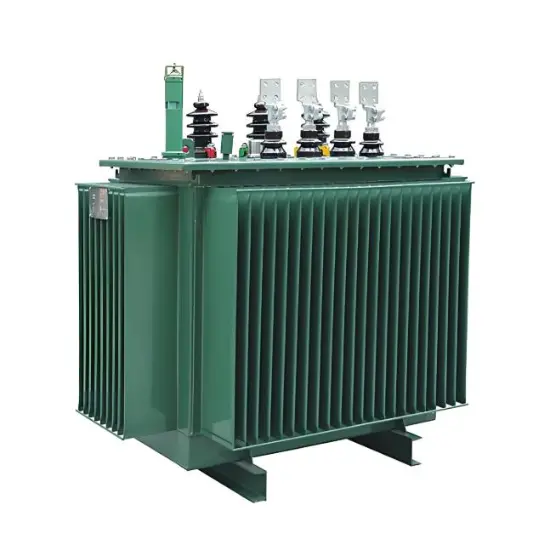
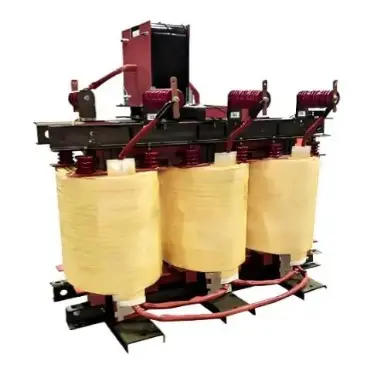
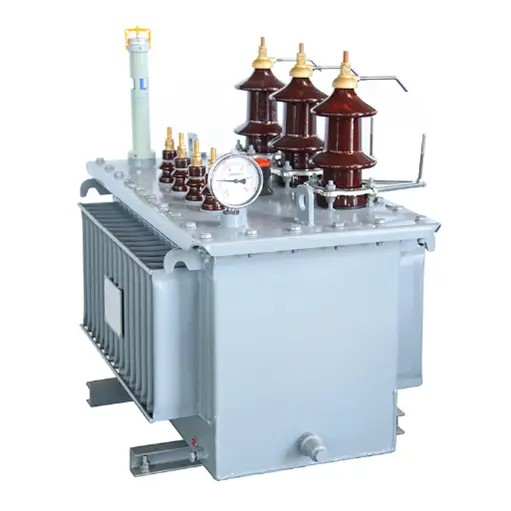
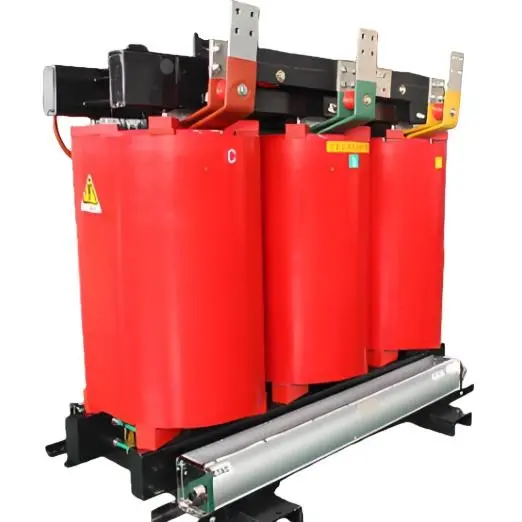
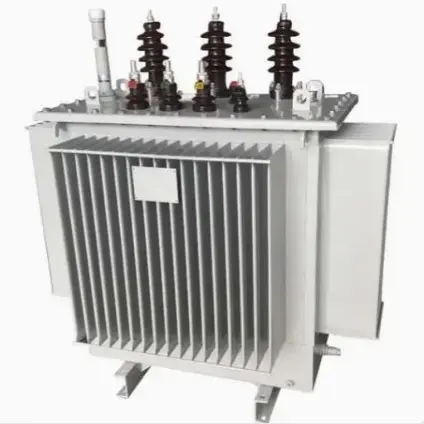
For users, when purchasing a 35kV new energy transformer, choosing between dry-type, mineral oil-filled, or vegetable oil-filled types involves multiple considerations. These include user habits, maintenance-free performance, safety and fire resistance, volume and weight, among others. However, cost differences are undoubtedly one of the most crucial factors.

To illustrate the issue intuitively, this paper selects a three-level energy efficiency dual-winding new energy transformer with a rated capacity of 3150kVA and a rated voltage of 37kV as an example for quantitative calculation and qualitative analysis.

Basic Parameters of the Product

  • Rated Capacity: 3150 / 3150kVA

  • Voltage Ratio: 37±2×2.5%/0.8kV

  • Connection Group: Dyn1

  • Short-Circuit Impedance: 7%

  • Energy Efficiency Class: Class 3

Differences in Material Costs

Based on the same basic technical parameters and energy efficiency class mentioned above, and combined with current market prices of raw materials (copper at 80,000 yuan/ton), the differences in tax-included material costs of 3150 kVA / 37kV dual-winding new energy transformers—for dry-type, mineral oil-filled, and vegetable oil-filled types—are calculated as follows.

It should be specially noted that for dry-type and oil-immersed transformers with the same capacity, voltage class, and energy efficiency class, their respective limits for no-load loss and load loss are different.
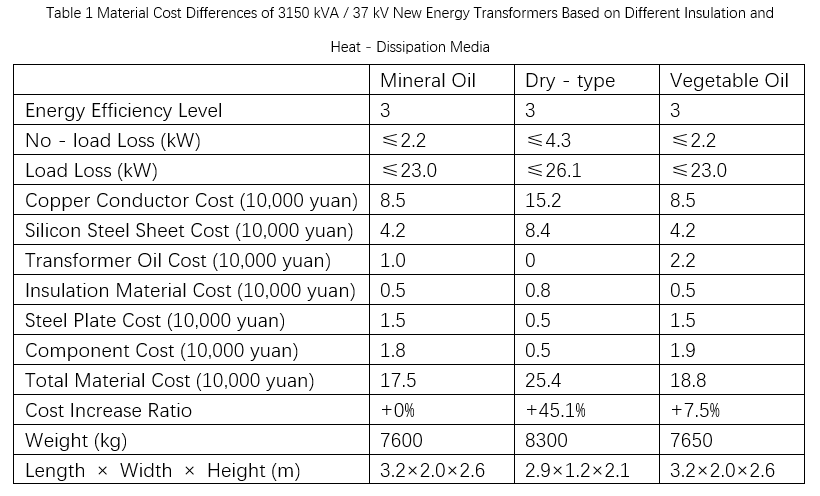
Cost Comparison Conclusion:For the 3150 kVA / 37 kV dual-winding new energy transformer, under the same level 3 energy efficiency, the dry-type transformer has the highest cost—about 45% higher than the mineral oil-filled transformer. In contrast, the vegetable oil-filled transformer offers better cost - effectiveness, with a cost only about 7.5% higher than that of the mineral oil-filled transformer.

Comprehensive Performance Comparison

To help users reasonably select the product type of 35kV - class new energy transformers based on the budgets and technical requirements of actual engineering projects, the qualitative comparison conclusions are presented in the following table.
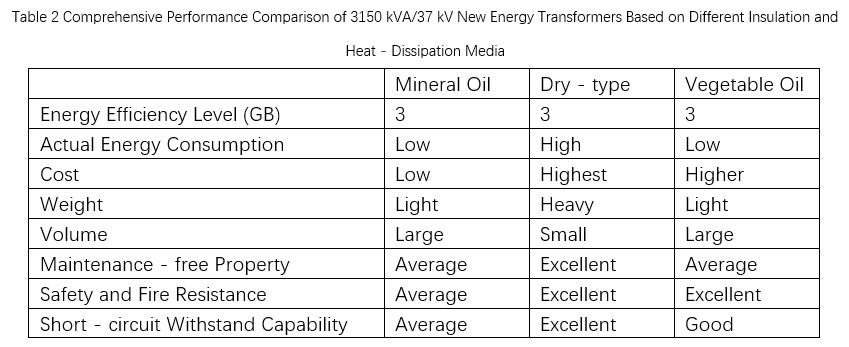
That is, dry-type transformers have significant advantages in terms of floor space, maintenance-free property, safety and fire resistance, short-circuit withstand capability, etc., while oil-immersed transformers have obvious advantages in aspects such as actual operation energy consumption, one-time purchase cost, and whole-life-cycle operation cost.
Give a tip and encourage the author!

Recommended

Why Must a Transformer Core Be Grounded at Only One Point? Isn't Multi-Point Grounding More Reliable?
Why Does the Transformer Core Need to Be Grounded?During operation, the transformer core, along with the metal structures, parts, and components that fix the core and windings, are all situated in a strong electric field. Under the influence of this electric field, they acquire a relatively high potential with respect to ground. If the core is not grounded, a potential difference will exist between the core and the grounded clamping structures and tank, which may lead to intermittent discharge.I
01/29/2026
What’s the Difference Between Rectifier Transformers and Power Transformers?
What is a Rectifier Transformer?"Power conversion" is a general term encompassing rectification, inversion, and frequency conversion, with rectification being the most widely used among them. Rectifier equipment converts input AC power into DC output through rectification and filtering. A rectifier transformer serves as the power supply transformer for such rectifier equipment. In industrial applications, most DC power supplies are obtained by combining a rectifier transformer with rectifier equ
01/29/2026
How to Judge, Detect and Troubleshoot Transformer Core Faults
1. Hazards, Causes, and Types of Multi-Point Grounding Faults in Transformer Cores1.1 Hazards of Multi-Point Grounding Faults in the CoreUnder normal operation, a transformer core must be grounded at only one point. During operation, alternating magnetic fields surround the windings. Due to electromagnetic induction, parasitic capacitances exist between the high-voltage and low-voltage windings, between the low-voltage winding and the core, and between the core and the tank. The energized windin
01/27/2026
A Brief Discussion on the Selection of Grounding Transformers in Boost Stations
A Brief Discussion on the Selection of Grounding Transformers in Boost StationsThe grounding transformer, commonly referred to as "grounding transformer," operates under the condition of being no-load during normal grid operation and overloaded during short-circuit faults. According to the difference in filling medium, common types can be divided into oil-immersed and dry-type; according to phase number, they can be classified into three-phase and single-phase grounding transformers. The groundi
01/27/2026
Related Products
Send inquiry
+86
Click to upload file
Download
Get the IEE Business Application
Use the IEE-Business app to find equipment, obtain solutions, connect with experts, and participate in industry collaboration anytime, anywhere—fully supporting the development of your power projects and business.