The electricity produced by direct hitting of sunlight on photo – voltaic cells, is called solar electricity.
When sunlight strikes on photo-voltaic solar cells, solar electricity is produced. That is why this is also referred to as Photo Voltaic Solar, or PV Solar.
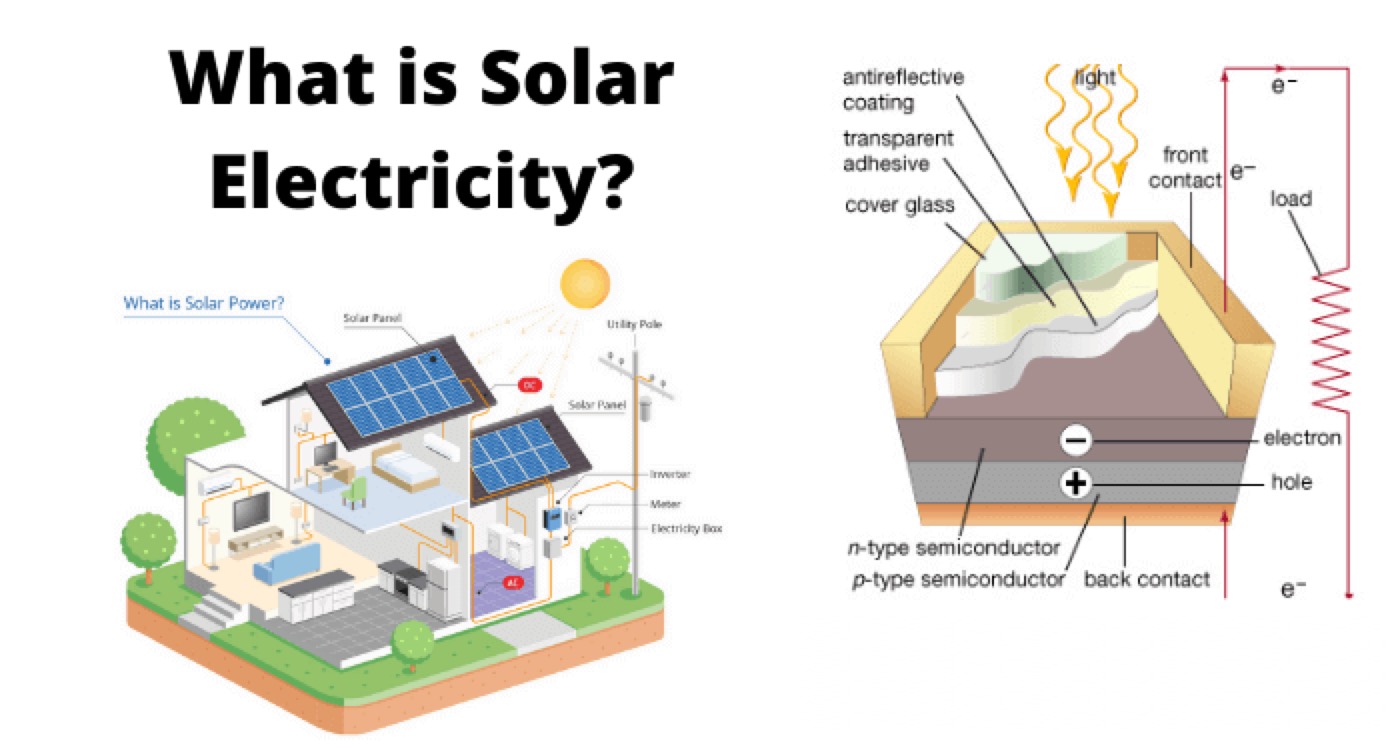
Generation of electricity by using solar energy depends on the photo voltaic effect. In photo voltaic effect, semiconductor p n junction produces electric potentia when it is exposed to sunlight. For that purpose, we make n type semiconductor layer of the junction very thin. It is less than 1 µm thick. The top layer is n layer. We generally refer it as emitter of the cell.
The bottom layer is p type semiconductor layer and it is much thicker than top n layer. It may be more than 100 µm thick. We call this bottom layer as base of the cell. The depletion region is created at the junction of these two layers due to immobile ions.
When sunlight strikes on the cell, it easily reaches up to p n junction. The p n junction absorbs the photons of sunlight ray and consequently, produces electrons holes pairs in the junction. Actually, the energy associated with photon excites the valence electrons of the semiconductor atoms and hence the electrons jump to the conduction band from valence band leaving a hole behind each.
The free electrons, find themselves in the depletion region will easily pass to the top n layer because of attraction force positive ions in the depletion region. In the same way the holes find themselves in the depletion region will easily pass to the bottom p layer because of attraction force of negative ions in the depletion region. This phenomenon creates a charge difference between the layers and resulting to a tiny potential difference between them.
The unit of such combination of n type and p type semiconductor materials for producing electric potential difference in sunlight is called solar cell. Silicon is normally used as the semiconductor material for producing such solar cell.
Conductive metal strips attached to the cells take the solar cell or photo voltaic cell is not capable of producing desired electricity instead it produces very tiny amount of electricity. Hence for extracting the desired level of electricity required numbers of such cells are connected together in both parallel and series to form a solar module or photo voltaic module. Actually, only sunlight is not the factor. The main factor is light or beam of photons to produce electricity in the solar cell. Hence a solar cell can also work in cloudy weather as well as in moonlight but then electricity production rate becomes law as it depends upon the intensity of incident light ray.
Solar electric power generation system is useful for producing moderate amount of power. The system works as long as there is a good intensity of natural sunlight. The place where solar modules are installed should be free from obstacles such as trees and buildings otherwise there will be the shade on the solar panel which affects the performance of the system. It is a general view that solar electricity is an impractical alternative of the conventional source of electricity and should be used when there is no traditional alternative of the conventional source of electricity available. But this is not the actual case. Often it seems that solar electricity is more money saving alternative than other traditional alternatives of conventional electricity.
For examples : – It is always economical to install a solar light or a solar power source where it is difficult and costly to get point from local electric supply authority such as in remote garden, shed or garage where standard electric supply point is not available. The solar electricity system is more reliable and uninterrupted as it does not suffer from unwanted power cut from an electric supply company. For constructing a mobile electric power source, for moderate power requirements, the solar module is a good choice. It can be useful whilst camping, working on outdoor sites. It is most effective means of creating green energy for our own purpose and may be for selling surplus energy to customers but for producing electricity in commercial scale the investment and volume of the system become large enough.
In that case area of the project will be much larger than conventional one. Although for running few lights and low-power electrical gadgets such as laptop computer, portable sized television, mini fridge etc solar electricity system is quite suitable provided there is sufficient free space on ground or on the roof top for installing solar panels. But it is not at all economical to run high-power consuming electric pieces of equipment like high-speed fans, heaters, washing machines, air conditioners and power tools with the help of solar electricity as the cost of production such high energy is quite higher that it is expected. Moreover, there may be the lack of space availability in your premises for installation of a large solar panel.
Ideal uses of low-cost solar panels are charging batteries in caravans and recreational vehicles or on boats when these are not in movement provided there should be trickle charging facility from dynamo during movement of these vehicles.
Statement: Respect the original, good articles worth sharing, if there is infringement please contact delete.