• Product
  • Suppliers
  • Manufacturers
  • Solutions
  • Free tools
  • Knowledges
  • Experts
  • Communities
Search


What is Metal Oxide Surge Arrester?

Edwiin
Field: Power switch
China

What is Metal Oxide Surge Arrester?

Definition:An arrester that utilizes zinc oxide semiconductor as its resistor material is called a metal oxide surge arrester or ZnO Diverter. This type of arrester offers protection against all kinds of AC and DC over - voltages. It is primarily employed for over - voltage protection at all voltage levels within a power system.

Construction & Working of Metal Oxide Surge Arrester:Zinc oxide is an N - type semiconducting material. It is pulverized into a fine - grained state. More than ten doping materials, in the form of fine powders of insulating oxides such as Bismuth (Bi₂O₃), Antimony Trioxide (Sb₂O₃), Cobalt Oxide (CoO), Manganese Oxide (MnO₂), and Chromium Oxide (Cr₂O₃), are added. The powder mixture undergoes certain treatment processes and is then spray - dried to yield a dry powder.

Subsequently, the dry powder is compressed into disc - shaped blocks. These blocks are sintered to obtain a dense poly - crystalline ceramic. The metal oxide resistor disc is coated with a conducting compound to safeguard the disc from adverse environmental impacts.
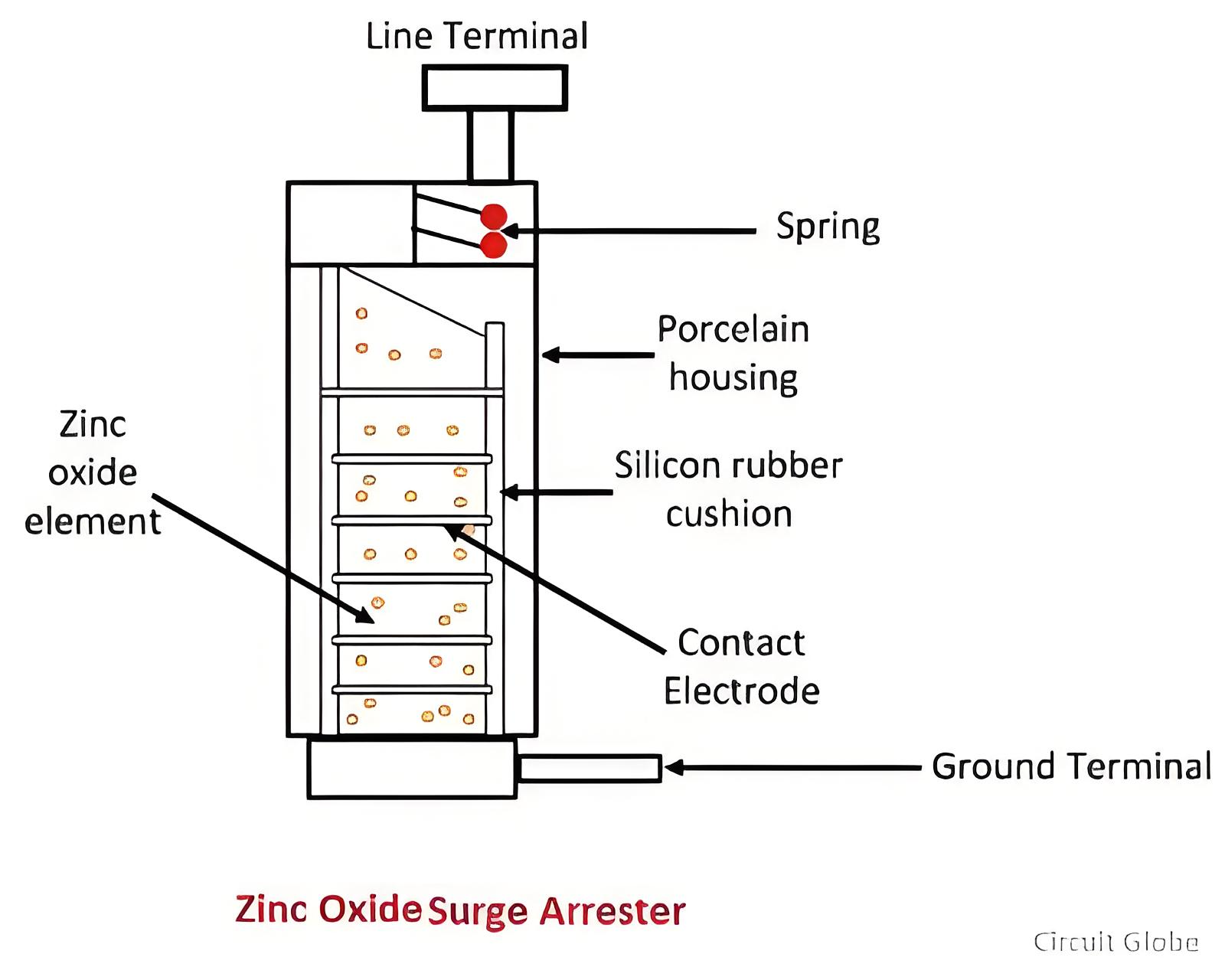
The conducting coating not only provides proper electrical contacts but also ensures uniform current distribution across the disc. Subsequently, the disc is enclosed within a porcelain housing that is filled with either nitrogen gas or SF6 gas. Silicon rubber is employed to fix the disc in place and also aids in transferring heat from the disc to the porcelain housing. The disc is maintained under pressure using appropriate springs.

The ZnO element in the diverter replaces the need for series spark gaps. Voltage drop in a ZnO diverter occurs at the grain boundaries. At the boundary of each ZnO grain, there exists a potential barrier which controls the flow of current from one grain to the next.

Under normal voltage conditions, this potential barrier prevents current from flowing through. However, during over - voltage situations, the barrier breaks down, leading to a sharp transition of the current from an insulating state to a conducting state. As a result, the current starts to flow, and the surge is safely diverted to the ground.

Once the surge has passed, the voltage across the diverters decreases, and the current reduces to a negligible value in the resistor units. Notably, there is no power follow - current.

Advantages of Metal Oxide Surge Arrester

The metal oxide surge arrester offers the following benefits:

  • It eradicates the risks of spark - over and the associated shock to the system when gaps break down.

  • It eliminates the requirement for a voltage grading system.

  • Under normal operating conditions, the leakage current in the ZnO arrester is significantly lower compared to other types of diverters.

  • There is no power follow - current in a ZnO diverter.

  • It has a high energy - absorbing capacity.

  • ZnO diverters exhibit high stability both during and after prolonged discharge.

  • In a ZnO diverter, it is possible to control not only switching surges but also dynamic over - voltages. This enables cost - effective insulation coordination.

Note: Sintering is the process of creating a solid mass of material. This is achieved either by heating the material or by applying pressure to it without melting the material.
Give a tip and encourage the author!

Recommended

Main Transformer Accidents and Light Gas Operation Issues
1. Accident Record (March 19, 2019)At 16:13 on March 19, 2019, the monitoring background reported a light gas action of No. 3 main transformer. In accordance with the Code for Operation of Power Transformers (DL/T572-2010), operation and maintenance (O&M) personnel inspected the on-site condition of No. 3 main transformer.On-site confirmation: The WBH non-electrical protection panel of No. 3 main transformer reported a Phase B light gas action of the transformer body, and the reset was ineff
02/05/2026
Faults and Handling of Single-phase Grounding in 10kV Distribution Lines
Characteristics and Detection Devices for Single-Phase Ground Faults1. Characteristics of Single-Phase Ground FaultsCentral Alarm Signals:The warning bell rings, and the indicator lamp labeled “Ground Fault on [X] kV Bus Section [Y]” illuminates. In systems with a Petersen coil (arc suppression coil) grounding the neutral point, the “Petersen Coil Operated” indicator also lights up.Insulation Monitoring Voltmeter Indications:The voltage of the faulted phase decreases (in
01/30/2026
Neutral point grounding operation mode for 110kV~220kV power grid transformers
The arrangement of neutral point grounding operation modes for 110kV~220kV power grid transformers shall meet the insulation withstand requirements of transformer neutral points, and shall also strive to keep the zero-sequence impedance of substations basically unchanged, while ensuring that the zero-sequence comprehensive impedance at any short-circuit point in the system does not exceed three times the positive-sequence comprehensive impedance.For 220kV and 110kV transformers in new constructi
01/29/2026
Why Do Substations Use Stones, Gravel, Pebbles, and Crushed Rock?
Why Do Substations Use Stones, Gravel, Pebbles, and Crushed Rock?In substations, equipment such as power and distribution transformers, transmission lines, voltage transformers, current transformers, and disconnect switches all require grounding. Beyond grounding, we will now explore in depth why gravel and crushed stone are commonly used in substations. Though they appear ordinary, these stones play a critical safety and functional role.In substation grounding design—especially when multiple gr
01/29/2026
Related Products
Send inquiry
+86
Click to upload file
Download
Get the IEE Business Application
Use the IEE-Business app to find equipment, obtain solutions, connect with experts, and participate in industry collaboration anytime, anywhere—fully supporting the development of your power projects and business.