2000-2500A DNH40 Series Disconnector Switch

Key attributes
| Brand | Switchgear parts |
| Model NO. | 2000-2500A DNH40 Series Disconnector Switch |
| Rated voltage | AC 1000V |
| Rated normal current | 2000A |
| Rated frequency | 50Hz |
| Series | DNH40 |
Product descriptions from the supplier
The DNH40 series disconnector switch (hereinafter referred to as "the switch") is suitable for industrial power distribution systems with AC 50Hz/60Hz and rated insulation voltage up to 1000V. It is designed for infrequent circuit connection/disconnection and electrical isolation, widely used in construction, power, petroleum, chemical, and automation systems. Suitable for multiple low-voltage distribution cabinets and special scenario cabinets that can carry high currents. The specific adaptation situations are as follows: GGD type low-voltage fixed switchgear, GCK type withdrawable low-voltage switchgear, GCS type withdrawable low-voltage switchgear, MNS type low-voltage withdrawable switchgear, Okken modular low-voltage switchgear, etc
Isolator Switches Feature
1、Modular Design
The DNH40 series features a modular structure that can be assembled according to customer requirements.
2、Durable Construction
The switch housing is made of glass fiber-reinforced unsaturated polyester resin, offering excellent flame-retardant properties, dielectric performance, anti-carbonization, and impact resistance.
3、Efficient Operating Mechanism
Equipped with a double spring energy storage mechanism, the switch allows instantaneous release of th spring during operation, ensuring quick connection and disconnection. This mechanism is independent of the operating handle speed, significantly enhancing the switching capabilities.
4、Rotary Contact Structure
The rotary multi-breakpoint contact structure ensures a safe isolation distance, meeting the reliable isolation requirements.
5、Visual Indicator
The position of the moving contact is visible through a window, providing a higher level of safety.
6、Clear Status Indication
The switch features a clear ON/OFF indicator. When in the “O” position, the handle can be locked to prevent accidental operation.
Isolator Switches Application
1、Machinery and Equipment
Suitable for machinery that requires infrequent connection and disconnection of circuits. The reliable isolation ensures safety during maintenance and operation.
2、Distribution Systems
Used in electrical distribution systems to isolate different sections for maintenance or in case of a fault. Ensures the safety of personnel and equipment.
3、Switchgear and Control Panels
Integral to switchgear and control panels for safe isolation of circuits. Ensures that operators can safely work on electrical panels without the risk of electric shock.
4、Motor Control Centers
Provides isolation for motor control circuits, allowing safe maintenance and operation. Essential in industrial environments where motor control is critical.
5、Photovoltaic Systems
Used in photovoltaic systems to isolate parts of the system for maintenance, ensuring safety and reliability in renewable energy setups.
Key Technical Parameters
| Model | DNH40 - 2000 | DNH40 - 2500 | |
| Conventional thermal current and rated operational current | A | 2000 | 2500 |
| Rated operational voltage (AC - 20/DC - 20) | V | 1000 | 1000 |
| Rated insulation voltage (Installation category Ⅳ) | Ui V | 1000 | 1000 |
| Dielectric strength | 50Hz 1min kV | 10 | 10 |
| Rated impulse withstand voltage | Uimp kV | 12 | 12 |
| Rated operational current (AC - 21A) | 690V A | 2000 | 2500 |
| Rated operational current (AC - 22A) | 690V A | 2000 | 2500 |
| Power loss per pole (at rated operational current) | W | 55 | 85 |
| Rated short - time withstand current | ≤690V1s kA | 55 | 55 |
| Rated short - circuit making capacity | ≤ 690V kA | 176 | 176 |
| Mechanical life | Oper | 6000 | 6000 |
| Operating torque (3 - pole) | Nm | 70 | 70 |
| Terminal screw specification | mm | M12 | M12 |
| Terminal tightening torque | Locking torque Nm | 50~75 | 50~75 |
Normal Operating Conditions
| Ambient Temperature | Range: -5°C to +40°C, with a 24-hour average temperature not exceeding +35°C |
| Humidity | At maximum temperature (+40°C), relative humidity ≤ 50%. At lower temperatures (e.g., +20°C), higher humidity (up to 90%) is permissible. Special measures must be taken to address occasional condensation caused by temperature fluctuations. |
| Altitude | ≤2000m |
| Pollution Degree | III |
| Installation Category | IV |
| Installation Requirements | The switch must be installed in a location free from significant vibration, mechanical shock, or exposure to rain/snow. The installation site must be free of explosive hazardous substances and corrosive gases/dust that could damage metal or insulation. |
| Note | If the switch is intended for use in ambient temperatures exceeding +40°C or below -5°C, the user must consult the manufacturer. |



Related Products
-
160-250A DNH40 Series Disconnector Switch

-
315-400A DNH40 Series Disconnector Switch

-
3200-4000A DNH40 series isolator switches

-
630-800A DNH40 Series Disconnector Switch

-
HH15 series Disconnector fuse group and disconnector

-
Disconnector Fuse Group HGLR Series, Fuse Switch Disconnector

-
Isolator Switch DNH8(HGL) Series Load-Disconnector Switch

Related Knowledges
-
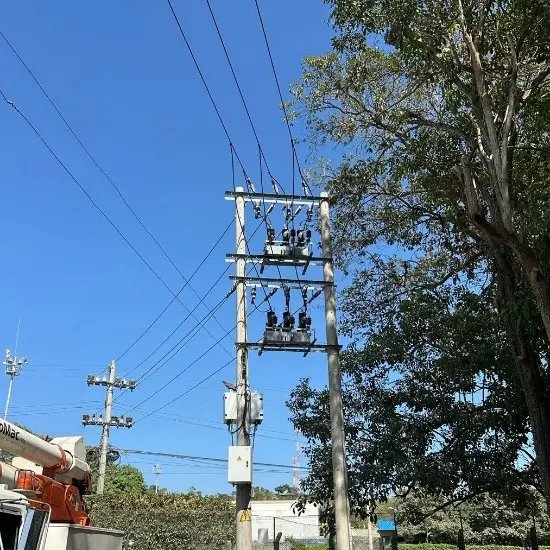 Faults and Handling of Single-phase Grounding in 10kV Distribution LinesCharacteristics and Detection Devices for Single-Phase Ground Faults1. Characteristics of Single-Phase Ground FaultsCentral Alarm Signals:The warning bell rings, and the indicator lamp labeled “Ground Fault on [X] kV Bus Section [Y]” illuminates. In systems with a Petersen coil (arc suppression coil) grounding the neutral point, the “Petersen Coil Operated” indicator also lights up.Insulation Monitoring Voltmeter Indications:The voltage of the faulted phase decreases (in01/30/2026
 -
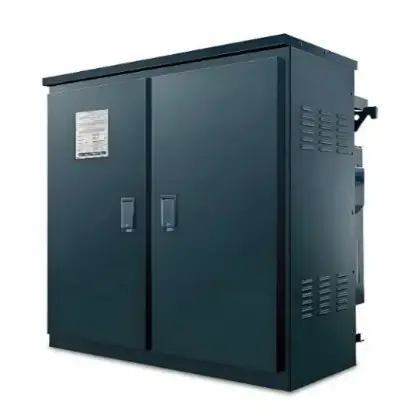 Neutral point grounding operation mode for 110kV~220kV power grid transformersThe arrangement of neutral point grounding operation modes for 110kV~220kV power grid transformers shall meet the insulation withstand requirements of transformer neutral points, and shall also strive to keep the zero-sequence impedance of substations basically unchanged, while ensuring that the zero-sequence comprehensive impedance at any short-circuit point in the system does not exceed three times the positive-sequence comprehensive impedance.For 220kV and 110kV transformers in new constructi01/29/2026
 -
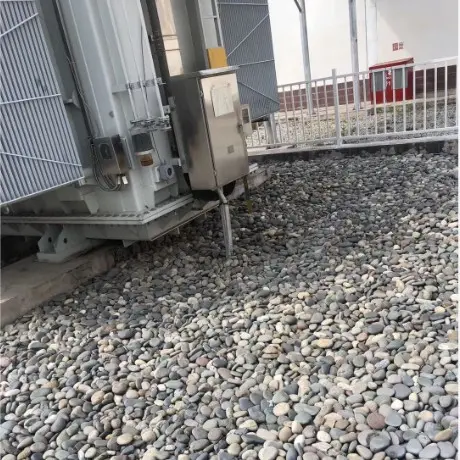 Why Do Substations Use Stones, Gravel, Pebbles, and Crushed Rock?Why Do Substations Use Stones, Gravel, Pebbles, and Crushed Rock?In substations, equipment such as power and distribution transformers, transmission lines, voltage transformers, current transformers, and disconnect switches all require grounding. Beyond grounding, we will now explore in depth why gravel and crushed stone are commonly used in substations. Though they appear ordinary, these stones play a critical safety and functional role.In substation grounding design—especially when multiple gr01/29/2026
 -
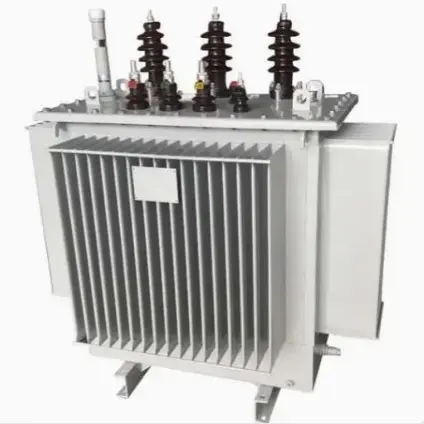 Why Must a Transformer Core Be Grounded at Only One Point? Isn't Multi-Point Grounding More Reliable?Why Does the Transformer Core Need to Be Grounded?During operation, the transformer core, along with the metal structures, parts, and components that fix the core and windings, are all situated in a strong electric field. Under the influence of this electric field, they acquire a relatively high potential with respect to ground. If the core is not grounded, a potential difference will exist between the core and the grounded clamping structures and tank, which may lead to intermittent discharge.I01/29/2026
 -
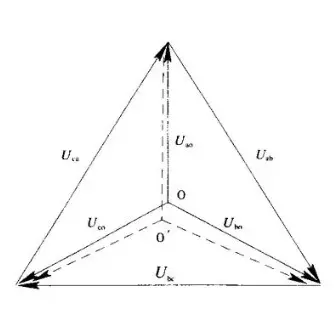 Understanding Transformer Neutral GroundingI. What is a Neutral Point?In transformers and generators, the neutral point is a specific point in the winding where the absolute voltage between this point and each external terminal is equal. In the diagram below, pointOrepresents the neutral point.II. Why Does the Neutral Point Need Grounding?The electrical connection method between the neutral point and earth in a three-phase AC power system is called theneutral grounding method. This grounding method directly affects:The safety, reliabilit01/29/2026
 -
 What’s the Difference Between Rectifier Transformers and Power Transformers?What is a Rectifier Transformer?"Power conversion" is a general term encompassing rectification, inversion, and frequency conversion, with rectification being the most widely used among them. Rectifier equipment converts input AC power into DC output through rectification and filtering. A rectifier transformer serves as the power supply transformer for such rectifier equipment. In industrial applications, most DC power supplies are obtained by combining a rectifier transformer with rectifier equ01/29/2026






