
In an electrical system, harmonics refer to the components with frequencies that are integer multiples greater than the fundamental frequency obtained by decomposing a periodic non-sinusoidal alternating quantity through Fourier series, and they are usually called higher harmonics.The main causes of harmonics are as follows: Existence of Nonlinear Loads: This is the primary cause of harmonics generation. For example, power electronic devices, including rectifiers, inverters, and frequency conver
03/13/2025
Consult
Tip
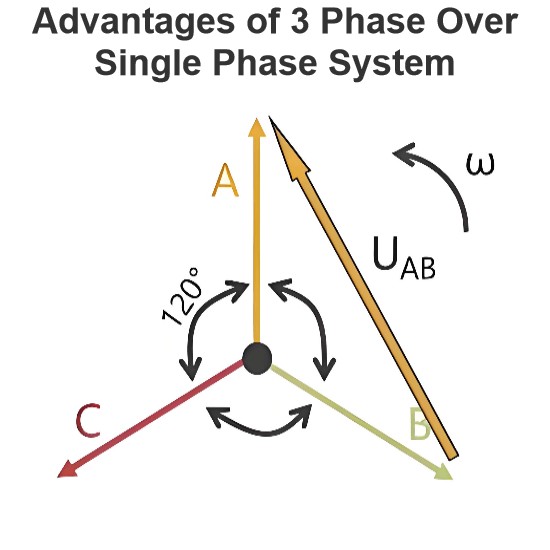
A three - phase system features three live conductors, supplying 440V power to large consumers. In contrast, a single - phase system has only one live conductor and is mainly used for domestic applications. Here are the key advantages of a three - phase system over a single - phase system:Higher RatingThe rating, or output, of a three - phase machine is approximately 1.5 times that of a single - phase machine of the same size.Constant PowerIn single - phase circuits, the power delivered is pulsa
03/05/2025
Consult
Tip

The Magnetic Dipole MomentWhen exposed to the same external magnetic field, different materials can exhibit vastly different responses. To delve into the underlying reasons, we must first grasp how magnetic dipoles govern magnetic behavior. This understanding begins with an exploration of the magnetic dipole moment.The magnetic dipole moment, often referred to as the magnetic moment for simplicity, serves as a fundamental concept in electromagnetics. It offers a powerful tool for comprehending a
02/25/2025
Consult
Tip

Advantages High magnetic permeability: Ferromagnetic materials have high magnetic permeability, which means they can generate a large magnetic induction intensity under a relatively small magnetic field strength. In a transformer, using ferromagnetic materials for the core allows most of the magnetic field generated by the windings to be concentrated inside the core, enhancing the magnetic field coupling effect. This, in turn, improves the electromagnetic conversion efficiency of the transformer
02/12/2025
Consult
Tip

Electromotive Force (EMF)Electromotive force refers to the work done by the power source in moving a unit positive charge from the negative terminal to the positive terminal. Its unit is the volt (V). Essentially, it is a physical quantity that measures the ability of a power source to drive electric charges to perform work. It's important to note that the term "electromotive" does not directly relate to mechanical motion but rather comes from processes where chemical energy, light energy, therm
02/11/2025
Consult
Tip

Temperature has a significant impact on dielectric strength, which is manifested as follows:1. Effects of Increased Temperature Material Softening: High temperatures cause insulating materials to soften, reducing their mechanical strength and insulation performance. Increased Conductivity: Rising temperatures enhance the mobility of charge carriers within the material, leading to increased conductivity and decreased insulation performance. Risk of Thermal Breakdown: At high temperatures, heat ac
02/06/2025
Consult
Tip

The magnetic permeability of core materials has a significant impact on transformer efficiency, mainly manifesting in the following aspects:1. Magnetic Flux Density High Permeability: Core materials with high permeability can more effectively conduct magnetic flux, increasing magnetic flux density and enhancing the electromagnetic induction efficiency of the transformer. Low Permeability: Lower permeability results in decreased efficiency of magnetic flux conduction, leading to increased energy
02/05/2025
Consult
Tip
How Input Voltage Affects the Current Through a Load Resistor in an Ideal TransformerAn ideal transformer is one that assumes no energy losses (such as copper loss or iron loss). Its primary function is to change the levels of voltage and current while ensuring that the input power equals the output power. The operation of an ideal transformer is based on the principle of electromagnetic induction, and there is a fixed turns ratio n between the primary and secondary coils, given by n=N2 /N1, whe
01/24/2025
Consult
Tip

How Magnetic Flux Affects Armature WindingsThe impact of magnetic flux on armature windings is central to the operation principles of motors and generators. In these devices, changes in magnetic flux induce an electromotive force (EMF) in the armature windings, based on Faraday's law of electromagnetic induction. Below is a detailed explanation of how magnetic flux affects armature windings:1. Induced Electromotive Force (EMF)According to Faraday's law of electromagnetic induction, when the magn
01/22/2025
Consult
Tip
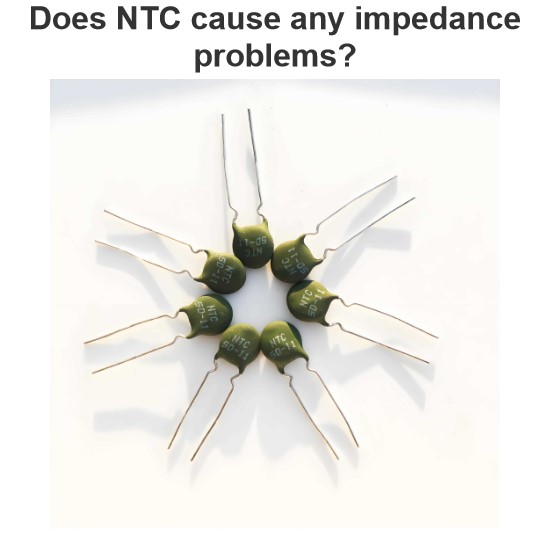
Can NTC Cause Any Impedance Issues?NTC (Negative Temperature Coefficient) thermistors are electronic components whose resistance decreases as temperature increases. They are widely used in temperature measurement, temperature compensation, and overheat protection applications. However, in certain scenarios, NTC thermistors can lead to impedance-related issues. Below are several potential situations and their solutions:1. High Initial Impedance Issue: At low temperatures, the resistance of an NTC
01/18/2025
Consult
Tip






