
Characteristics of Direct Current (DC)Direct Current (DC) is a type of electrical current that flows in a single direction, unlike Alternating Current (AC), which periodically reverses direction. DC has several distinct characteristics:1. Constant Direction Direction: DC flows consistently from the positive terminal to the negative terminal of the power source. Stability: Due to its constant direction, DC is more stable and is suitable for applications requiring a steady current.2. Voltage and C
10/28/2024
Consult
Tip
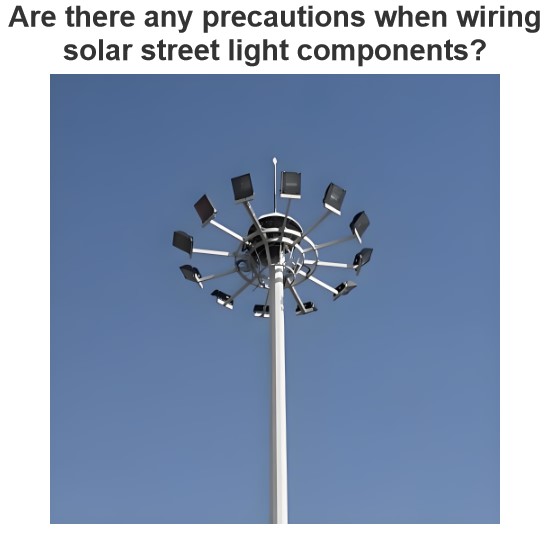
Precautions for Wiring Solar Street Light ComponentsWiring the components of a solar street light system is a crucial task. Correct wiring ensures the system operates normally and safely. Here are some important precautions to follow when wiring solar street light components:1. Safety First1.1 Turn Off the PowerBefore Operation: Ensure that all power sources of the solar street light system are turned off to avoid electric shock accidents.1.2 Use Insulated ToolsTools: Use insulated tools for wir
10/26/2024
Consult
Tip

Transformer Voltage Gain LimitationsTransformers are devices that utilize the principle of electromagnetic induction to change alternating current voltage. They play a crucial role in power transmission, distribution, and transformation. However, transformers cannot infinitely increase voltage, as their voltage gain is limited by various factors.Working Principles and LimitationsTransformers achieve voltage increases or decreases through electromagnetic induction between the primary winding (inp
10/26/2024
Consult
Tip
Some Main Characteristics of Electrical Energy Plasma DischargeHigh Temperature CharacteristicsDuring the plasma discharge process, extremely high temperatures are generated. When gas forms plasma under the action of electrical energy, the particles in the plasma (such as electrons and ions) possess high kinetic energy, and the intense collisions among these particles cause the temperature to rise sharply. For example, in an arc plasma, the temperature can easily reach several thousand degrees C
10/26/2024
Consult
Tip

The concept of overload powerOverload power refers to the situation where a device exceeds its rated power during actual operation. Every electrical device has a rated power, which is the maximum power that the device can withstand under normal operation. When the actual operating power of the device exceeds this rated power, it is called overload. The specific value of overload power depends on the type of device, the manufacturer, and the specific application scenario.The impact of overloaded
10/26/2024
Consult
Tip

The main line voltage from the meter to the circuit breaker box typically depends on local power supply standards and distribution systems. Globally, there are several common voltage standards. Here are the details:1. Single-Phase Systems1.1 120V Regions: North America (United States, Canada) Usage: Residential and small commercial buildings1.2 230V Regions: Europe, Asia, Africa, Australia Usage: Residential and small commercial buildings2. Three-Phase Systems2.1 208V Regions: North America Usag
10/25/2024
Consult
Tip

1. According to Ohm's LawOhm's Law FormulaWhen the resistance (R) is constant, according to Ohm's Law (I = U/R), it can be rearranged as U = IR. Therefore, if you know the change in current (I) and the value of resistance (R), you can find the voltage (U) using this formula. For example, given a resistance R = 5Ω, and the current changes from 1A to 2A, when the current I = 1A, the voltage U1 = IR = 1A × 5Ω = 5V; when the current I = 2A, the voltage U2 = 2A × 5Ω = 10V.Experimental Exploration Sit
10/25/2024
Consult
Tip

Negative voltage by itself does not directly produce current, but it can create a voltage difference within a circuit, which in turn drives the flow of current. In a circuit, current is generated by the movement of charge, and this movement is driven by a voltage difference, or potential difference. When there is negative voltage present in a circuit, if it forms a voltage difference relative to other parts, it will result in the flow of current.For example, if there is a positive voltage source
10/25/2024
Consult
Tip

In electrical systems, grounding (grounding) primarily serves to provide a safe path for fault currents to be directed to the earth, protecting equipment and personnel. However, grounding is not the normal return path for current because there are distinct differences in function and design between grounding and the normal return path. Here are some key reasons:1. Safety Purpose1.1 Fault Current Dissipation Fault Protection: The primary purpose of grounding is to provide a low-impedance path for
10/25/2024
Consult
Tip

Reducing the neutral-to-ground voltage (NGV) is an important measure to improve the stability and safety of electrical systems. High NGV can lead to equipment failure, electromagnetic interference, and safety hazards. Below are some common methods and techniques to reduce the neutral-to-ground voltage:1. Improve the Grounding System1.1 Optimize the Grounding GridGrounding Grid Design: Ensure the grounding grid is designed properly, using a sufficient number and length of grounding electrodes to
10/25/2024
Consult
Tip






