• Product
  • Suppliers
  • Manufacturers
  • Solutions
  • Free tools
  • Knowledges
  • Experts
  • Communities
Search


Free Expert Guides on Power Systems, Circuit Design & Electrical Troubleshooting

Access free engineering resources from IEE Business—covering power design, circuit layout, equipment selection, and troubleshooting. Expert-developed guides help engineers, procurement, and project teams make better decisions. Stay ahead on smart grids, renewables, efficiency, and AI tools. Improve reliability, reduce downtime, and enhance outcomes with real-world solutions. Explore our knowledge hub today.
Important points in engineering studies in high voltage gas insulated switchgear (GIS)
Important points in engineering studies in high voltage gas insulated switchgear (GIS)Engineering Studies in Gas - insulated Switchgear (GIS)Once the electrical engineer has defined the preliminary configuration of the GIS and determined and specified the primary equipment data, additional studies related to the engineering aspects, as well as the logistics of delivery and installation, must be carried out.The most crucial engineering studies are summarized as follows:1. Transient Recovery Volta
04/06/2025
Consult
Tip
Consult
Tip
SF6 decomposition products from electrical arc in gas switchgear
During the switching of normal load or short-circuit current, SF₆ molecules are ionized and fragmented by the arc. The figure illustrates the main reaction processes and the locations where each process is likely to occur. SF₄, as the primary decomposition product resulting from the electric discharge, first reacts with H₂O on the inner wall surface, giving rise to SOF₂. The metal fluorides remain in the form of powder or dust on the surface. H₂O is released in this reaction and thus becomes ava
03/19/2025
Consult
Tip
Consult
Tip
Trending method in switchgear control and auxiliary circuits visual check
The trending method involves verifying whether a signal lies within the normal range, exhibits consistent behavior in relation to other information, and does not show signs of drifting or abnormal fluctuations. Here are some examples:1. Operating environmental conditionsMonitoring temperature and humidity levels. Deviations from the normal range can impact the performance of electrical and mechanical components.2. Circuit breaker mechanical operation counterAutomation data is used to monitor the
03/10/2025
Consult
Tip
Consult
Tip
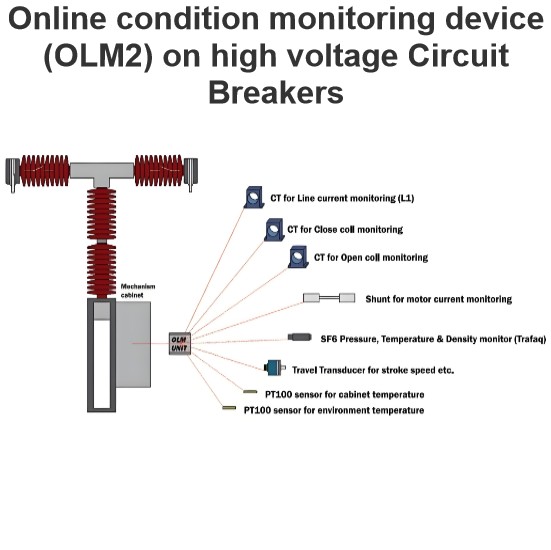
Online condition monitoring device (OLM2) on high voltage Circuit Breakers
This device is capable of monitoring and detecting various parameters according to the specifications outlined:SF6 Gas Monitoring: Utilizes a specialized sensor for measuring SF6 gas density. Capabilities include measuring gas temperature, monitoring SF6 leak rates, and calculating the optimal date for refilling.Mechanical Operation Analysis: Measures operational times for closing and opening cycles. Evaluates primary contacts separation speed, damping, and contact overtravel. Identifies signs o
02/13/2025
Consult
Tip
Consult
Tip
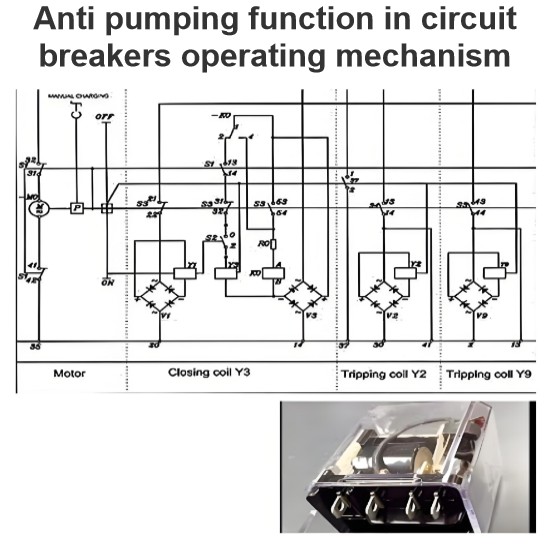
Anti pumping function in circuit breakers operating mechanism
The anti - pumping function stands as a crucial characteristic of control circuits. In the absence of this anti - pumping function, assume that a user connects a maintained contact within the closing circuit. When the circuit breaker is closed onto a fault current, the protective relays will promptly trigger a tripping action. However, the maintained contact in the closing circuit will attempt to close the breaker (once again) onto the fault. This repetitive and dangerous process is referred to
02/12/2025
Consult
Tip
Consult
Tip
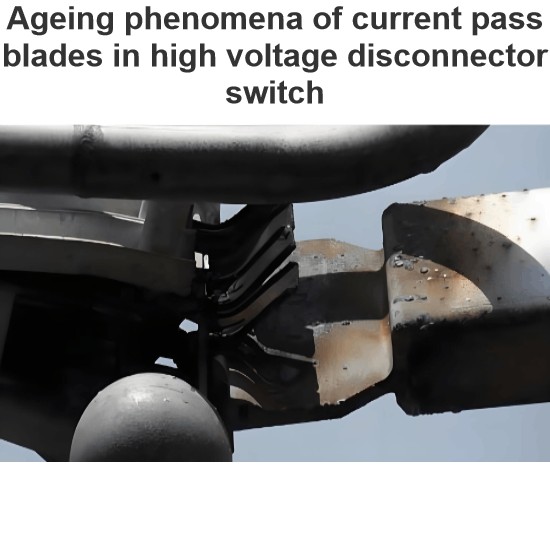
Ageing phenomena of current pass blades in high voltage disconnector switch
This failure mode has three primary origins: Electrical Causes: The switching of currents, such as loop currents, can lead to localized wear. At higher currents, an electric arc may burn at a specific spot, increasing the local resistance. As more switching operations occur, the contact surface wears down further, causing an increase in resistance. Mechanical Causes: Vibrations, often due to wind, are the main contributors to mechanical aging. These vibrations cause abrasion over time, leading t
02/11/2025
Consult
Tip
Consult
Tip
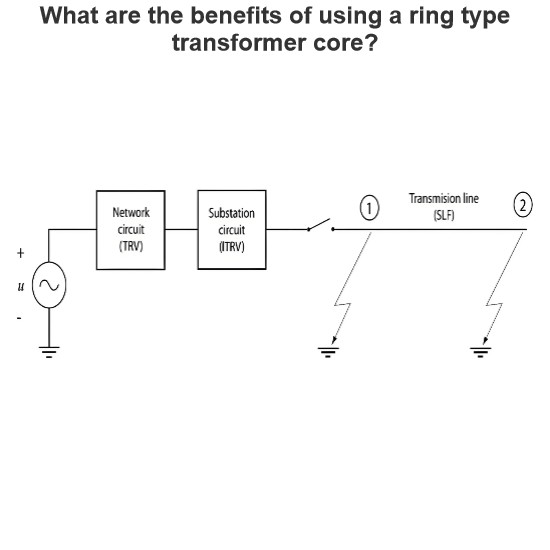
Initial Transient Recovery Voltage (ITRV) for high voltage circuit breakers
Transient Recovery Voltage (TRV) stress similar to that encountered during a short-line fault can also occur due to the busbar connections on the supply side of a circuit breaker. This specific TRV stress is known as Initial Transient Recovery Voltage (ITRV). Given the relatively short distances involved, the time to reach the first peak of ITRV is typically less than 1 microsecond. The surge impedance of the busbars within a substation is generally lower compared to that of overhead lines.The f
02/08/2025
Consult
Tip
Consult
Tip
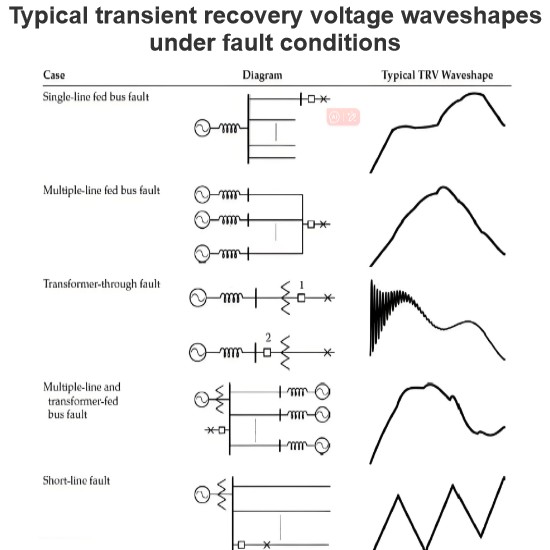
Typical transient recovery voltage waveshapes under fault conditions
Transient Recovery Voltages (TRVs) caused by fault current interruptions are typically categorized into three types of waveshapes: exponential, oscillatory, and sawtoothed. Additionally, significant TRV conditions can be classified under two main scenarios: Short Circuit Current Interruption: This is the simplest scenario involving the interruption of a symmetrical, rated-frequency short-circuit current. Since this current naturally reduces to zero at least once every half cycle, it represents t
02/07/2025
Consult
Tip
Consult
Tip
Gasket design for SF6 leakage
Leakage Causes and Gasket Design ConsiderationsLeaks in equipment often occur due to the deterioration of gasket materials over time and with use. Three critical factors influence gasket design and performance: Hardening of Gaskets:High ambient temperatures and the heat generated by electrical currents passing through circuit breakers during normal operation can reduce the elasticity of gaskets, causing them to harden over time. Chemical Attack:In substations, SF6 gas undergoes chemical changes
02/06/2025
Consult
Tip
Consult
Tip
Auxiliary contact in switchgears
Auxiliary contacts are essential components in circuit breakers and switchgear, providing critical functionality for control and indication. Here's a breakdown of their purpose and operation:Purpose of Auxiliary Contacts: Breaker Trip & Closing Control: Auxiliary contacts are used in control circuits to manage the supply to the trip coil and closing coil, ensuring proper operation of the circuit breaker. Breaker ON/OFF Indication: These contacts provide signals to indicate whether the b
02/05/2025
Consult
Tip
Consult
Tip
Send inquiry
+86
Click to upload file
Download
Get the IEE Business Application
Use the IEE-Business app to find equipment, obtain solutions, connect with experts, and participate in industry collaboration anytime, anywhere—fully supporting the development of your power projects and business.