• Product
  • Suppliers
  • Manufacturers
  • Solutions
  • Free tools
  • Knowledges
  • Experts
  • Communities
Search


Free Expert Guides on Power Systems, Circuit Design & Electrical Troubleshooting

Access free engineering resources from IEE Business—covering power design, circuit layout, equipment selection, and troubleshooting. Expert-developed guides help engineers, procurement, and project teams make better decisions. Stay ahead on smart grids, renewables, efficiency, and AI tools. Improve reliability, reduce downtime, and enhance outcomes with real-world solutions. Explore our knowledge hub today.
What are harmonics in electrical systems, and what causes them?
In an electrical system, harmonics refer to the components with frequencies that are integer multiples greater than the fundamental frequency obtained by decomposing a periodic non-sinusoidal alternating quantity through Fourier series, and they are usually called higher harmonics.The main causes of harmonics are as follows: Existence of Nonlinear Loads: This is the primary cause of harmonics generation. For example, power electronic devices, including rectifiers, inverters, and frequency conver
03/13/2025
Consult
Tip
Consult
Tip
Test equipments for AIS high voltage disconnector switch insulators cracks and life
Acoustic Emission: This method can be effectively employed to detect hazardous cracks in support insulators on - site in an offline mode. It is well - suited for identifying damages caused by mechanical stress, such as fatigue - related cracks. However, it is ineffective for detecting defects like pores. Non - destructive Ultrasound: Relying on the ultrasound impulse method, this technique works offline by exciting the insulator and its defects through the injection of short acoustic impulses.
03/12/2025
Consult
Tip
Consult
Tip
Optimisation SF6 handling procedures during on-site testing and commissioning for GIS
Gas Compartment Design and OptimizationPre-filled SF6 Gas CompartmentsGas compartments are pre-filled with sulfur hexafluoride (SF6) at a pressure slightly above atmospheric pressure for transportation. This ensures that the equipment remains stable during transit and reduces the workload required for on-site installation.Optimization to Minimize SF6 UsageGas compartments are optimized to use the minimum amount of SF6 necessary for a given functionality. Since the lowest achievable SF6 recovery
03/11/2025
Consult
Tip
Consult
Tip
Trending method in switchgear control and auxiliary circuits visual check
The trending method involves verifying whether a signal lies within the normal range, exhibits consistent behavior in relation to other information, and does not show signs of drifting or abnormal fluctuations. Here are some examples:1. Operating environmental conditionsMonitoring temperature and humidity levels. Deviations from the normal range can impact the performance of electrical and mechanical components.2. Circuit breaker mechanical operation counterAutomation data is used to monitor the
03/10/2025
Consult
Tip
Consult
Tip
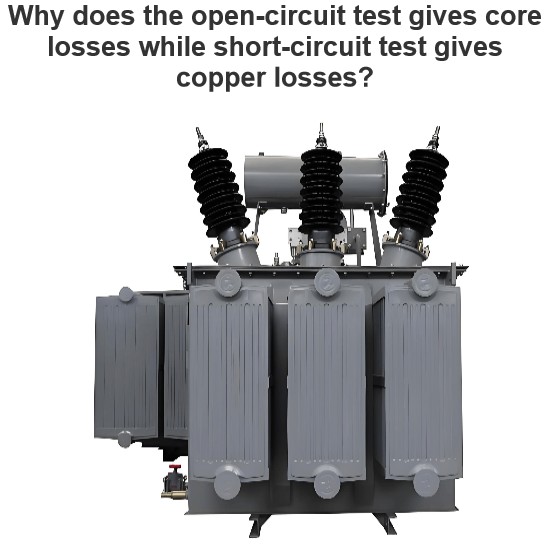
Why does the open-circuit test gives core losses while short-circuit test gives copper losses?
Open circuit tests and short circuit tests are two fundamental methods used in transformer testing to separately determine core losses and copper losses.Open Circuit Test (No-Load Test)In an open circuit test, a rated voltage is typically applied to one winding while the other winding is left open. This setup is primarily used to measure core losses for the following reasons:Core losses mainly consist of hysteresis losses and eddy current losses, which occur in the transformer's core. When an AC
03/07/2025
Consult
Tip
Consult
Tip
Electrical Earthing
Definition: Electrical earthing refers to the process of directly channeling the immediate discharge of electrical energy into the earth via a low - resistance wire. This is achieved by connecting the non - current - carrying components of electrical equipment or the neutral point of the power supply system to the ground.Galvanized iron is commonly used for electrical earthing purposes. Earthing offers a straightforward pathway for leakage current. When there's a short - circuit in the equipment
03/07/2025
Consult
Tip
Consult
Tip
Low temperature ambient effect for outdoor vacuum circuit breaker (VCB) operation
The vacuum arc - interrupting performance relies on the arcing within the metal vapor, which is generated from the contact material. Significantly, this process remains unaffected by low temperatures.A vacuum interrupter is typically fabricated from metals and ceramics and undergoes brazing at approximately 800 degrees Celsius. The material characteristics of both metal and ceramic, as well as the brazed joints between them, are inherently resistant to low - temperature impacts.Sliding guides ar
03/06/2025
Consult
Tip
Consult
Tip
Timing tests method in switchgears
Timing tests serve the purpose of determining the durations for operations such as opening (tripping), closing, close - opening, and reclosing. These time measurements are crucial for ensuring the safe and reliable operation of circuit breakers, thus being a key outcome of proper circuit breaker design.The main contact times are verified after production, during commissioning, and while the circuit breaker is in - service as part of periodic maintenance. To conduct these tests, timing test devic
03/05/2025
Consult
Tip
Consult
Tip
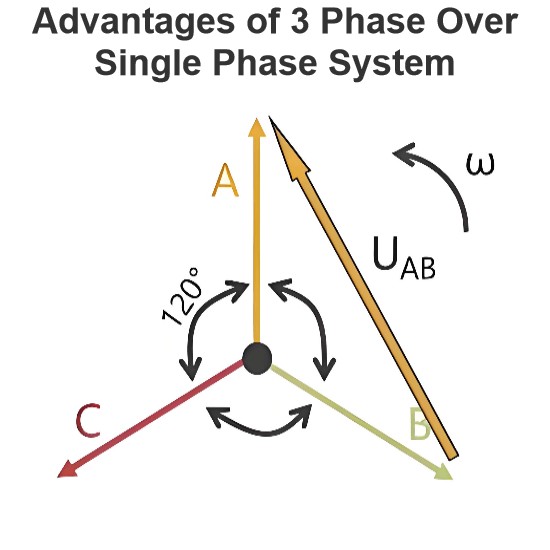
Advantages of 3 Phase Over Single Phase System
A three - phase system features three live conductors, supplying 440V power to large consumers. In contrast, a single - phase system has only one live conductor and is mainly used for domestic applications. Here are the key advantages of a three - phase system over a single - phase system:Higher RatingThe rating, or output, of a three - phase machine is approximately 1.5 times that of a single - phase machine of the same size.Constant PowerIn single - phase circuits, the power delivered is pulsa
03/05/2025
Consult
Tip
Consult
Tip
Power factor test on circuit breakers
Assessing the Integrity of Internal and External InsulationTo ensure the reliability and safety of circuit breakers, it is essential to evaluate both their internal and external insulation. Testing equipment typically has an output voltage of 10 kV and is designed to be portable so that it can be used in all substation environments. While this testing is primarily used for oil circuit breakers (CBs), it can also be applied to SF6 switchgear.Purpose of Power Factor TestsPower factor tests are con
03/03/2025
Consult
Tip
Consult
Tip
Send inquiry
+86
Click to upload file
Download
Get the IEE Business Application
Use the IEE-Business app to find equipment, obtain solutions, connect with experts, and participate in industry collaboration anytime, anywhere—fully supporting the development of your power projects and business.