• Product
  • Suppliers
  • Manufacturers
  • Solutions
  • Free tools
  • Knowledges
  • Experts
  • Communities
Search


Free Expert Guides on Power Systems, Circuit Design & Electrical Troubleshooting

Access free engineering resources from IEE Business—covering power design, circuit layout, equipment selection, and troubleshooting. Expert-developed guides help engineers, procurement, and project teams make better decisions. Stay ahead on smart grids, renewables, efficiency, and AI tools. Improve reliability, reduce downtime, and enhance outcomes with real-world solutions. Explore our knowledge hub today.
What are the advantages of high frequency heating?
Advantages of High-Frequency HeatingHigh-frequency heating, also known as induction heating or radio frequency (RF) heating, is a technology that uses alternating magnetic fields generated by high-frequency currents to heat conductive materials. This technique has widespread applications in industry and manufacturing and offers several advantages. Here are the main advantages of high-frequency heating:1.Fast Heating Speed Rapid Temperature Rise: High-frequency heating can bring materials to the
11/18/2024
Consult
Tip
Consult
Tip
How are core loss and hysteresis loss related?
Relationship Between Core Loss and Hysteresis LossCore loss (Core Loss) and hysteresis loss (Hysteresis Loss) are two common types of losses in electromagnetic devices. They are closely related but have distinct characteristics and mechanisms. Below is a detailed explanation of these two losses and their relationship:Core LossCore loss refers to the total energy loss that occurs within the core material due to the magnetization process in an alternating magnetic field. Core loss primarily consis
11/16/2024
Consult
Tip
Consult
Tip
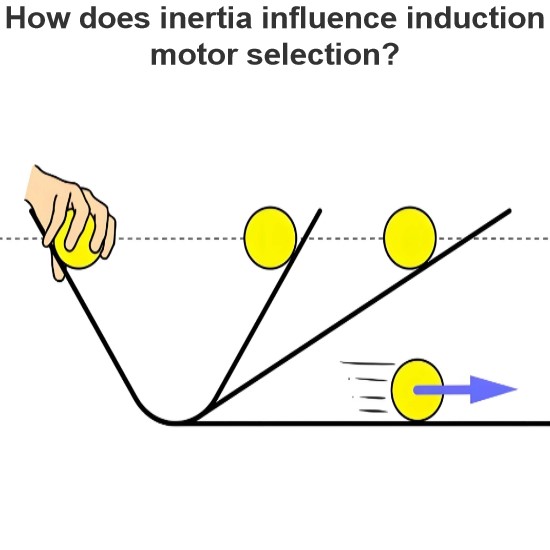
How does inertia influence induction motor selection?
Inertia plays a crucial role in the selection of induction motors (Induction Motors), especially in applications involving dynamic response and starting performance. Here is a detailed explanation of how inertia affects the choice of induction motors:1. Starting PerformanceInertia Affects Starting Time: High-Inertia Loads: High-inertia loads (such as large flywheels, heavy machinery, etc.) require more time to reach rated speed. The induction motor must provide sufficient starting torque to over
11/05/2024
Consult
Tip
Consult
Tip
In which direction does the force electromagnetism move?
The direction of the electromagnetic forceThe direction of the electromagnetic force can be determined by some physical laws and rules, such as the Lorentz force law and the left-hand rule. Here is a detailed explanation:Lorentz Force LawLorentz force law describes the force experienced by a charged particle in an electric and magnetic field. For a charged particle, the direction of the force acting on it can be determined using the following formula:F=q(E+v*B)Among them, F is the Lorentz force,
10/31/2024
Consult
Tip
Consult
Tip
How many kinds of Newton’s laws are there?
Newton's Laws of MotionNewton's three laws of motion are the foundation of classical mechanics, describing the behavior of objects under the influence of forces. Here are Newton's three laws of motion along with detailed explanations:Newton's First Law (Law of Inertia)Content: An object at rest stays at rest, and an object in uniform motion stays in uniform motion, unless acted upon by an external force.Explanation: Inertia: The property of an object to resist changes in its state of motion is c
10/31/2024
Consult
Tip
Consult
Tip
Why do electrons continue to move in the same direction in an electric circuit with a potential difference?
In a circuit with a potential difference, electrons move in the same direction due to the influence of the electric field force. When the power supply is turned on, a large amount of negative charge (electrons) accumulates at the negative pole of the power supply, while a large amount of positive charge accumulates at the positive pole. These charges are separated within the power supply due to chemical reactions or other energy conversion processes, resulting in a potential difference, or volta
10/30/2024
Consult
Tip
Consult
Tip
What is the impact of capacitive and reactive loads on power factor?
Impact of Capacitive Loads and Reactive Loads on Power FactorUnderstanding the impact of capacitive loads and reactive loads on power factor requires a basic understanding of the concept of power factor and the characteristics of these loads.Power FactorDefinition:The power factor (PF) is a measure of the ratio of actual power (active power, measured in watts, W) to apparent power (measured in volt-amperes, VA) in an AC circuit. It indicates the efficiency of electrical energy utilization in the
10/30/2024
Consult
Tip
Consult
Tip
What are some of the key characteristics of an electrically energised plasma discharge?
Some Main Characteristics of Electrical Energy Plasma DischargeHigh Temperature CharacteristicsDuring the plasma discharge process, extremely high temperatures are generated. When gas forms plasma under the action of electrical energy, the particles in the plasma (such as electrons and ions) possess high kinetic energy, and the intense collisions among these particles cause the temperature to rise sharply. For example, in an arc plasma, the temperature can easily reach several thousand degrees C
10/26/2024
Consult
Tip
Consult
Tip
What is the power of overload?
The concept of overload powerOverload power refers to the situation where a device exceeds its rated power during actual operation. Every electrical device has a rated power, which is the maximum power that the device can withstand under normal operation. When the actual operating power of the device exceeds this rated power, it is called overload. The specific value of overload power depends on the type of device, the manufacturer, and the specific application scenario.The impact of overloaded
10/26/2024
Consult
Tip
Consult
Tip
What is the difference between reactive power and resistive power?
Difference between Reactive Power and Resistance PowerReactive power and resistive power (real power) are two fundamental but distinct concepts in a power system. They describe different aspects of the energy storage and conversion processes within a power system.1. Definition and Physical MeaningReactive Powerrefers to the power generated when current flows through a capacitor or inductor in an AC circuit. It does not perform any actual power conversion or energy transfer but is used to compens
10/21/2024
Consult
Tip
Consult
Tip
Send inquiry
+86
Click to upload file
Download
Get the IEE Business Application
Use the IEE-Business app to find equipment, obtain solutions, connect with experts, and participate in industry collaboration anytime, anywhere—fully supporting the development of your power projects and business.