• Product
  • Suppliers
  • Manufacturers
  • Solutions
  • Free tools
  • Knowledges
  • Experts
  • Communities
Search


Free Expert Guides on Power Systems, Circuit Design & Electrical Troubleshooting

Access free engineering resources from IEE Business—covering power design, circuit layout, equipment selection, and troubleshooting. Expert-developed guides help engineers, procurement, and project teams make better decisions. Stay ahead on smart grids, renewables, efficiency, and AI tools. Improve reliability, reduce downtime, and enhance outcomes with real-world solutions. Explore our knowledge hub today.
Transmission Lines
A transmission line serves the crucial function of conveying electrical power from generating substations to diverse distribution units. It effectively transmits voltage and current waves from one end to the other. Structurally, a transmission line consists of a conductor that maintains a consistent cross - section throughout its length. Meanwhile, air functions as the insulating or dielectric medium situated between the conductors, playing a vital role in preventing electrical leakage and ensur
05/14/2025
Consult
Tip
Consult
Tip
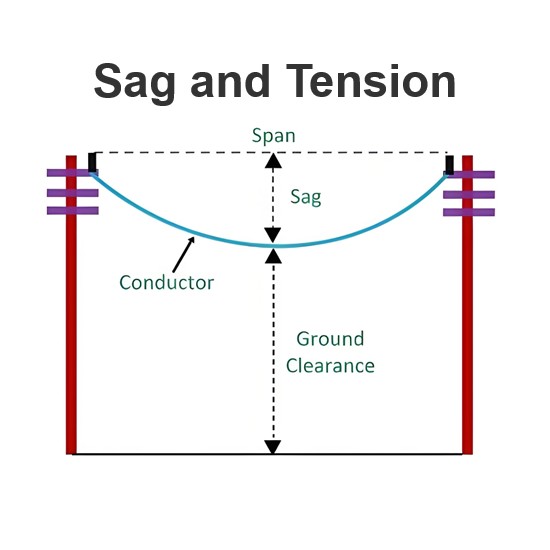
Sag and Tension
For safety purpose, the ground clearance of the conductors at maximum temperature and minimum loading condition should be maintained. Analysis of the sag and tension is important in the transmission line for the continuity and quality of electrical services. If the tension of the conductor is increased beyond the limit, it may get broken, and the power transmission of the system get erupt.The dip of the conductor between the two level supports is called sag. In other words, the vertical distance
05/13/2025
Consult
Tip
Consult
Tip
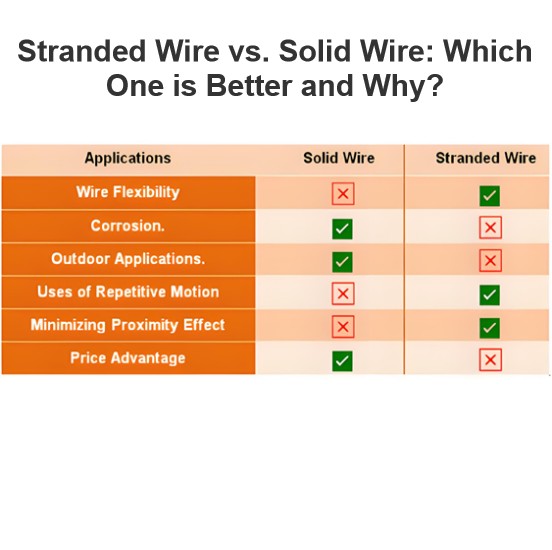
Stranded Wire vs. Solid Wire: Which One is Better and Why?
What is Stranded Wire?A stranded wire consists of multiple thin strands of conductors bundled together, often with each pair of strands twisted and insulated. These wires come in various sizes tailored to specific applications.In the UK, common wire sizes are denoted in formats such as 3/0.029″, 7/0.036″, and 7/0.042″. Here, the first digit (e.g., 3 or 7) indicates the number of individual stranded conductors, while the second part (e.g., 0.029″, 0.042&
05/13/2025
Consult
Tip
Consult
Tip
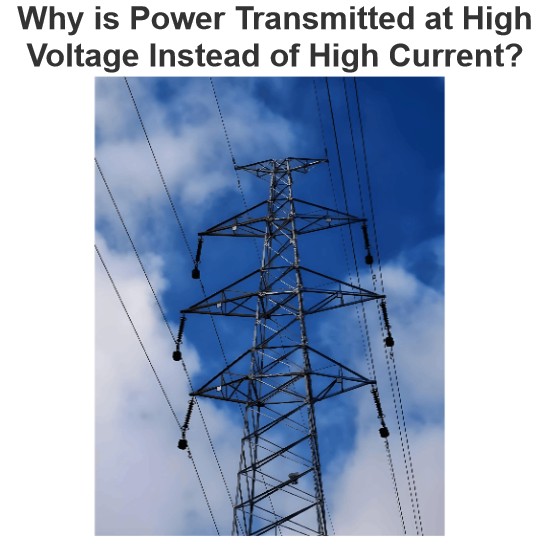
Why is Power Transmitted at High Voltage Instead of High Current?
The Rationale Behind High-Voltage, Low-Current Power TransmissionFor long-distance power transmission, sending electrical power at high voltage and low current stands as the most efficient and cost-effective strategy. This approach significantly mitigates resistive losses, reduces the reliance on costly conductors, and enhances the overall performance of the electrical grid. In this article, we will delve into the key reasons why high-voltage transmission is favored over low-voltage or high-curr
05/12/2025
Consult
Tip
Consult
Tip
Oil Filled Cables
DefinitionAn oil - filled cable is defined as a cable where low - viscosity oil is maintained under pressure, either within the cable sheath itself or in a containing pipe. Under all conditions of varying loads, the oil in the cable fills the voids in the oil - impregnated paper. Historically, mineral oils were commonly used, but more recently, alkylates such as linear decyl benzene and branched nonyl benzene have gained popularity. This is due to their low viscosity and their ability to absorb
05/12/2025
Consult
Tip
Consult
Tip
What are Line Supports?
DefinitionLine supports refer to various structures, such as poles or towers, that are employed to uphold overhead power lines or wires. These structures play a crucial role in power transmission. They ensure appropriate spacing between conductors and maintain a prescribed distance between the conductors and grounded components. Additionally, they uphold the specified ground clearance, which is determined by electrical and mechanical considerations.Types of Line SupportsThe key requisites for li
05/12/2025
Consult
Tip
Consult
Tip
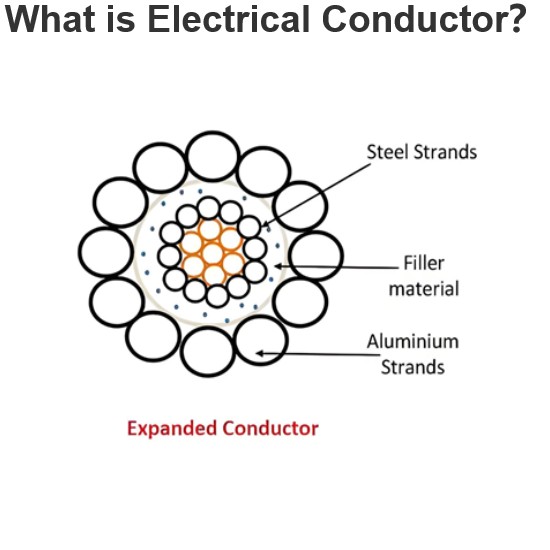
What is Electrical Conductor?
DefinitionAn electrical insulating material is defined as a substance that restricts the flow of electricity through it. In such materials, electric charges do not move freely; instead, they offer a highly resistive pathway, making it extremely difficult for electric current to pass. One of the primary applications of electrical insulating materials is in overhead transmission lines, where they are placed between the towers and conductors. Their role here is to prevent the leakage of electric cu
05/10/2025
Consult
Tip
Consult
Tip
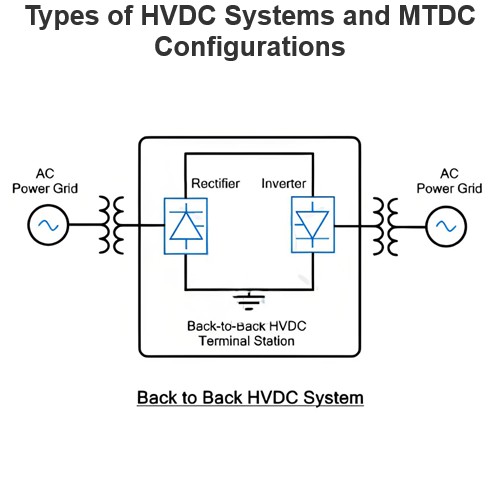
Types of HVDC Systems and MTDC Configurations
High - Voltage Direct Current (HVDC) System ConfigurationsHigh - Voltage Direct Current, commonly abbreviated as HVDC, is a highly efficient method for long - distance power transmission, significantly reducing power losses compared to traditional alternating - current (AC) transmission. The HVDC system can be implemented in various configurations, each tailored to specific operational requirements. This article provides a concise overview of the main types of HVDC system configurations.Back - t
05/07/2025
Consult
Tip
Consult
Tip
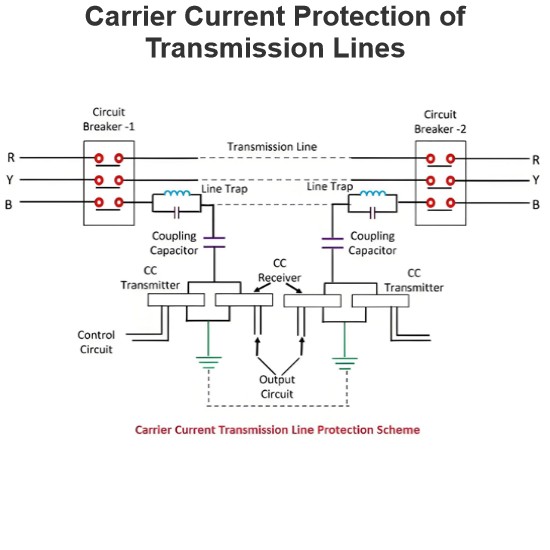
Carrier Current Protection of Transmission Lines
Carrier Current Protection Scheme for Transmission LinesThe carrier current protection scheme is predominantly employed for safeguarding long - distance transmission lines. Unlike conventional protection methods that focus on comparing actual current values, this scheme operates by comparing the phase angles of the currents at the two ends of the line. Based on the phase - angle relationship, it can accurately determine whether a fault is occurring within the protected line section (internal fau
05/06/2025
Consult
Tip
Consult
Tip
Electrical Transmission Networks – EHV and HV Overhead Lines
Electrical Transmission Networks and Overhead LinesIn electrical power systems, Extra High Voltage (EHV, where the voltage V&ge;150kVand High Voltage (HV, with60 kV &le; V <150 kV) are commonly employed for energy transmission. The use of these high - voltage levels serves to reduce the current flowing through the transmission lines. According to Joule's law, W=RI2t=UIt, whereWrepresents the energy dissipated as heat,Ris the resistance of the conductor,Iis the current,tis the time, an
05/06/2025
Consult
Tip
Consult
Tip
Send inquiry
+86
Click to upload file
Download
Get the IEE Business Application
Use the IEE-Business app to find equipment, obtain solutions, connect with experts, and participate in industry collaboration anytime, anywhere—fully supporting the development of your power projects and business.