• Product
  • Suppliers
  • Manufacturers
  • Solutions
  • Free tools
  • Knowledges
  • Experts
  • Communities
Search


Free Expert Guides on Power Systems, Circuit Design & Electrical Troubleshooting

Access free engineering resources from IEE Business—covering power design, circuit layout, equipment selection, and troubleshooting. Expert-developed guides help engineers, procurement, and project teams make better decisions. Stay ahead on smart grids, renewables, efficiency, and AI tools. Improve reliability, reduce downtime, and enhance outcomes with real-world solutions. Explore our knowledge hub today.
What is the difference between electrical wire and electrical cable?
1. Structure and Dimensions Wire: Typically consists of several flexible conductors with an insulating layer on the outside. Wires are smaller in size and have a relatively simple structure. Cable: Consists of one or more conductive cores that are insulated from each other, usually surrounded by a protective sheath. Cables are larger in size and have a more complex structure.2. Purpose Wire: Primarily used for transmitting smaller amounts of electricity and signals, suitable for connecting house
12/03/2024
Consult
Tip
Consult
Tip
What are the Applications of Coaxial Cables in the railway signalling installations?
Based on the provided search results, although there is no direct mention of specific applications of coaxial cable in railway signaling equipment, we can speculate on its possible use cases based on its extensive applications in other fields. Here are some potential applications of coaxial cable in railway signaling equipment: Signal Transmission: Coaxial cables can be used for signal transmission in railway signal systems due to their excellent shielding performance and low signal loss, ensuri
11/29/2024
Consult
Tip
Consult
Tip
How is electricity transmitted? Is it through wires or cables? What is the role of cables in the transmission process?
Electricity is primarily transmitted through wires and cables. Both wires and cables play crucial roles in the transmission of electrical energy, not only for conveying the energy but also for protecting and managing it. Below is a detailed explanation of the process of electricity transmission and the specific roles of wires and cables.Basic Process of Electricity Transmission Generation:Electricity is first generated at power plants, which can use various energy sources such as coal, natural g
11/27/2024
Consult
Tip
Consult
Tip
What are high-voltage power cables and the key features of high voltage power cables?
A high-voltage power cable is a type of cable used for transmitting and distributing high-voltage electrical energy, typically in power transmission and distribution networks. The design and manufacturing of high-voltage power cables must meet strict standards to ensure safe and reliable operation under high voltage and high current conditions. Here are the main features of high-voltage power cables:1. Complex Structure Conductor: Usually composed of multiple strands of copper or aluminum wire t
11/26/2024
Consult
Tip
Consult
Tip
How does changing the size of a wire in an electrical circuit affect the current?
Changing the thickness of wires in a circuit can have a significant impact on the current, which is reflected in several aspects:1. Resistance changeThe thickness of a wire directly affects its resistance. According to Ohm's Law, resistance is directly proportional to the length of the conductor and inversely proportional to its cross-sectional area. Therefore, thinner wires have higher resistance, while thicker wires have lower resistance.2. Power LossDue to the presence of resistance, when cur
11/26/2024
Consult
Tip
Consult
Tip
What is the purpose of series compensation in reducing capacitance in overhead lines?
Series compensation in power systems is primarily used to reduce the capacitive effects of transmission lines, thereby improving the transmission capacity and stability of the lines. Here are the main purposes and functions of series compensation:1. Increase Transmission Capacity Capacitive Effect: Long-distance overhead transmission lines exhibit significant capacitive effects, leading to increased charging currents, which limit the transmission capacity of the lines. Series Capacitors: By inse
11/26/2024
Consult
Tip
Consult
Tip
What is the purpose of using high voltage and low frequency in electricity?
Purpose of Using High Voltage and Low Frequency in Power SystemsThe main purpose of using high voltage and low frequency in power systems is to improve transmission efficiency and reduce costs. Here are the specific reasons:1. High Voltage Reduce Current: According to Ohm's law V=IR, increasing the voltage can reduce the current. Under the same power transmission conditions, higher voltage means lower current. Lower Line Losses: Line losses are proportional to the square of the current, i.e., Pl
11/22/2024
Consult
Tip
Consult
Tip
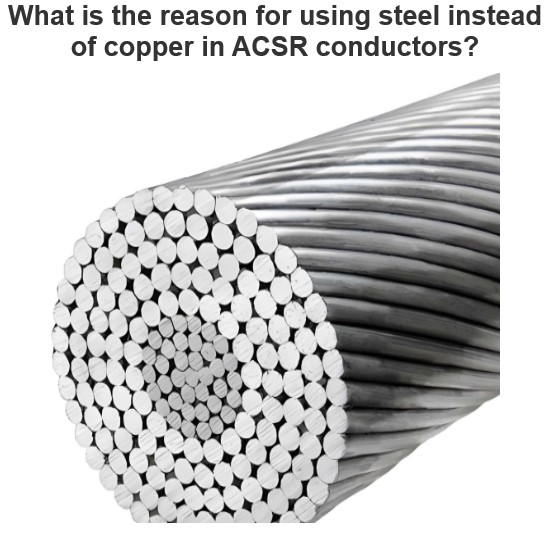
What is the reason for using steel instead of copper in ACSR conductors?
ACSR (Aluminum Conductor Steel Reinforced) conductors are commonly used in power transmission and consist of aluminum strands surrounding a steel core. The reasons for using steel instead of copper as the internal reinforcement material are as follows:1. Strength and DurabilityHigh Strength: Steel has high mechanical strength and can withstand significant tensile and pulling forces, especially in long-distance transmission lines where it needs to resist wind loads, ice loads, and its own weight.
11/14/2024
Consult
Tip
Consult
Tip
What is the reason for not using square waves for power transmission lines?
The reason transmission lines do not use square waves and prefer sine waves involves several aspects of electrical engineering, including efficiency, equipment compatibility, electromagnetic interference, system stability, and control and measurement. Here is a detailed explanation:1. Efficiency and Losses Harmonic Distortion: Square waves contain rich harmonic components. These harmonics cause additional losses when transmitted over power lines, including resistive losses in conductors and iron
11/12/2024
Consult
Tip
Consult
Tip
How to Handle Cable Voltage Leakage?
Cable voltage leakage (also known as insulation failure or leakage current) is a serious electrical issue that can not only damage equipment but also cause fires and personal injuries. Handling cable voltage leakage requires a series of measures, from detection to repair, to ensure the safety and reliable operation of the electrical system. Here are the steps and methods for handling cable voltage leakage:1. Power Off and Safety MeasuresPower Off: First, ensure that the power is disconnected to
11/08/2024
Consult
Tip
Consult
Tip
Send inquiry
+86
Click to upload file
Download
Get the IEE Business Application
Use the IEE-Business app to find equipment, obtain solutions, connect with experts, and participate in industry collaboration anytime, anywhere—fully supporting the development of your power projects and business.